Tuesday, October 27, 2009

#199 Apple Sauce III

Eagle-eyed followers of the blog will notice that there has been no Apple Sauce I or II. In English Food there four recipes for apple sauce, so I thought it best to get the ball rolling. I’ve made this one first because it is not a sauce for pork, but for chicken. I had a very nice-looking free range chicken that I bought from the poulterer Peter D Willacy at Houghton Farmers Market, you see. He has no website, but you can call him in 01253 883470. The best thing about their chickens is that they come with giblets; not something you see these days, not even in good butchers. I’m hoping to buy a capon from them soon. This sauce can also be served with veal.

Anyways, if you are roasting a chicken this weekend, try this very easy creamy and usual hot apple sauce:

Core, dice and peel a pound of Cox’s pippin apples (or a good equivalent) and fry them in some clarified butter. (If you don’t clarify your butter first, it may burn. Melt it slowly in a pan, blot away any solids on the surface with some kitchen paper, then decant the liquid butter away, leaving behind any other solids that sank to the bottom.) When they have softened and turned a little golden, remove the apple pieces with a slotted spoon, leaving behind the buttery juices. Add six tablespoons of white wine (or cider) to the juices to deglaze and reduce it all well. Lastly, stir through six tablespoons of double cream and sharpen with a squeeze of lemon juice. Serve hot.


#199 Apple Sauce III. A strange one this one because the sauce is essentially stewed apples and cream, which in my book is a pudding. That said, it did go surprisingly well with the chicken as there are no strong flavours to drown out the subtle chicken. 5.5/10.

Tuesday, October 20, 2009

Number 200 fast approaches...

Well who would’ve ever have thunk that I would still be doing this frankly stupid endeavour and be quickly approaching number 200. I have been pondering what to cook for it – I want to do something very English and/or grand and I think I have chosen something; it may not fit the latter criterior, but it is possibly more English than roast beef and Yorkshire pudding. Can you guess what it is? Answers on a postcard….

I’d also like to take this opportunity to thank everyone who has read and commented on the blog – I am still flabbergasted than people read it and cook from it. My biggest thanks go to all my poor friends and family that have had t put up with some of these meals, which have been pretty far out of their comfort zone. Everyone has been great sports.

Thanks again, folks!

#198 Compote of Bonchretien Pears

I’ve been rather busy of late and not had much time for cooking or blogging. Oh well, we all have fallow periods. It seems like ages ago that I did the dinner party that was just a couple of weeks ago and I’ve only just gotten round to telling you about the dessert.

I wanted to do something that I could make ahead and was seasonal too. This pear compote was the obvious choice. A nice clean tart fruit after all that cream and fried bread from the previous courses. I was concerned that I wasn’t going to find any Bonchrétien pears though – I’d never heard of them. I turns out the Bon Chrétien (which translate as ‘good Christian’) pears are a type of Williams pear, the most common of the pears.

This recipe is another from Hannah Glasse, a book called The Complete Confectioner, published in 1790 – there are no specific weights and cooking times really, which is a good thing as there is a huge variation in sweetness and folks’ tastes too. Do buy good pears for this though; don’t worry if they are under-ripe.

Peel, core and slice your pears. Plunge them into a pan half-full with boiling water that has been acidulated with lemon juice. Bring to the boil and simmer for two minutes before draining and returning to the pan. If your pears are particularly hard, they may need a little more time; if they are soft, I probably wouldn’t simmer them at all. Gently stew the fruit with some sugar to taste for a few minutes, either over the hob or in the oven. Make sure the pan is covered well. To add extra flavour and interest add some pared lemon peel or a split vanilla pod (I went with the latter). Once tender, remove from the heat, squeeze some orange juice over the pears and leave to cool, covered. Griggers or Glasse make no suggestions for accompaniments, so I went with vanilla ice cream.

#198 Compote of Bonchrétien Pears. I don’t cook with pears very often and this is first time I’ve made a compote from them. They were are very good end to a rich meal, and the vanilla made them extra-delicious. I think that we should all swap our apples for pears whenever we think about making a crumble or pie this autumn or winter. 8/10

Friday, October 16, 2009

#197 Sedgemoor Eel Stew

The first of four eel-based recipes from the book (five if you include the elvers recipe) and hopefully the star turn for my dinner party. I chose this one first because I knew them some people would be squeamish about them and this one seemed the least scary. It’s called a stew, but really it’s poached fish in a parsley sauce; a dish that everyone’s had in some way or form before. It’s a classic Somerset recipe this, where there are eels in abundance (according to Griggers); this is not the case so much these days, certainly for Manchester. However, I did get them. Try your fishmonger and you never know; I got mine from Out of the Blue in Chorlton. Be warned – you do get them live, so be prepared to kill them and prepare them yourself. Read how I went about it here.

This serves six easily.

You need three to four pounds of clean and skinned freshwater eel for this recipe. Begin by cutting the eel(s) into even-sized portions of around two inches in length. Season them lightly. Make a stock from the eel heads and skin as well as the flat part of the tails: Place the trimmings in a pan and cover them with half-water, half-cider (use good dry cider). Bring to a boil and then cover and summer for twenty minutes.

Arrange the eel pieces in a shallow pan and pour over enough hot stock to barely cover the eels. Poach the eels for around fifteen minutes, until the eel meat starts to come away from the bones. Don’t let the stock come to a proper boil though – steady poaching is the key, and it may take longer with thicker eels. When cooked, remove the eel pieces and arrange them on a serving dish, cover them with cling film and keep them warm.

Now make the sauce by boiling down the cooking liquor until it tastes strongly and then add ¼ pint (i.e. a 150 ml pot) of clotted, Jersey or double cream and four tablespoons of chopped parsley. Season again if required. Pour the sauce over the eel and serve. She suggests serving this stew with toast or fried bread. As fried bread had already featured in the last two courses, I went for toast. I also served some broccoli too.

#197 Sedgemoor Eel Stew. This was really good; the sauce was both sharp and creamy due to the cider and fresh with grassy parsley. The flavours were robust, but not too strong to mask the eel itself. It was very delicate in flavour; you could tell that they had come from a very good river as it tasted of fresh springwater. It stayed beautifully moist due to the gelatinous nature of it too. Much superior to salmon or trout, I think. Now that people don’t eat eel, I feel I have found a real hidden gem. I just have to go through the rigmarole of killing and cleaning them! At least I can say that this was the freshest fish I've ever had! 8.5/10

FYI: delicious as eel maybe, beware if someone offers you raw eel, say as sashimi. Eel blood is toxic before it is cooked, so if you get given a bloody bit, it could be a bad man trying to do away with you.

Thursday, October 15, 2009

#196 Mange Tout Salad with Chicken Liver and Bacon

The starter to the dinner party. The problem with dinner parties is that unless you’re careful, you end up stressed out in the kitchen cooking away and not seeing or speaking to anyone. This warm salad seemed just the job, as long as everything was prepped beforehand; it takes only minutes to make. This recipe looked simple and very tasty indeed – anything with chicken livers and fried bread always gets my vote. I also like that in this recipe appears in the Vegetables chapter of the book!

FYI: although liver is both delicious and cheap – be warned of potential poisoning through an overdose of vitamin A. However, this only really applies to polar bear, seal and husky liver. But you have been warned, so don’t come crying to me when you’ve got serious hypervitaminosis.


This recipe serves four to six people:

Briefly boil 12 ounces of mange tout in salted water; just two minutes will do it. Don’t put a lid on (the same goes for any green vegetable) as it keeps them crisp and gives them a vibrant green colour. Drain them and keep them warm in a bowl in a low oven. Now cut six rashers of streaky bacon into strips and fry them in a little sunflower oil until crisp, remove, drain, add more oil, then fry 24 (ish; let’s no get too pernickety) bread cubes in the oil. When golden brown, drain and keep them and the bacon warm. Make a simple vinaigrette from some sunflower or hazelnut oil and some white wine vinegar. Use a ratio you prefer, though Griggers suggests 3:2 oil to vinegar. Stir this into the mange tout. Now fry the chicken livers: you need six – cube them and remove any gristly bits and gall bladders should there be any. Fry them quickly and briefly – they should be a little bit pink inside. Remove them from the heat. Carefully stir in the bacon and liver and serve straight away.

#196 Mange Tout Salad with Chicken Liver and Bacon. This was delicious. The salty and fatty bacon and rich metallic liver were perfectly balanced with the bland and sweet mange tout. The crispy croutons add extra textures too. I really love these simple recipes in the book (you’re not always sure which ones they are going to be). Minimum effort, maximum reward. Brilliant stuff 8.5/10

Wednesday, October 14, 2009

#195 Canapes a la Creme

The entrée for the dinner party. It’s one of those recipes that I’ve never got round to because – frankly – it’s never really seemed that interesting and a bit of a rigmarole to produce (there quite a few of these!). Grigson says that they are “[a] fine mixture of hot, rich, piquant and cold.” I don’t really know why this recipe is in English Food, I’m sure that there are other canapés in book Savouries à la Mode by Mrs de Salis she could’ve nabbed. Perhaps she chose this one because the ingredients are quite English. Anyways, here is the method, if you want to try and make some for yourself:

Cut some white bread in centimetre thick slices. Cut out circles and fry them in butter. Grigson doesn’t say how large they should be – I used a highball glass. Next put anchovy fillets on each slice – she says three, but that seemed excessive to me for the size of fried bread I'd cut out, so just added one. Finally add a spoonful of cold clotted cream to each canapé and serve straight away.

The canapes in production


#195 Canapés à la Crème. 3/10. They weren’t vile – all of the ingredients that go to produce this are among my favourite foods – they were just odd and uninspiring. There was not too much fattiness from the fried bread and cream, and the anchovies were too much (it’s a good job I didn’t add three!). I think they could’ve been improved if a cream cheese or crème fraiche mixed with chives as suggested on the night had been used rather than clotted cream. Still, they were easier to make than I thought – particularly when I had my army of sous chefs with me! Cheers guys.

Tuesday, October 13, 2009

...Next, Simply Prepare Your Eels

So how do you kill and prepare an eel? Well, if you look in English Food, Griggers just says to ask your fishmonger to do the dirty work. The was not to be the case for me, for two main reasons: my fishmonger (and pretty much any fishmonger in the country, I hasten to add) had never dealt with them at all. Remember: fishmongers do not receive live fish, apart from the odd lobster or crab perhaps, so this was just as out of his comfort zone as mine. The second reason was that I felt it part of my duty as a meat-eater to do this. Every animal we have eaten has had to be killed. These days, however, the consumer hardly ever does this themselves. We are too far removed from our food these days and therefore disrespectful of it so some degree. This is a way of addressing this issue for me. I did not expect to find it easy. In fact I was very nervous; I had never killed anything in my life and I was not looking forward to it. I didn’t want it to be easy; I wanted it to be distressing (for me, not the eels). We take all this animal killing in our stride.


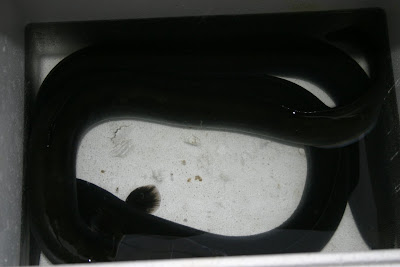
The eels await their fate in their little polystyrene prison


I have gone off on a tangent. Larousse Gastronomique gives you these instructions on how to prepare an eel. It sounded all so easy:

To kill an eel, simply seize it with a cloth and simply bang its head violently against a hard surface. To skin it, simply put a noose around the base and hang it up. Simply slit the skin in a circle just beneath the noose. Simply pull away a small portion of the skin, turn it back, take hold of it with a cloth and simply pull it down hard.

I added the “simply”s. Well it didn’t quite go like the description in Larousse. So here’s what we ended up doing:

First up, you need to have a couple of rums to help prepare you. That’s what Paul and I did and I think it helped. We fannied around a bit before Charlotte walked in from work, grabbed one in a cloth and gave it several massive thwacks again the wall. Job a good one? No. It was still alive! She gave it another couple and it went limp. This was not like killing a trout with a short, sharp crack on a stone. We felt quite distressed about the several hits that we had to give it to kill it – we didn’t want to cause any unnecessary suffering. So the new plan was to hit it once to knock the others out or slow them down, and then chop the heads off with a meat-cleaver. I know this might sound extreme but, it seemed like the best thing – plus I remember it being the method I remember seeing some chef doing on telly once. We did it, and guess what? They were still moving about! I took the two now headless eels to the, plus Charlotte’s to the skin to rinse, and revived Charlotte’s. Off with its head.

Before you get angry about any mistreatment here – it turns out that they were all dead quite early on. We worked this out because all three eel bodies were still seemingly happily snaking around in the sink a good 45 minutes post-beheading. It seems that much of their behaviour is down to instinct and their autonomic nervous system. Though I've no idea how this happens and why it's so different to other fishes. Below is the rather gruesome video of the headless eels I took when they were in the sink. I mentioned the whole episode to Matthew Cobb (who I work with at Manchester University) who said he'll put a link to this post on his z-letter. (FYI: The z-letter is weekly newsletter about all things zoological.) Hopefully I shall find out why they just don't conk out. Be warned before clicking on the video if you are squeamish, remember too though that they are dead. Also, I apologise for my rather camp commentary. Let me know if you can tell me anything about eels and their habit of moving and swimming long after death.


The next stage of preparation is to skin them. In our panic, thinking we hadn’t killed eels when we had, we cut off the heads so couldn’t do the noose trick outlined in Larousse. Instead, we tried to make slit down the base and peel the skin away some other way. Anthea had arrived by this point, to find us sweating, giggling and holding bloody carving knives, and she suggested using some salt as it would give grip against their very slimy skins. At first all this seemed to do was kick-start the wriggle reflex again, but eventually – with Anthea restraining the wriggling eel with yet more cloths – I managed to get a purchase on the eel and pull the skin off in one piece. Just two more to go.

The hard work was done, just the gutting to do. At last I was on familiar territory. I’ve gutted fish several times before. To do this, make a cut from its anus – you’ll see it, about halfway down – to the neck end and pull away any innards away from the rib cage. Give it a rinse and you are done.

Well I have to say it was a pretty distressing episode, it wasn’t as bad as we thought at the time. I now know that eels carry on a-moving quite a while after death. So, to sum up:

1. Holding a cloth, hit your eel several times very hard against a wall.
2. Whilst the eel is limp, quickly cut off its head with a cleaver or very sharp knife.
3. Using salt as an abrasive, pull the skin back – persevere here – until you have a good inch of skin eked away, then pull off like a big macabre witch stocking.
4. Gut and wash the eel.

It sounds so easy put into four sentences.

Monday, October 12, 2009

First, Catch Your Eels...

There are four eel recipes in English Food: fried eel, jellied eel, eel stew and eel pie. If I’ve any chance of cooking all the recipes in English Food, I realised that I really need to start sourcing the more unusual ingredients. I also needed to source people prepared to eat them. Eels were once very popular, particularly in South-Western England and London. They aren’t so much these days for two reasons – people are scared of eels, and the baby eel (elver) population has crashed, causing some concerns of the future of the European eel. I‘ve discussed the elver issue in an earlier post. The adult population has gone down as a knock-on effect, but not to dangerous levels. It is a shame that people don't want to eat them as they are tasty, but it is probably a good thing for their population. There's is nothing wrong with fishing for then in small numbers however.

Before preparing and cooking your eel, you have to get hold of some from somewhere, no mean feat, not for you, but for the poor fishmonger you talk into getting them for you.


The European Eel

Whilst shopping in Manchester, I popped into the Arndale Market to see if there was anything interesting on the off chance. There wasn’t, but I thought I’d enquire about eels. He said there’d be no problems, he just needed a bit of notice, so off I went and organised a dinner party and invited people round. When I rang up, the guy who answered said “sorry mate, but I’ve not seen eels for years, there’s no chance”. Oh dear. It seems that eel would be off the menu completely.

I didn’t give in, and as soon as I got to work, I rang the one place that I knew would find out for sure if eels are still available: Out of the Blue in Chorlton. Out of the Blue is a great fishmonger, and has won many an award. I used to use them all the time when I lived there. After a bit of detective work from their end, I got a phone call back a few days later and as if by magic, Dave Yarwood, the owner said he’s managed to get hold of some for me and they’d be ready by the Friday. Also – something I didn’t realise, you get them live. I knew the fishmonger would probably get them live, but I didn't know I'd have to do away with them myself.

Feeling rather nervous throughout the week, it was finally Friday and off I went to Chorlton full of trepidation. In the shop, Dave asked me to come behind the counter where there they were – three freshwater eels swimming around in a big water-filled box. I remained as calm outside; inside, I was bricking it. What the hell!? I’m going to have to do away with three eels. I’ve never killed anything in my life, houseflies aside. I’d like to point out that Dave Yarwood is a total star for this – the amount of effort he put into getting hold of these eels for outweighed the effort I put in prepping or cooking them. He had to drive all the way to Sandbach at some god-awful time in the morning only to get there to find no one around. He did find a note on the door saying the eels were in a bag in the stream round the back!


Out of the Blue, Chorlton

I got a taxi back home and put the box of eels in the backyard. I started to prep all the other food for the dinner party, looking outside every two minutes at the box. Time was getting on and I knew I had to do the deed soon. Luckily for me Paul was coming round to give me a hand… Though what was about to happen next was pretty distressing for me and the eels both! See here

Sunday, October 11, 2009

A Dinner Party

I had a dinner party at the weekend and invited some folks from work. It’s good to cook for people, though for this one, the guests really went above and beyond the call of duty when it comes to helping me out in the kitchen, as people often do. The reason for this is that the main course was freshwater eel, though why this meant that folks went above and beyond the call of duty is a story for a separate posting. I’ll just say for now that you get them live. People are very squeamish about eel, in fact the English are pretty squeamish about fish in general these days, but Alex, Paul, Anthea and Simone all said they were up for it. Here’s them menu I came up with:

Entrée: #195 Canapés à la Crème
Starter: #196 Mange Tout Salad with Chicken Liver and Bacon
Main: #197 Sedgemoor Eel Stew
Dessert: #198 Compote of Bonchrétien Pears

Everything on the menu is either quick to make, or could have been made ahead, so that I wasn’t stood in the kitchen throughout. The really difficult thing was finding four courses that didn’t all contain cream and bread. As always with this project, I’m always a little worried about the recipe just being plain shite. I didn’t have to worry. There’s nothing else to say here really, I just wanted to add this entry with all the courses so that the next few postings make some sense…

Thursday, October 8, 2009

#194 Almond Soup (White Soup)

Yes, another soup...

This recipe is the very first one that appears in English Food. Although it may seem rather odd nowadays, it is one of the most historical recipes there is. Almond soup, or almond milk as it was originally called goes right back to the Middle Ages. It was made with almonds, onions, wine and spices. More recently, it diverged into two completely separate dishes: almond soup and blancmange.

Griggers reckons that one of the reasons (apart from it tasting good) that it’s remained popular is because the ingredients are easy to come by; most being found about the house. Well, it is popular no longer – I’d heard of it, but only vaguely. Not all the ingredients are easy to come by these days either – the main reason I’ve only got round to making this now is that I managed to finally get hold of the veal knuckle required for the stock.

I always really enjoy making these sorts of recipes in the book – I don’t even mind if they’re not that nice – it’s just interesting cooking and tasting these old, old recipes. I’ve said it before, but it is great that such books like English Food exist, it’s also great to see that many of these unfashionably historical recipes are tasty and interesting. Does this one fit into that category though..?

To make the soup, you need to start the day before and get on with the task of stock-making. Start off by placing a small gammon hock (I made one myself in the brine tub!) and a good meaty veal knuckle that has been cut into three pieces in a large pan or stockpot. Add four pints of cold water and slowly bring to the boil; the slower you do this, the clearer the stock will be. When it does come to the boil, skim away any scum and add a quartered onion, a quartered carrot, four chopped celery sticks, a teaspoon of lightly-crushed peppercorns, two blades of mace, a bay leaf and a tablespoon – no, I didn’t misread the book, tablespoon – of salt. Bring back to the boil and then turn the heat right down so that the stock simmers gently away for four hours. Strain and chill overnight and skim the fat off the top. Bring back to the boil and reduce the stock until there is around 2 ½ pints remaining. Alternatively, if you simply cannot be arsed with all of that, use a light beef stock!

For the soup, place 2 ounces of blanched almonds and an ounce of white bread (crusts removed) into a blender along with a couple of ladlefuls of stock and liquidise the lot. Push the gloop through a sieve into the reduced stock. Turn the heat off under the pan. Next, beat an egg yolk into ¼ each of double cream and soured cream and whisk it into the soup, reheat, making sure the stock is not boiling, to prevent the egg from cooking and curdling. Now season with white pepper, salt (!), Cayenne pepper and lemon juice. Serve with fried croutons or fried almonds.

#194 Almond Soup (White Soup). Certainly not one for those on a low salt or low fat diet. It was very salty and rich. I assume that the tablespoon of salt listed in the ingredients is a typo since a ham hock is also used for the stock. I’m not convinced that I actually liked this soup, it was certainly nicer the next day when the flavours had time to develop. It’s certainly a posh soup, but I think it could’ve been improved by using a less salty stock. Perhaps after all this time-biding, it would have been better if I’d simply used a light beef stock as suggested in the recipe. 4.5/10.

Saturday, October 3, 2009

#193 Kidney Soup

Kidney Soup was apparently a kitchen standby in households of times past – particularly in Scotland. Indeed, this recipe is taken from Florence B. Jack’s book Cookery for Every Household. Ms Jack was the principal of the Edinburgh School of Domestic Arts, and very austere she was too.

Now I know it sounds weird, but this is a classic recipe that is also cheap – cheap because it’s main ingredient is kidney, of course. We are being told that offal and the cheaper cuts of meats are suddenly becoming popular due to the recession, but I have not seen any evidence of really from the people that I speak to (though I have in butcher's shop windows). When saying I’ve been doing this recipe, there has been nothing but pulled faces and dry retching (the only exception being Anthea – frequent blog commenter – she ate it often as a child). I must admit, however, that as much as I love kidneys, I wasn’t quite sure about eating them in soup. However, this book is full of surprises.

To start with you need a whole ox kidney; cut away any fat and gristly bits and cut up the kidney into small pieces. Brown it in an ounce and a half of butter or dripping in a large saucepan along with a sliced onion. Pour over four pints of beef stock and stir, adding some salt. Bring the stock to a boil and skim any scum that rises to the top. Add a bouquet garni and some spices: 20 peppercorns, a blade of mace and a quarter teaspoon of celery seeds. Tie the bouquet and spices in a piece of muslin first. Simmer for 3 to 4 hours, covered on the hob or in the oven.

When ready, skim any fat from the surface and strain the soup. As with most soups and stews its best let it cool down completely – overnight is best – so that you be sure of getting rid of all the fat. Pick out the bits of kidney and give them a rinse. Heat up the soup again and add an ounce of flour that has first been slaked in a tablespoon of mushroom ketchup. (The recipe doesn’t actually say what kind of ketchup, but with this being beef, mushroom or tomato are the best to use.) let the soup thicken slightly and add the kidney pieces. Finally season with more salt and pepper if required, plus some lemon or orange juice and a dash of sherry to add complexity of the flavour.

FYI: the kidneys were thought to be the part of the body concerned with conscience and reflection. Apparently, God would inspect the kidneys to see how good someone had been. In fact, one kidney was responsible for good thoughts, the other evil. The Latin word renes, is used to describe anything of the kidney (e.g. renal), but also is the root word for reins too. So there you go; a choice nugget of factoid for you there.


#193 Kidney Soup. This was a really delicious soup! I loved it the slightly spiced beef consommé was light and tasty and complimented the strong metallic gamey taste of the kidneys. It requires a bit for forethought to make it, but it is worth it I reckon. Cheap, tasty and good for you. 6.5/10.

Thursday, October 1, 2009

#192 Elizabeth David's Prawn Paste

In days of yore, we English loved potted meats and fish. You don’t seem to see many potted foodstuffs around these days: though potted beef is still popular in Yorkshire. Pate does not count. This one at first sight seems a bit weird, and perhaps foul, but there are some interesting ingredients in there. One of the great things that Elizabeth David did in the sixties and seventies was introducing us to Mediterranean flavours, and she managed to sneak a few in here: olive oil instead of butter, basil instead of parsley, lime rather than lemon. She transformed our eating habits; along with Grigson, Floyd, et al. of course. It may seem odd these days – all those continental ingredients mashed up in a now-defunct method of preparing meat and fish – but there you go.

Place eight ounces of cooked, peeled prawns in a blender along with the juice of a lime and around six tablespoons of olive oil – use extra virgin if you have it since as it’s not going to be cooked. Blend until smooth and add half a teaspoon of dried basil and a heaped saltspoon (!) of crushed coriander seeds. Season with a little salt and some Cayenne pepper. Divide between some small ramekins, cover and refrigerate. Serve with hot, thin toast.

By the way, I don’t know the capacity of a saltspoon as I don’t own one, so don’t ask me. Actually, I’d not even heard of one. I guessed and added a quarter of a teaspoon. Also, don’t buy dried basil, as it has no flavour; dry your own in a cool oven for about 20 minutes until crumbly: much better.


#192 Elizabeth David’s Prawn Paste. It may have sounded like horrible soggy fish pap, but this was delicious. The prawns were sweet, the olive oil was fruity and the basil and coriander seeds combined with the lime juice provided a morish tang. Really good – go and make some. 7.5/10.

October Food

Here we are in Autumn proper, and although there’s still a decent ‘in season’ list, many of the really summery fruit and veg have started to dwindle. However, there is a plus – the fish and game is on the increase, and I really intend to get through a fair few recipes that involve them. I really wanted to cook eel last month and didn’t get a chance, so that is top of the list. I’m off to a farmers Market in a week or two as well – hopefully I’ll bag me a grouse!

Vegetables: beetroot, borlotti beans, broccoli, cabbages, cardoons, carrots, cauliflower, celeriac, celery, chard, courgettes, cucumber, fennel, kale, kohlrabi, leeks, onions, peppers and chillies, potatoes, pumpkins and squashes, rocket, salsify, spinach, tomatoes, turnips.

Fruit: apples, grapes, greengages, medlars, pears, quince, raspberries.

Wild greens and herbs: nettles, watercress.

Wild flowers and fruits: bullace, crab apples, damsons, juniper berries, rosehips, rowan berries, sloes

Fungi and nuts: chanterelles, chestnuts, hedgehog fungus, horse mushrooms, oyster mushrooms, parasol mushrooms, puffballs, shaggy inkcap, summer truffles, walnuts, blewits.

Fish and shellfish: cod, crab, eels, lobster, mussels, oyster, mackerel, mussels, oysters, prawns, salmon, scallops, sea bass, sprats, squid, trout.

Game: goose, grey squirrel, grouse, hare, mallard, partridge, rabbit, woodpigeon.

Wednesday, September 30, 2009

#191 Lamb with Plums

It was Butters’ birthday the other week, so naturally I did a bit cooking. He requested lamb as that is his favourite meat. This one is an interesting one – a leg of lamb pot roasted with wine and plums. Butters was a bit disappointed that it wasn’t a roast, you just can’t please some people, can you? I wanted to do this one because it used plums and they are in season and are nice and cheap to boot. I’m quite a fan of the English habit of eating rich meat with fruit; we have gotten out of this habit recently though. Another important thing: it’s also nice and easy.

Start off by browning a leg of lamb all over in butter. If it is very fatty, it would be a good idea to trim any excess off – it’ll prevent the dish becoming too greasy. Place the joint in a large ovenproof casserole and add two glasses of red wine, ten plums (leave them whole), a medium chopped onion, a chopped clove of garlic and a quarter teaspoon each of ground cinnamon and allspice (or nutmeg). Cover with the lid and place in an oven preheat to 200⁰C for around two hours. Remove the lamb, and keep it warm. Skim any fat from the juices in the casserole and pass it through a sieve to make a smooth sauce. Reheat it and add sugar – one or two teaspoons should do, you don’t want it too sweet, plus some extra spices if you like. Pour some sauce over the lamb, and serve the remainder in a jug or gravy boat. Griggers is strict with the accompaniments: “Potatoes are the only vegetable to serve with lamb cooked in this way.” That’s us told.


#191 Lamb with Plums. This was a really delicious, simple recipe. The lamb turned out to be very succulent and the tart, spicy plum sauce was really delicious. I’m not about just having spuds with it though, I like a bit of green with my tea. 8/10.

Tuesday, September 29, 2009

#190 Finnan Haddock

A bit of a cop out this one as it it’s not really a recipe, though it is listed as one in the book. It’s actually more a bit of advice on good eating. There’s many like this in the book. Here, Griggers discusses the dos and don’ts of buying Finnan haddock, which is smoked haddock. We call it Finny haddock in Yorkshire. Findon, or Finnan is a small coastal village near Aberdeen in Scotland. It is there where the proper stuff is made. Griggers warns us of buying those ‘golden fillets’ that are that weird shiny orange colour like cheap sweaty spray-on tan, which I suppose it is but with added smoke flavour. Splarf. My mum used to buy them and they are vastly inferior to the proper stuff. There have been a few recipes so far in the book that has used Finnan haddock, and I think that I have mentioned all this before. However, if you want the really good shit, it is Arbroath that you need to travel to. There, Arbroath smokies are made. As I was in the fishmongers buying some prawns (see a later entry for what I wanted those for) there some were, just lying there. So I bought one, as you have to be opportunistic in this game.

So the recipe? “Heat briefly under the grill or in the oven, and eaten with plenty of butter and bread, or used for kedgeree.” So a brief grilling it was for my little smokie.


#190 Finnan Haddock. If you ever see those little Arbroath smokies in the fishmongers you have to buy some. The flesh was so succulent and sweet due to its protection by the now leathery skin, and the smoke flavour was nothing like anything I’ve tasted before: it was as though it had only just been taken out of the smokehouse and slipped onto my plate. The smoke flavour was sweet and acrid, not unlike a good cigar. Excellent. 8/10. If I catch any of you buying a golden fillet, I will come over personally and poke you in the eye with it.

Tuesday, September 22, 2009

#189 Mussel and Leek Rolypoly

“People sometimes shudder at the mention of roly-poly puddings” says the Grigson; er, no dear, just the idea of THIS one! Why on Earth is there no jam roly-poly pudding, please!? I’ve been putting off the more weird ones – like this – but they are building up now. I wasn’t looking forward to it, but Griggers really does big this one up. It is cheap though, at least when mussels are in season.

I have only recently been able to pluck up the courage to eat mussels; I’ve always been a bit squeamish with bivalves for some reason. However, I do love mussels now. The Romans loved them too, and they’ve been cultured in France since the late thirteenth century, ever since a shipwrecked Irishman called Patrick Walton was washed up on a French beach and noticed some mussels growing on the fishermen’s nets. I doubt he wrapped them in suet pasty though.

To begin you need to cook your mussels – 48 in all, says Grigson. Scrub them and remove their beards and any parasites. Place them in a hot, wide shallow pan and cover. As soon as the mussels open, take them off the heat. Don’t use any mussels that have not opened. Shell them, reserving any juices, and let them cool. Pass the juices through some muslin into a small pan.

Now make the rest of the stuffing: In a bowl, mix together 3 ounces of finely chopped onion, 2 trimmed and finely chopped leeks, 2 chopped rashers of streaky bacon, 3 tablespoons of chopped parsley and a little salt plus plenty of ground black pepper.

Suet pastry is the easiest pastry to make. Sieve 10 ounces of self-raising flour in a large bowl and mix in a pinch of salt and 5 ounces of shredded suet. Using a knife or your hands, mix in some cold water until a firm and light dough is formed.

You are now ready to construct the rolypoly pudding. Roll the dough into a rectangle and sprinkle over the leek mixture leaving a centimetre border around three sides, and then evenly sprinkle over the mussels. Brush the edges with water and roll up the pastry starting at the borderless end, lastly press down the sides to prevent any leakage from the sides. Wrap it in a tightly-sealed but baggy foil parcel and steam for two hours on a rack in a self-basting roaster. If you don’t have one – use a normal roaster and make a foil lid as I did. When ready, place in an ovenproof serving dish and crisp it up in the oven for 10 to 15 minutes - careful now, it might collapse (see pic!). Whilst that is happening, make the butter sauce. Boil down the reserved mussel liquor, take it off the heat, and whisk in 4 ounces of chilled, cubed butter, bit by bit. Season well, add some chopped parsley, and it is ready.


#189 Mussel and Leek Rolypoly 4.5/10. I though I liked this in the end, but then I wasn’t sure; it certainly wasn’t awful. I even had seconds. The mussels were soft and sweet, the leeks were cooked nicely and the pastry was crisp. The sauce was good too. I think it was too rich, and I ate too much. An unusual one, but I’m not sure I would recommend it.

Thursday, September 17, 2009

#188 Ragout of Lamb

Another bargain from Orton Farmers’ market – a nice leg of lamb for a tenner. I love lamb, I do. Griggers actually half-inched this one from a chap called Michael Smith. I don’t know who he is. Anyway, I wanted to do this one because I got to use to use up a massive punnet of tomatoes that I also got from the market. This recipe is not worth making with those crappy old chlorosed supermarket thingies. Get some proper ones; if you grow them yourself, alls the better. It’s a nice recipe this one, a nice summery stew.

You need 2 pounds of leg of lamb that has been cubed for this recipe. If you get the butcher to bone it, don’t forget to ask for the bone – you’ve paid for it, make some stock out of it! Shake the cubed meat in a bag along with two tablespoons of well-seasoned flour. Brown them in a pan with a couple of tablespoons of vegetable oil. Place the browned lamb in a casserole and then brown 2 diced carrots and half a head of celery that has also been diced in the pan. When done add those to the casserole. If you have a casserole that can go straight onto the hob, then you can do it all in one. Now add ½ teaspoon of Cayenne pepper, 2 crushed garlic cloves, a sprig of rosemary and the grated rind of a lemon to the meat and vegetables and pour over 1 ¼ pints of chicken stock. Bake in the oven for 1 ½ hours at 190⁰C.

At the mid-way point, you need to add around 18 caramelised spring or pickling onions. To make them prepare the onions: leave about 2 or 3 inches of green stalk on the spring onions. If it’s pickling onions, you are using, just peel them. Melt ½ an ounce of butter in a pan and add the onions, plus 1 ½ teaspoons of sugar. Cook until caramelised, making sure they all get coated and browned evenly.


The final stage of this recipe is to cook the tomatoes lightly – they are used as a topping: peel the tomatoes, halve them, scoop out the seeds and dice them up. Melt ½ an ounce of butter in a saucepan and cook the tomatoes lightly. Take the ragout out of the oven, skim it of fat, check for seasoning, place it in a bowl and place the tomatoes on top. Scatter with chopped basil. Serve with a baked potato.

#188 Ragout of Lamb. A really nice stew this one; the meat was beautifully tender and the chicken stock, tomatoes and basil really lifted and made it light and summery – it’s a shame we have no actual summer to speak of. The onions collapse into sweet, sweet mush too. Great stuff - 7.5/10.

Tuesday, September 15, 2009

#187 Soyer's Clear Vegetable Soup

I am still trying to count the pennies at the minute and this recipe was designed to be cheap to make as it is from Alexis Soyer’s book Shilling Cookery for the People (1845). I’ve mentioned Soyer before in the blog – he was a French chef who wanted to help the people and the book was one way. He was also a pioneer – he helped develop cooking on gas and ovens with adjustable temperatures. Anyway, I did baulk at this recipe: shilling cookery with veal in it!? However, I was wrong; I managed to get hold of a veal knuckle to make the soup for just 25 pence from the Orton Farmers' Market. Bargain. You may have some reservations about eating veal, but these days you really don’t need to – I’ll discuss that in a later entry though.


I love how the book has two vegetable soup recipes and neither even entertain being vegetarian! Brilliant. We love Griggers!

To make this soup you need to begin by making a veal stock: You need to get hold of 2 pounds of veal knuckle – it seems that they are quite easy to get hold of as long as your butcher sells veal in the first place. Ask the butcher to chop it into small pieces – I couldn’t as I was at the market and had to do it myself which was a nightmare to do. Place the knuckle pieces in a large pan along with 2 ounces of butter; 2 ounces of chopped, lean unsmoked bacon; 3 teaspoons of salt; ½ teaspoon of ground black pepper; 6 ounces of sliced onion; and ¼ pint of water. Bring the water to a boil and stir the ingredients for around 10 minutes. An opaque whitish stock is created. Now add a further 4 ½ pints of water and bring to a boil, then skim, then simmer for 45 minutes. Strain the stock when cooked. You can do all this in advance, of course.

For the soup itself you need to dice some vegetables: around 8 ounces of turnip, Jerusalem artichokes or carrot, or a mixture; plus 3 ounces of mixed onion, leek and celery. Melt 2 ounces of butter or dripping in a pan and add the diced vegetables along with 2 teaspoons of sugar. Stir them until they caramelise and, when ready, add 3 pints of the stock. Simmer until the vegetables are tender. Lastly, stir through 2 tablespoons of chopped parsley or chives, or both. Serve with brown bread and butter.


#187 Soyer’s Clear Vegetable Soup. This was an unusual soup; I can’t decide if I liked it or not. I was a very thin soup that wasn’t hearty at all, so it didn’t fill any gap in my stomach! It was saved by the sweet vegetables and their caramelised coating that darkened the soup and made look quite attractive. Not sure if I’d make it again though - 5/10.

Wednesday, September 9, 2009

#186 Cheese and Oat Biscuits

To go with the vegetable soup I made yesterday, Old Griggers recommends these cheese and oat biscuits to help pad it out into a main meal. Indeed, they go well with most soups, she says. She also says that they are good piled high with cream cheese, finely chopped onion and Cayenne pepper. I’ve never made my own savoury biscuits, so I was interested in seeing how these turned out. They are also cheap to make; a prerequisite these days.


Mix together 3 ounces of rolled oats with 5 ounces of plain flour and rub in 3 ½ ounces of salted butter. Next stir in 4 ounces of grated cheese – a mixture of grated strong Cheddar and Parmesan (I did a ratio of about 3:1) and form it into a dough with two egg yolks. Use a little cold water to bring it together if need be. Season the dough well with salt and pepper. Now roll out thinly and cut our rounds with a scone cutter, place them on a greased baking tray and bake at 200⁰C for around 10 minutes until golden. Cool on a wire rack.

#186 Cheese and Oat Biscuits. I was really impressed by these. So impressed, in fact, that I managed to scoff them all over the course of the evening. Both the use of strong cheeses and a good seasoning is very important, and that is what makes them so much better than any cheese biscuit you could buy. The fact that they’re a piece of piss to make is an added bonus! 8/10.

Tuesday, September 8, 2009

#185 Vegetable Soup

In case you didn’t know, ‘Thrifty’ is my middle name. Well ‘Skint’ is, at any rate and I’m ploughing through the cheaper of the recipes. This is not necessarily a difficult, but they also have to be healthy too as I’ve developed a bit of a man gut and my moobs are beginning to bud. This is not good.

Obviously the soups are a good target and this vegetable soup seems perfect. I have my own recipe for vegetable soup that I’ve put on the blog before and I think it’s pretty good, she has some interesting additions such as dill and allspice berries. Let’s see if Griggers does a better one…

An important point that Griggers makes is that you don’ have to stick to any particular strict rules with this kind of soup – any vegetables will do I think. Also, this recipe for vegetable soup is not vegetarian, but it could easily be adapted by omitting the meat and using vegetable stock.

Begin by simmering a pound of sliced cabbage in 2 ½ pints of water or light stock along with 12 lightly crushed peppercorns, 6 crushed allspice berries and ½ pound of salt pork, smoked bacon joint or ham hock for 30 minutes. I would use just water if your using a hock with bone, stock otherwise. Now add 2 coarsely chopped carrots, 4 potatoes that have been peeled and cubed, 2 sliced leeks (or one leek and one onion) and a few lovage leaves (these are optional). Simmer for a further 30 minutes. Remove the meat and use it for another meal, or, as I did, chop it up and return it to the soup at the end. The soup needs to be blended now – don’t go mad with it, either pulse and partially liquidise it, or use a mouli-legumes. Found that one of those hand blenders is the best thing for this job. Finally, add one to two tablespoons of grated Parmesan, some dill (optional), cream (also optional) and season with salt, pepper and sugar. Griggers suggests eating the soup with fingers of cheese on toast or cheese and oat biscuits. I went with the latter (cheap and easy to make!).


#185 Vegetable Soup. I can’t believe I’ve not made this recipe yet! Well I have to say it beats my vegetable soup hands down. The soup is very hearty and the addition of the salty piquant cheese and the lemon-fresh dillweed really transform it into a pretty macho vegetable soup. 8/10.