Showing posts with label fruit. Show all posts

Friday, January 25, 2019

#436 Worcestershire Pear Soufflé

I like to eat as seasonally and as locally as possible, especially when it comes to fresh fruit. However, this is impossible in the middle of winter when all there is to eat are the ubiquitous apples and pears, so I cast my net a little further this time of year.
However, it is easy to forget what a delicious and versatile fruit the pear can be; especially when aromatic and very ripe, its optimum state according to the late, great broadcaster Terry Wogan who said it had to be so ripe and messy that the only way to eat one was hovering over the sink completely naked.
A ripe pear is a gastronomic delight. And one rarely experienced by those who buy their fruit in packets at the supermarket, following the ‘best before’ dates to the letter. If you have a large, ripe pear, leave it in the fruit bowl as long as you dare, you won’t be disappointed. If you need to feed several people, use it to make a soufflé like this one.
The peariness can be enhanced – should you like – with some pear brandy. This can come in the form of a calvados that uses perry (pear cider) in its manufacture, or the liqueur Poire William. These can be tricky to get hold of, so you could go with the cherry liqueur, Kirsch.
By the way, this is the last of two sweet soufflés from the book (the other being #293 Mrs Beeton’s Chocolate Soufflé), and the last of the entire book (there are several soufflé recipes in the book). Not only that, it the last of the recipes in the behemoth that is the Puddings chapter of the book!
First of all, preheat your oven to 200°C, and prepare your soufflé dish: Take two macarons and crush them. A good macaron should be squidgy in the middle, so I found this task much easier by freezing them and blitzing them in my food processor. Next, butter the dish well – you’ll need one around 2 ½ pints (1.5 litres) capacity for this recipe. Sprinkle the macaron dust all around the inside of the buttered dish, saving the remaining crumbs for later (see below).


Take a large, ripe pear and peel, core and quarter it. Take a fork and give it a mashing, or if feeling lazy, use a food processor or hand blender. My pear was so ripe that it started to brown almost immediately, stymie this by quickly adding the juice of half a lemon along with a tablespoon of the pear brandy (or Poire William, or Kirsch).
Place 4 ounces of butter in a mixing bowl and let it melt slowly over a pan of just simmering water. As you wait, measure out 4 ounces of vanilla sugar (posts #36 Vanilla Sugar and #266 Concentrated Vanilla Sugar show you how) and 1 ounce of cornflour. When the butter has melted, sift these into it and beat in well with a whisk.
Separate four eggs, take the bowl off the heat and beat the yolks in one-by-one, then add the pear mixture. Whisk the whites to the stiff peak stage (when you can turn the bowl upside down and the whites stay firmly put). Add a large tablespoon of the whites to the mixture and mix in well, don’t worry about losing any air at this stage, adding a little egg white now means that the rest will be ‘accepted’ by the mixture more readily.


Tip in the rest of the egg white, fold it into the pear mixture with a metal spoon. I found that the mixture was too runny to mix the whole lot together well – I presume I didn’t let the cornflour thicken enough. Pour the mixture into the soufflé dish, sprinkle with the remaining macron crumbs and put in the oven. 
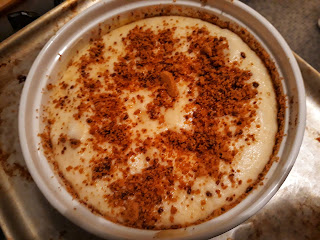


After 3 minutes, turn down the heat to 190°C and cook for another 27 minutes (i.e. half an hour in all).
Serve immediately!


#436 Worcestershire Pear Soufflé. I’m not sure what to make of this recipe – it tasted delicious, the overripe pear, alcohol and hint of vanilla made for quite a heady aromatic hit, but the texture was a little wrong; the mixture essentially sank to the bottom, not getting incorporated properly, and remained very liquid. I know that a good soufflé should be light at the top and saucy in the centre, but here the contrast was a bit too much. I think that Jane’s instructions were not clear enough regarding the base mixture – perhaps the butter-sugar-cornflour mixture should have been cooked until very thick before adding the rest of the ingredients. I think that this is worth trying again to get right as it should have been an excellent pud. In conclusion, flavour excellent, but recipe perhaps too vague: 7/10

Friday, April 13, 2018

#430 Granny Milton's Pears in Brandy


Here is recipe that uses up a glut of hard ‘windfall’ pears, should you have a tree, or know of one nearby. When I first read through this recipe – quite a few years ago now – I made a note to go to Chorlton Meadows, a lovely green area in Manchester that has a relatively unsullied Mersey River snaking through it. When I first started the blog, I had moved from Chorlton and had got to know it quite well, and I knew there was an area called Hardy’s Farm in the meadows, and part of the farm had been orchard full of apple and pear trees as well as gooseberry bushes.

Every year, in late summer, I made sure I visited the site of the farm and EVERY YEAR there were no tasty pears on the pear trees; they were either totally non-existent or shrivelled brown mush. To this day, I have never seen the pears there come to, as it were, fruition.

Not to be beaten, I made sure I planted a nice pear tree on my little allotment. The first year saw dozens of lovely white flowers, some of which I removed as I didn’t want to put the small tree under too much strain when it came to fruit production. It wasn’t too long before the flower petals were shed, and little pears started to grow. Eventually they reached a good size and had blushed with a delicious-looking pink colour, so I reckoned they would start falling soon. The next time I turned up to the allotment my beautiful pears had been STOLEN. I was livid.

After that the pear tree never flowered again.

These are the lengths I go to, dear readers, to follow the recipes as closely as possible; I didn’t want to simply buy some unripe pears from a shop. Anyway, I gave up and bought some.

I have no idea who Granny Milton is, but I assume she had an amazing pear tree in her garden. Well good for her.


First of all prepare your pears – be they windfall or otherwise – by peeling, coring and quartering them. You need 6 pounds in all for Granny Milton’s recipe, but it can easily be adjusted if you have a different amount.

Next zest three lemons and mix the zest with the juice of the lemons and weigh out 4 ½ pounds of granulated sugar.

Find a large bowl and layer up the pears, zest and juice, and sugar. Cover with cling film and leave overnight.

Next day, put the pears and extracted juices in a heavy pan along with a 4 1/2-inch stick of cinnamon and 8 cloves. Put on the lid and bake slowly in an oven preheated to 140°C for 6 hours.

When the time is up, take the pears out of the oven and allow to cool down completely before stirring in 6 tablespoons of brandy. Remove the whole spices and spoon the pears with the juices into sterilised jars and seal. I found that a lot of the sugar didn’t dissolve into the pear syrup, forming a half-inch thick layer of sugar that could peeled from the base of the pan!

Leave the pears to mature in their jars in a dark cupboard or pantry for three months before eating them.

#430 Granny Milton’s Pears in Brandy. Jane doesn’t suggest what to serve these pears with. I have so far eaten them with sharp cheeses or Greek yoghurt. The pear flavour is very much preserved, and the spices really come through, giving good depth of flavour. They turned a beautiful deep translucent orange-brown colour. However, they were extremely sweet, so I’m quite glad that a lot of the sugar didn’t dissolve, I would suggest eating them with tart accompaniments. Not sure they were worth the wait! 5.5/10

Friday, October 7, 2016

#422 Peppered Redcurrant Jelly


This is the last fruit jelly recipe in the book, and I’ve become somewhat of a seasoned jelly maker, making up my own recipes and these days cooking them up at The Buttery to go with meat and cheese platters, roast meats and the like. This is the second of two redcurrant jelly recipes from English Food.

Redcurrant jelly is considered a rather niche preserved, being served with rich meats such as lamb, venison and other game, or as an ingredient in Cumberland Sauce, but it is versatile; I like it with cheese.

Redcurrant jelly is very much the preserve of the gardener – the delicate berries do not transport well and have a short shelf life, which is why they are expensive to buy fresh. On a recent walk around nearby Chorlton Meadows I found dozens of sprays of ruby-red currants growing out of sight beneath a huge mass of thick brambles. Typically in these situations, I brought neither bag nor tub and so I ate them straight from the bush until acid reflux began. It was a shame really, as I could have made a huge amount of jelly. Hey-ho, I’ll remember this secret spot next year.

Our cultivated redcurrants are actually made up of three distinct species, and the less common whitecurrant is simply a variety of redcurrant that has lost the ability to produce the distinctive red pigment. There is also a pinkcurrant.

Country houses and kitchen gardens particularly in the 18th Century, grew vast amounts of red and white currants; their pectin-rich and tart juice used as a base for dozens of other preserves and sauces. I have never made whitecurrant jelly, and I wonder why one doesn’t see it anywhere?

This redcurrant jelly is enriched with red wine and contains cracked black peppercorns, I imagine it would work just as well using whitecurrants and white wine.

This recipe can be easily scaled up or down, depending on how many redcurrants you have, and the great thing about making a jelly is you don’t have to go through the rigmarole of stripping the berries from their stalks as they all get left behind during straining.

Put three pounds of redcurrants in a saucepan. To this, add around 2 ¼ pints of liquid; between 8 and 16 fluid ounces of it should be red wine, the remainder water. Bring to a boil and simmer until the currants are soft and pulpy. Pass through a jelly sieve or bag and allow to drip overnight.

Next day, place the juice in a saucepan or preserving pan with three pounds of granulated sugar. Put over a medium heat and stir with a wooden spoon until the sugar has dissolved. Remove the spoon and turn the heat up so that the fruity syrup boils enthusiastically. At this point put a saucer in the freezer so you can test for a set later.

After 15-20 minutes boiling, test to see if the jelly has set. There are two ways: (1) use a thermometer, pectin gels set at 105C; (2) the wrinkle test where a few drops of jelly on a cold saucer cool and wrinkle when you scrape them with a finger. I usually do both to be on the safe side. If the jelly isn’t set, boil for another 10 minutes and retest.

Finally, roughly grind about a teaspoon of black peppercorns using a pestle and mortar and stir in right at the end of cooking. Allow to sit for 15-20 minutes before potting in hot, sterilised jars.


#422 Peppered Redcurrant Jelly. This is a delicious jelly, spiked with rough spicy peppercorns giving it both interesting flavour and texture. The red wine doesn’t make it too rich, as you might expect it to, so be generous with it. I am going to use it for some future lamb dishes I think, though I did try a little sample with some good cheese, butter and bread. Very good, 8/10.

Monday, September 28, 2015

#414 Oldbury Gooseberry Tarts


The summer fruit season is pretty much done and dusted now, with just autumn raspberries and wild blackberries hanging around, but back in June at the very beginning of the season, I made these little gooseberry ‘tarts’. I’m using ‘inverted commas’ there because they are not tarts, they are pies.
In their simplest form, Oldbury fruit tarts are  hand-raised pies made from a hot-water pastry, filled with fruit and sugar and then baked. The pies, according to two of Jane’s correspondents, had links with Oldbury in Gloucestershire, and would be made by families as soon as soft fruits began to appear. In the latter half of the 19th century (and I’m sure much earlier than that too) the pies were ‘sold at fairs at a penny each’.
Below is the recipe and my review of the tarts, but it’s worth pointing out that sometimes these Oldbury pies would be made just like normal raised pies, but instead for being filled with jellied stock as you would  a pork pie, it is filled with fruit jelly preserve instead. This sounds so delicious and I may have a go at these more complex ones. I like the idea of a slice of fruit pie with jelly and some good cheese (Gloucester, of course) to round off a meal.
The hot water pastry for these pies is different to Jane’s recipe for her savoury (#282) Raised Pies in that there is both lard and butter here but no egg or icing sugar (which give crispness and an appetising brown colour to the cooked pastry). However, the method is essentially the same:
First cube 4 ounces each of butter and lard and pour over them 5 tablespoons of boiling water. Stir around until the fats have melted.  Put a pound of plain flour in a bowl, make a well in the centre and tip in the warm liquid mixture. Using a wooden spoon, and then your hands, form a dough.

At this point, I kneaded the dough until smooth – Jane says it should have ‘a waxy look’ – then popped it back in the bowl, covered it with cling film and left it to rest for a bit until it felt like it could be rolled and moulded successfully.
I found that the dough made six tarts using Jane’s method of thinly rolling out batches into circles and, then using a saucer as a template to cut out perfect shapes. I kept the trimmings for the lids.
Here’s the tricky bit: now mould the edges of each pastry circle to a height of about an inch so that they form cases – or in old English coffyns. This was a bit of a nightmare; you need a good cool stiff dough to do this, and if possible, three hands.


Now you can tumble in your topped and tailed gooseberries (about 8 ounces altogether) and a good amount of Demerara sugar (at least an ounce per tart, I’d say, but use your discretion). Roll out the lids, make a hole in the centre, and glue them in place with a brush and water, making sure you crimp the edges. Now leave the pastry to harden, this is a matter of a couple of hours in the fridge, but if leaving them in a cool larder, it’ll require an overnight wait.


Bake the ‘tarts’ for around 25-30 minutes at 200⁰C. Because of a lack of either egg , icing sugar or glaze, the pastry doesn’t turn a nice golden brown, but if the filling is happily bubbling away within, you can be pretty sure they are ready.


I served them warm with some pouring cream.
#414 Oldbury Gooseberry Tarts. Well these were not really worth the effort as the pastry was pretty disappointing in both taste and texture. Gooseberries in any form are good of course, so I did eat them. I’m looking forward to trying to make a larger pie filled with fruit jelly – that has to be delicious. 4/10.

Thursday, January 15, 2015

#402 Blaeberry or Blackcurrant Pie


Wild blaeberries (from berryworks.com)


The flitterin faces come doun the brae
And the baskets gowd and green;
And nane but a blindie wud speer the day
Whaur a’ the bairns hae been.

The lift is blue, and the hills are blue,
And the lochan in atween;
But nane sae blue as the blaeberry mou’
That needna tell whaur it’s been.


Blaeberry Mou,
William Soutar


Here’s recipe from English Food that I have found extremely difficult to cook; blaeberries and blackcurrants simply don’t crop up in greengrocers. Almost all of the blackcurrants grown in this country are snatched up and turned into Ribena, the leftovers being very expensive, assuming you can track them down. Blaeberries are not commercially grown and therefore you have to rely on happening upon bushes - many bushes; you’ll need between 1 ½ and pounds for this recipe!

But then I came across some huge punnets of them at a greengrocer called Elloits in Chorlton, Manchester. I couldn’t believe my luck so I bought a couple and skipped away clutching my precious bounty back home.


 So – and I know you are quite likely to be thinking this – what the heck are blaeberries!? They have many aliases: tayberries, bilberries, whortleberries, whimberries, wild blueberries….the list goes on. Blaeberries are very commonly found in the very north of England, Scotland and Ireland. They are quite popular in France – where they are called myrtles – and are generally used to make liqueurs.

 Jane Grigson tells us of a rather disturbing song she used to sing at school as a child where a young mother is left distraught when her baby is stolen by faeries whilst she picks blaeberries:


I went to gather blaeberries, blaeberries, blaeberries,
I went to gather blaeberries, and left my darling baby-O.
I found the track of the swan in the mist,
The swan in the mist, the swan in the mist,
I found the track of the swan in the mist,
But ne’er a trace of my baby-O.


So the blaeberry is steeped in the history of the northern climes of the British Isles, but people are trying to get this wild, rather niche, delicacy cultivated and into our shops. Susan McCallum of the Hutton Institute is asking for people to keep an eye out for blaeberry hotspots so that the most productive plants can be bred. This is because they match the American blueberry for their health benefits, and sales of blueberries are on the increase. Here's the post all about the project.

In this recipe, Jane says we can use blaeberries or blackcurrants in this recipe; I assume because they are both found in Britain, but I think that you should use blueberries as alternative fruit because their flavour is so very close to that of the blaeberry. Jane also uses the Yorkshire trick of spiking the tart with some freshly chopped mint.


Pick over 1 ½ to 2 pounds of fresh blaeberries or blackcurrants, removing leaves and stalks. Weigh out 8 ounces of caster sugar and mix it with a heaped tablespoon of cornflour and a level tablespoon of chopped mint leaves. Layer the fruit and sugar mixture alternately in a pie dish, making sure the fruit is humps up in the centre and cover with some sweet shortcrust pastry. Brush the pie with water or egg white and sprinkle more sugar on top. Bake at 220⁰C for 15 minutes, and then turn the heat down to 190⁰C and bake for a further 20-30 minutes. Serve with cream.


It’s worth mentioning that it can be made as a double crust pie too.


 #402 Blaeberry or Blackcurrant Pie. I decided to make this pie for one of my Pud Clubs, and not only did it go down very well, but won – pitched against six other puds! It was so delicious; a deep jammy and tart filling that was so intensely flavoured it was almost a shock, and the aromatic mint took it to another level. This might be up for the award of best pud in English Food! 10/10

Friday, January 9, 2015

#401 Plum Bread


I made this bread (the penultimate recipe in the Bread part of the Teatime chapter) all the way back last autumn when plums were in season. It has taken me only four months to pull my finger out and tell you about it.

This is a recipe from a book called British Cooking by Theodora Fitzgibbon published all the way back in 1965. I just a quick search of her back catalogue and she has written a huge series of books on British and Irish cookery. (I ordered a load off that evil website that rhymes with Schlamzon, don’t judge me.)

Jane points out that raisins can replace plums out of season. Here’s what to do:

This is an old school recipe and so it starts with an ounce of fresh yeast creamed in 3 tablespoons of warm milk. Leave it to do its stuff for 10 minutes and in the meantime mix together 8 ounces of strong white flour, 2 tablespoons of sugar and the grated zest of a lemon in a bowl.

Make a well in the centre and plop in a large beaten egg, 2 ounces of melted, but tepid, butter and the yeast. Now mix to form the dough. What Jane does not mention is that this dough is so stiff it couldn’t possibly make a decent loaf of bread. Nevertheless, once the dough is (somehow) kneaded to make a smooth dough, place it in an oiled bowl with some clingfilm over it.

Next stone and chop enough plums to make 8 ounces and knead these into the bread. This was quite simply an impossible task, the dough was so stiff that the plums just squashed and made a pulpy mess. This required the food mixer.

“Mix in the plums, this makes the dough sticky”, says Jane. Well the Kitchen Aid made it into a big old sloppy mess, and I was not feeling hopeful.

Pour this mixture into a buttered and lined 9 inch loaf tin and leave it prove until the dough comes to the top of the tin. Bake for an hour at 190⁰C, remove and see if it sounds hollow, if not, pop it back in for another 15 minutes.

#401 Plum Bread. Of all the hundreds of bread recipes in England, why did Jane pick this one? It was so difficult to make and really was not worth the effort. Although the plums were delicious and sweet, the final bread had a strange sour taste. Its texture was very close and cakey. I am wondering if there was a typo or something somewhere in the recipe (I have spotted quite a few in other recipes). Disappointing and took up far too much of my time. 3/10.


Sunday, April 27, 2014

#392 Scallops Stewed with Orange Sauce


This is a recipe that comes from the 18th Century that unusually combines shellfish with orange – in particular the Seville orange and this is the final recipe in the book that uses them. It’s been interesting to see the diverse recipes for these bitter oranges that I used to think were used solely for making marmalade. Now that I appreciate such things, I was looking forward to this one.

If you are not a fan of shellfish, Jane says that white fish such as sole and whiting can be substituted quite easily.

This recipe serves 6 people, but it can be easily scaled up or down.

Although it's not mentioned, use the corals in this recipe too. 
Waste not, want not!

To start, simmer together ¼ pint each of water and dry white wine along with a tablespoon of white wine vinegar, ½ teaspoon of ground mace and 2 cloves in a saucepan for 5 to 10 minutes or so. You have essentially made a very simple court bouillon. Season the water with salt and pepper, and then prepare your scallops. Cut 18 scallops in half lengthways and pop them into the water. The scallops need poached only briefly in just simmering water. I left mine in for 2 minutes only, though I reckon 90 seconds might have been better.

Quickly, fish out your scallops with a slotted spoon and keep them warm and covered. Strain the stock and reduce it to a volume of around 8 fluid ounces. Whilst you wait for that to happen, make a beurre manié by mashing together ½ ounce of softened butter with a tablespoon of flour.

When the stock has reduced, turn down the heat to a simmer and whisk in small knobs of the butter-flour mash to thicken the sauce. Let the sauce simmer without boiling for a few minutes to cook out the flour and then add the juice of a Seville orange (failing that the juice of a regular orange and the juice of half a lemon). Check the sauce for seasoning and add more salt and pepper if needed. If you want a richer, more luxuriant, sauce beat in an egg yolk and 3 tablespoons of cream. For some reason I added some parsley to the dish, though it doesn't say so in the recipe.

Place scallops in a bowl, pour over the sauce and serve straight away. Jane suggests serving the scallops with #176 Samphire or with #382 Laverbread as a Sauce.

#392 Stewed Scallops with Orange Sauce. Intriguing though the recipe was, it didn’t quite live up to my expectations. I didn’t think the flavour of the oranges and scallops married that well, perhaps because the sauce was rather sharp. I think with some tweaks, however, this could be made a lot better or even reimagined as a scallop and orange salad or something like that. Just below mediocre, 4.5/10.

Monday, September 16, 2013

#383 Spiced Redcurrant Jelly


Redcurrant jelly is such an English sundry. Delicious with roast lamb, an essential ingredient in #45 Cumberland Sauce and venison sauce, and a great addition to a ham glaze.

A couple of things are interesting here: first the spice, and second the addition of vinegar. Jane likes adding tart vinegars to here sweet preserves that are used in savoury dishes. It was a revelation when I first came across it, making #367 Hot Red Pepper Jelly, which I was so impressed by I’ve been making it for the market stall.

In the past it has been difficult to get hold of redcurrants in grocers and supermarkets, but this year they seem to have been everywhere. However, I was prompted to make this jelly when I spied a heavily-laden redcurrant bush nestled among a load of 5-foot high weeds in an unruly corner of a vacant plot next to my allotment. How there was so many with all that competition from the weeds I do not know. Naturally, I had forgotten my phone, so I couldn’t photo it. I picked just a fraction of what is asked for in the recipe, but it is very straight-forward to scale down (or up).
Pick over 3 pounds of redcurrants, no need to remove stalks and leaves, and pour into a preserving pan, large saucepan or stockpot along with 1 ½ pints of water, 3 cloves and a teaspoon of ground cinnamon. Turn up the heat and bring to simmering pot and allow it cook until the currants have softened enough to burst open. Strain through a scalded jelly bag and allow it to slowly drip through into a clean bowl overnight.
Next day, pour the strained spiced juice into a clean pan with 3 pounds of granulated sugar and 8 ounces of malt vinegar. Put on a medium heat and stir until the sugar has dissolved, then turn up the heat and allow the jelly to boil for around 10 to 15 minutes before testing for a set. To do this put a few drops on a cold saucer and allow it to cool. Push the jelly with your finger, if it wrinkles, it has set, if not, boil for a further 10 minutes and check again. Alternatively, you can use a jam thermometer – a temperature of 105⁰C is the magic number.
Don't worry about the scum, it's easily got rid of
Let the jelly cool for 10 minutes and remove the scum either with a spoon or by beating in a small knob of butter until the froth dissipates. Pot into sterilised jars.
#383 Spiced Redcurrant Jelly. This is very good indeed. It has a pleasantly sweet and sour tang and is the most beautiful ruby colour; nothing like the bought stuff at all. I used it to accompany some lamb chops one day, and used it to make some lamb gravy on another. The sad thing is that now I have to until next summer to make some more! 8.5/10

Tuesday, July 30, 2013

#380 Gooseberry Sauce for Mackerel


After the rather wet start to the summer, I was beginning to think that this year’s gooseberries were never going to arrive. Then we had that glorious stint of hot weather. Now we have so many gooseberries and other soft fruit, we barely know what to do with them. Well here's one thing, just as mackerel is in season. I like Jane’s introduction to this recipe:
On May 26th, 1796, Parson Woodforde [we have met him in the blog before, see here] and his neice, Nancy, had for their dinner ‘a couple of maccerel boiled and stewed gooseberries and a leg of mutton roasted’. In other years, they were not so lucky; the gooseberries did not always ripen for the arrival of the first spring mackerel.
Ms Grigson’s recipe is a very simple one indeed:
Begin by topping and tailing 8 ounces of gooseberries and then melt an ounce of butter in a pan. Add the gooseberries, cover with a lid and cook until soft. I love how they go from vivid green to an almost straw-yellow when heated.
Use your wooden spoon to crush the berries on the side of the pan to form a rough purée, you could, if you are so inclined, pass them through a sieve to produce a smooth sauce. I don’t see the point in these things normally; it’s not like gooseberry seeds are particularly offensive.
The tart flavour of the gooseberries is cut with either ¼ pint of double cream or béchamel sauce. I went for the latter for health’s and money’s sake. Taste the sauce and add a little sugar, if needed, don’t make it sweet like an apple sauce for pork.
That’s it! Very simple and not just for mackerel either, but other oily fish, roast duck, pork, lamb, veal and – no surprises – goose.
#380 Gooseberry Sauce for Mackerel. A triumph of good, simple cooking. The creaminess of the béchamel did a great job of wrapping its way around those tart gooseberries, so much so that only a pinch of sugar was required. I could eat it all on its no problem! 8.5/10

Wednesday, November 21, 2012

#361 Poor Knight's Pudding with Raspberries


This is the third and final dessert on the theme of the classic pud pain perdu (for all three click this link). The others were recipes from 1420 and 1937, whereas this one is Jane Grigson’s adaptation of her grandmother’s way of using up left-over raspberry jam sandwiches. Here’s what she says on the subject:

Before the last war, when tea was an occasion for enjoyment and not for guilt, we often used to have home-made raspberry jam sandwiches at my grandmother’s house. There were always too many – raspberry jam being her favourite – and next day they would appear as a pudding, having been fried in butter. I always thought, and still do think, that their latter end was more glorious than their debut.

This is also the second and last of the recipes involving raspberries. I do wish Jane had written more as they are my favourite fruit and I had been looking forward to this one for quite a while: raspberries, cream and fried bread. What could there possibly be not to like about that?

This recipe serves four – but it can be increased or decreased as appropriate.

First of all you need to get your raspberries ready: place a pound of the delicious darlings in a bowl and sprinkle them with 4 ounces of icing sugar and ½ a teaspoon of ground cinnamon. Leave them to exude their juices; I left them overnight in the fridge.

Whip up 6 ounces of whipping cream (or half-and-hald single and double cream) and a tablespoon of caster sugar. Next, cut 8 slices of white bread and cut off the crusts if you like and fry them in clarified butter. To make this, Jane suggests melting 6 ounces of butter in a small saucepan before passing it through a sieve into your frying pan. Fry the bread to a golden brown.
 
On a plate, place a slice of fried bread, then some raspberries with their juice, then a second slice of bread and finally a nice, healthy blob of cream.
 
 
#381 Poor Knight’s Pudding with Raspberries. This was absolute heaven! The sweet-tart raspberries where made so delicious with their seasoning of cinnamon. Obviously with all that butter and cream it is not for dieters, but a portion does count as one of your five fruit and veg, so it’s not all bad. A perfect pud: 10/10.

Friday, September 21, 2012

#354 Passion Fruit Curd


Well there goes the Great British Summertime, but don’t worry our Griggers is at hand to give us a little bit of tropical sunshine with this rather unusual fruit curd recipe. She must have been rather ahead her time with this one – I think the first time I ever saw a passion fruit in a greengrocer’s shop it was around 1990. I love fruit curd and am always on the lookout for new recipes – especially for the stall. Jane does suggest giving all sort of fruits a go; raspberries, gooseberries, apricots – knock yourselves out, she says (I paraphrase).

This curd is unusual in that it is made in the same way as custard:

You will need 4 large, 6 medium, or – in my case – 8 small passion fruit. Halve them and scoop out the pulp, seeds and all, into a small saucepan. Stir in 4 ounces of sugar and 4 ounces of slightly salted butter that has been cut into cubes over a low heat. Meanwhile, beat 3 large eggs (or 2 large eggs and 2 egg yolks) well in a bowl. When the sugar has dissolved and the butter melted, turn up the heat until it boils then tip it into eggs , furiously whisking to prevent the egg from curdling. Pour the custardy mixture back into the pan and stir over a low heat until it becomes quite thick. If you want to err on the side of caution use a double boiler or a glass bowl over simmering water. I found you don’t need it for this recipe, though I did use a thermometer so that I could get the curd as thick as possible without it curdling – you want a temperature of 78C (though Jane gives a temperature of 80⁰C, but I always find this too high for curds).

Remove from the heat, but mind you still keep on stirring it – the residual heat of the pan may still curdle it – then pass it through a sieve, making sure you work all of the curd out. Stir in a few of the seeds and add a tablespoon or so of lime juice to sharpen it a little. Pot into sterilised jars, let them cool then seal them. It will fill two 200 ml jars.

#354 Passion Fruit Curd. This was a strange one and no mistake. The flavour of cooked passion fruit is rather different to fresh – it’s weirdly not unlike fresh bread, and it took rather a while to get used to it. I ate it on toast, but I reckon it would have been a fantastic filling to a sponge cake. Also, they coordinated very well with my kitchen decor. 6.5/10.

Wednesday, July 11, 2012

#345 English Apricot Pie


Flowers and Apricots by Joseph Bidlingmeyer, 1850


I have been eyeing this recipe for a good while, but fresh apricots are so pricey I have always put it off. However, Soulard Farmers’ market came to save me from my apricot fast by selling them for just over a dollar a pound! They were delicious too.

The reason apricots are so expensive is manifold: they flower very early and suffer poorly from bad weather – they will die even if there’s a light frost or a high wind; they don’t take to grafting well; they are very particular about the soil they grow in, to the point where the amount of fertiliser dug into the soil needs to be calculated; they also do not travel well. They are delicate things and much prefer Eastern climbes as they originated in China, coming to Europe via India and the Middle East. It is for all these reasons that you usually find apricots dried rather than fresh.


As an aside, the reason the apricot doesn’t take to grafting is because they were mis-classified as a member of the plum family, Prunus, and were grafted onto other Prunus species, cherry is usually the grafters’ favourite. It is actually part of the rose family. Everyday’s a school day.


So what are the benefits of eating this temperamental and pricey fruit, other than that they are quite delicious? Well there is quite a long list of benefits to eating apricots. The 18th century French writer Bernard le Bovier Fontenelle, who was a member of the Royal Society, lived to 100 years old and the secret to his longevity was apricots, a tip he got from his grandma. ‘A royal fruit, she called it, saying that the scatterbrained folk of our days ought to make more use of it.’ Quite.

Fontenelle

As it happens, apricots are high in phosphorus and magnesium and can significantly increase mental ability. They are super-rich in beta-carotene (which gives the fruit its yellow colour); 4 ounces of apricots will give you 50% of your daily allowance. They are also good for the blood – they can even alleviate anaemia better than liver! They are also a significant source of fluoride. Amazing.


This pie was invented by the great chef Carême. He is very particular about the type of pie dish you should use; it must be very shallow, not much deeper than a plate.


Halve 1 ½ pounds of fresh apricots and take out the stones. Next, melt 2 ounces of unsalted butter in a frying pan and stir in 8 ounces of caster sugar; this might seem alot but they really do need it. Over a moderate heat stir the sugar into the butter. After a few minutes it should start to melt. Add the apricots and coat in the butter-sugar mixture. Stir for a minute or two – you don’t want to cook the fruit, just get the apricot halves well covered.
Pile the fruit and butter and sugar, which should be toffee-like at this point, into a shallow pie dish.
Roll out some puff pastry. Cut strips around half and inch a glue them around the edge of the plate with beaten egg so that the strips ‘extend partway down the dish itself. This will create a good seal, preventing the apricots from escaping. Brush the strips with egg and cover.


Use a fork to seal the pastry lid then make a central hole so that any steam generated during cooking can escape. Brush with more egg and sprinkle some more caster sugar. Start the pie off in a hot oven – 230°C (450°F) – for 15 to 20 minutes so that the pastry can turn golden brown, then continue cooking at a lower heat of 160-180°C (325-375°F) for 15 minutes. ‘Serve hot or warm with plenty of cream.’

Sorry about the terrible pic.
I'm normally drunk by dessert...

#345 English Apricot Pie. What a delicious fruit pie! It occurred to me whilst I was eating it that I have never eaten apricots this way. Well it certainly won’t be the last time I do it; the sugar and butter became a deliciously sweet sauce and the cooked apricots softened and turned very tart. That Carême chap knew what he was talking about.