Showing posts with label 7.3 Griddle Cakes and Pancakes. Show all posts

Friday, July 13, 2018

Chapter 7: Teatime - Completed!


When I started this project, baking wasn’t the seemingly national pastime as it is now since the rise of the behemoth that is The Great British Bake Off, but it was something I liked to do and was okay at, but certainly had a very narrow baking repertoire. I certainly never baked bread or biscuits, my cake-making was average, but I did make a passable shortcrust pastry. After baking my way through the recipes in this chapter, my world was opened up to a vast array of sticky, spicy, sweet and sometimes stodgy treats, many of which are now standards in my own cooking.

Baking #429 Cumberland Currant Cake
People are sick of mass-produced cakes and biscuits devoid of real flavours, covered in single-use plastic wrapping. Many of the recipes were quite obscure then and I wouldn’t have bothered with them normally, they seem less so now as people all over the country are looking to tradition in their home baking. That said, some recipes in the book are still obscure and old fashioned: you still don’t see #227 Wigs, #62 Seed Cake, #274 Saffron Cake or #431 Murrumbidgee Cake. All these recipes can be found within the pages of English Food.

#113 Muffins
The Teatime chapter was a whopper; so big  I had to split it into four parts, otherwise it would have felt like a never-ending task as there were 72 recipes!
I split them into:
·       7.1: Bread (15 recipes)
·       7.2: Cakes & Tarts (35 recipes)
·       7.3: Pancakes & Griddle Cakes (13 recipes)
·       7.4: Biscuits (9 recipes)
Click on the hyper-links to see my reviews of the four sections.

The chapter scored an overall mean score of 7.0, which seems pretty average for the book so far. For those who care (and I know none of you do), here’s a little bar chart showing the mean scores for the chapter as a whole and then the separate subchapters. There are even error bars, don’t say I don’t treat you.
One important thing I learnt was that Teatime treats are not always sweet cakes and biscuits, but sandwiches made with a variety of breads, toast, muffins and crumpets.

There are blurred lines between my distinctions too; cakes used to be leavened with yeast before the advent of chemical raising agents so there is a continuum between bread and cake, cake and tart, tart and biscuit, biscuit and cake.

#186 Cheese and Oat Biscuits

But where does our obsession with teatime come from?

Well, tea had been drunk in Britain from around 1660; Charles II enjoyed a cuppa char every now and again, that’s for sure. However, it was extremely expensive and only the richest of folk could afford this exotic Chinese drink. It only really started to catch on when Assam tea plants were discovered to be growing in India in the 1820s. Prior to this, the Chinese had held the whole process of tea growing and drying under a shroud of secrecy. The British could buy their tea much more cheaply – it was also the catalyst for the British occupation of India, but that’s a story for another day. It was still expensive at this point, but the upper and middle-upper classes starting drinking it with gusto.

Anna, 7th Duchess of Bedford
The idea of teatime as we know it originates in the mid-19th century when the 7th Duchess of Bedford started asking for tea and bread and butter to be served to her in her room at 4 o’clock. The reason she did this was to quash her hunger pangs as she waited for dinner at 9 o’clock. Then, the only other meal of the day was breakfast. She started inviting her lady friends to enjoy her, and soon her lady friends began their own teatimes and invite other ladies to attend. The Duchess was very prominent in society and was good friends with Queen Victoria, so when her Royal Highness decided to start taking tea in afternoon too, the country went nuts.
The Queen had elaborate teas, and whatever she was doing, and wherever she might have been, she stopped for tea at around 4 o’clock. It would be very common for an en route queen to stop her carriage and entourage, for a fire to be lit at the roadside, and for her to sup tea and eat the associated treats. She loved travelling and eating but found it much less exciting once her travel occurred mainly by train and there was no need to stop for tea anymore!

Making dough
Ladies had to be seen hosting teatimes and attending teatimes, one must have needed quite some stamina to trawl across the town or village several times so that one could be noticed.
Some disapproved of teatime, Sir Henry Thompson in 1891 said it was an undesirable habit as it was too generous and spoiled the coming dinner. He may well have been right, those poor ladies must have eaten and drank their fill when doing their rounds.
A truly traditional teatime is made up of sandwiches of cold meats and watercress. Cucumber was not originally popular as people regarded it with distain thinking raw cucumber was poisonous. It was also a rigmarole to prepare the sandwiches in advance; just using sliced cucumber made sandwiches soggy, so the slices had be salted overnight to draw out moisture, then rinsed and individually patted dry.

#270 Mereworth Biscuits
Joining the sandwiches were crumpets, muffins, wigs and seed cakes. Seed cakes were very popular because the caraway seeds that went into them were one of the very few spices that could be grown in Europe. There would be lashings of butter, honey and jam too of course.
Sweet sponge cakes like Victoria sponges were not generally eaten by the grown-ups, but instead made up the bulk of the nursery tea, though I’m sure there are many adults today who would prefer it!
I spotted a great reference to a Victorian book called Walsh’s Manual of Domestic Economy, which recommended, as part of a child’s teatime, a wineglass of homebrew to ‘restore health to the most delicate children’. Get that top tip on Mum’s Net!
Personally, I am very glad that home baking and teatime have regained popularity in Britain. I hope it’s not a fad and we all start buying Mr Kipling’s Fondant Fancies again in 18 months’ time or whatever.
Long may it continue!

Wednesday, December 30, 2015

7.3 Griddle Cakes & Pancakes - Completed!


The Griddle Cakes & Pancakes section of the Teatime chapter was somewhat of a mixed bag, containing several disappointments and one of the best, and possibly the most cooked recipe in the whole book. Inside the chapter are  some of the oldest and best-loved recipes in England. Crumpets and Muffins are sole decedents of yeast-leavened griddle cakes, prior to the invention of raising agents in the mid-18th Century, and oatcakes have been made in England for millennia.


#113 Muffins

We usually think of griddle cakes as leavened mixtures and pancakes as unleavened, like a crepe, but really it seems like these  two terms really mean nothing; there are thin batters, thick mixtures with or without raising agents called pancakes it seems.
Wherever they lie on the pancake-griddle cake spectrum, they were typically baked on a thick cast iron skillet, griddle iron (also called a girdle) or bakestone. These days, bakestones are too made of cast iron, but they were once made from smooth flat stones which, once made hot in coals, could retain their heat and cook many cakes evenly and efficiently.

King Alfred burns the cakes
It is these sorts of cakes that in the Dark Ages, Alfred the Great, King of Wessex, famously burned when he took shelter after battle in a poor woman’s home. Not knowing who he was, she asked him to watch them as she sent out to collect more wood for the fire.  Distracted working out future strategy, he got a stern telling off when she returned and found them blackened. Full story here.
Although this is a book of English food, there are several Welsh recipes, and they are much superior to the English ones. The highlight of this part of the book is Welsh Light Cakes; lovely frilly griddle cakes made with tangy soured cream. Not recommended however, is the West Yorkshire Riddle Bread, boring, rubbery, bland, and just unpalatable; they were a mystery (a riddle?) to me. I must admit I was not very confident cooking many of the recipes at the beginning of the project and really I should revisit them – the best will be reblogged on the ‘other’ blog at some point. Singin’ Hinnies are first in the queue.


#417 Riddle Bread
Because of me – ahem – misinterpreting some of the early recipes, the recipes in this section score the lowest mean of the completed parts so far, with an average of just 6.4 overall. Below are all of the recipes as they appear in the book with hyperlinks to my posts and their individual scores.


Tuesday, December 8, 2015

#417 West Yorkshire Oatcake or Riddle Bread

This is the last recipe in the Griddle Cakes & Pancakes part of the Teatime chapter – and it was one I have been looking forward to; I am from the West Riding of Yorkshire (a place called Pudsey, which is nestled between Leeds and Bradford), but I had never heard of Yorkshire oatcakes or ‘riddle bread’ until I thumbed through English Food. In Jane’s introduction she described a letter from one of her readers who complained of the difficulties of purchasing oats in Liverpool. The reader, who was from Yorkshire originally, really missed her riddle bread and wished she could get hold of some. How odd that in the 1970s people could not buy oats in the North of England!? It’s the one cereal crop that loves bleak and damp climes and was grown in abundance in Lancashire, Yorkshire and the rest of Northern England and Scotland.


Oats are considered a superfood these days and are widely available, though fine oatmeal is required in this recipe, which can be tricky to get hold of. I wonder if this was what Jane’s Liverpool writer was after. You are unlikely to find it in supermarkets, but some health food shops might stock it. I found some online at a reasonable price.


Making oatcakes - picture from the book The Costume of Yorkshire

I am a huge fan of oats in all forms (however, see below) and really love the Derbyshire oatcake: a large soft, slightly rubbery disc that can be eaten like a pancake, rolled up dripping with butter and sugar. I assumed riddle bread would be the same, but no.


Jane gives detailed instructions on how to make the riddle bread, according to her it made from a batter of fine oatmeal, yeast, salt and water which is quickly ladled and flung in strips across a hot bakestone (or bakstone, if you want to use proper dialect). This produces a pancake with a smooth underside and a bumpy upper side ‘riddled’ with holes. The strips would be hung up before the fire in a wickerwork basket called a creel, or in a kitchen so that they could dry out and be sprinkled into soup. As often with these traditional recipes, it is hard to picture what the technique used actually is, so I cross referenced. Jane usually credits her sources, and she found out about this method in a very good book called Good Things in England, written by Florence White in the 1920s, but there was no extra information to be gleaned.


The odd thing is I cannot find another method for making this riddle bread that matches Jane and Florence’s description. All other sources describe a batter that is shaken upon a chequerboard-like griddle to spread it out and hasten the cooking process, similar to the process of riddling corn, hence ‘riddle’ bread. They could be eaten straight away with plenty of butter like a crumpet or pikelet. This seemed a much easier way of doing things, but, alas, I have to follow Jane’s instruction, so here goes:


With a fork, cream half an ounce of fresh yeast in a little just-warm water and allow to froth. As you wait, mix together in a bowl a pound of fine oatmeal and a ‘scant’ teaspoon of salt. When it has attained a decent head, tip into the oatmeal and whisk in enough warm water to make a batter the thickness of double cream.


Get a cast iron bakestone or griddle on the heat and brush with very little oil or lard. Test the heat with a drop of batter; if it puffs up quickly, it is hot enough. Cast a ladleful of the batter across the bakestone in one swift stroke (this may require a few test flings). If you have the heat of the stone right, it will bubble up all around the edges. 


Once the top has lost its rawness, it can be removed and dried out. Jane suggests doing this on string or clothes rails. I found this impossible to do; the lack of gluten in the oats made somewhat brittle pancakes. Instead, I just placed them on drying racks in the oven on a very low heat until dry.
Now the little strips of riddle bread ‘can be used for soups, fish, fowl, cheese, butter, or any other kind of meat in place of any other kind of bread or biscuit.’ My strips were withered sploshes, I’m sure, compared to the foot long ones prepared in bakeries of yore.

#417 West Yorkshire Oatcake or Riddle Bread. ‘The flavour is slightly bitter’, says Jane, ‘and very appetising’. Well I don’t know what I did wrong here, but they were not appetising at all. I tried some fresh from the stone and they were okay, but the dried ones were as dull as dishwater. I tried reheating them and crumbling them into a stew, but however I ate them, they were not appetising. They were not inedible though, so I give them a 2/10.

Thursday, March 7, 2013

#371 Oatcakes


I love an oatcake – in fact I love oats in general, they are my favourite of the cereals.

You may think that Jane Grigson is taking liberties (and she has done this many times already) by including a Scottish recipe in a book of English Food, but you would be mistaken. Oats were the main cereal crop for the most of northern England as well as parts of Wales too; wheat was for the rich and oats and barley for the poor. In Scotland, oats were the only cereal that would grow, so oats have become more synonymous there than in England or Wales.

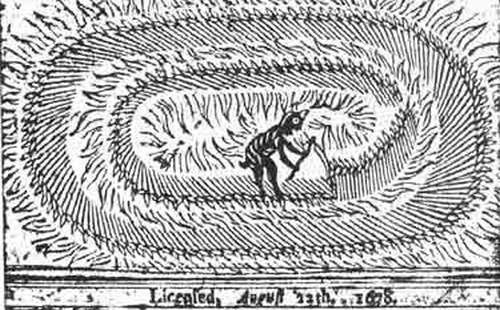
The best thing I found out was that an oatfield fell victim  to a crop circle in 1676 - the first ever recording of one! The woodcut below shows that people assumed it was the work of the devil, rather than men from outer space.

 
To make true Scottish oatcakes, you need some specialist equipment (the recipes themselves hardly differ); a spurtle, which is a wooden stick used to for stirring and mixing and it looks a bit like Harry Potter’s wand; a special rolling pin called a bannock-stick that leaves a criss-cross pattern on the rolled out dough; a spathe, a special piece of equipment that is used to move the oatcakes from board to girdle that is heart-shaped with a long handle; then there is the banna-rack, a toaster used to dry the oatcakes.  I do own a spurtle, but the other pieces of equipment are rather more tricky to get hold of.
You can make oatcakes large or small, leave them whole (bannocks) or cut into quarters (farls). Here endeth today’s Scottish vocab lesson. I found this wealth of information in a great book that I picked up in a second-hand bookshop in Inverness last year. It is called The Scots Kitchen: Its Lore & Recipes by F. Marian McNeill and it’s well worth getting hold of a copy.

Oatcakes are somewhere between a pancake and a biscuit, but appear in the Pancakes & Griddle/Girdlecakes  section of the Teatime chapter and not the Biscuits part. I think I would classify them as a biscuit even though they are cooked on a girdle because they’re so crisp; after their initial cooking , they would be dried out in front of the fire and then stored in a meal-chest or girnel covered in oats. We use Tupperware today of course.

I made these oatcakes to take up with me on a visit to my friend Frances who lives in an amazing 17th century house in the Lake District. In her instructions, Jane says to ‘toast lightly before the fire before serving them’, and Frances’s house is not short on proper roaring fires as you can see by the photo below.

Mix together 4 ounces of medium oatmeal with 4 ounces of plain flour and a level teaspoon of salt, then rub in 2 ounces of lard, dripping or poultry fat (vegetarians can, of course, use hard vegetable fat, but be careful to buy some not made from hydrogenated fats). Mix in enough cold water to make a soft dough. Roll out thinly on a ‘oatmeal-strewn board’ and cut out circles using a scone cutter.
 
To attain really thin oatcakes, Jane suggests slapping them ‘between your oatmealy hands. I tried this but it was difficult. I found it much easier to roll and cut out circles, then rolling the circles separately on the board. They weren’t perfectly circular, but they were very thin and crisp. The mixture made me 16 good-sized oatcakes.
 
Before you griddle to oatcakes make a glaze by beating together an egg with a tablespoon of milk and a teaspoon of sugar.

Heat up an ungreased griddle or other suitable heavy-based pan. When hot, place the oatcakes on the griddle and paint them immediately with the glaze. Let them cook through – you know this is happening because the glaze dries and goes shiny when they’re done. There is no need to turn them.
 
Cool on a wire rack and store in an airtight container and toast them dry in front of a lovely fire, or failing that back on the griddle or in the oven.

We ate them fresh from the fire with butter spread on them.

#371 Oatcakes. These were very good indeed, they were good and salty and the slightly sweet glaze counteracted it perefectly. Most importantly the almost too-heavy seasoning brought out the lovely toasted oatiness – I think it is important to say that I used organic oats, and I am sure that this made a difference because it really was a hit of oat flavour. I loved how they all curved and curled as they cooked too. Very good 8/10
 

Saturday, July 14, 2012

#346 Pice ar y Maen (Welsh Cakes on the Stone)


The griddle (or girdle) cakes in this book have been a bit mystery to me in that there are a fair few, so they’re obviously greatly-loved, yet they have all been rather dry, often with the raw taste of flour and more like a bit of cooked, badly-made, pastry. The problem is, I don’t really know what they should be like in consistency as I have never eaten one outside of Neil Cooks Grigson, and there is often little guidance from Jane as to how much liquid goes in. This time I am going to add more liquid so that it is more like a biscuit dough to see if this makes a difference.

Pice ar y Maen are traditionally made on St David’s day in Wales, but like the pancakes made on Shrove Tuesday, they’re made all year round too. Apart from the inclusion of the spice mace in the recipe, it’s made up of ingredients that are likely to be in the store cupboard.  

Sift one pound of flour with a teaspoon of baking powder, a good pinch of salt and a teaspoon of ground mace


Next rub in with fingers, pastry blender, mixer or processor 4 ounces each of butter and lard. Stir in 4 ounces of raisins or currants and 6 ounces of sugar. Now beat in 2 eggs along with a little milk. You need a dough that is soft, but not so much that it falls apart and sticks to the rolling pin and worktop. I prefer to be generous with the liquids.


Strew plenty of flour and roll out thinly – if the dough is too sticky to do this easily, knead in some more flour. Cut out into dinner plate-sized rounds, though I think a 3 inch diameter round works best as they are easier to turn.

Heat a little bit of lard in a heavy-bottomed pan, cook for about 3 minutes per side.

Rather than serving with butter and syrup, Griggers says you should turn them in the extra sugar.


#346 Pice ar y Maen (Welsh Cakes on the Stone). Well I have to say that these have been the best of the griddle/girdle cakes so far – the other ones have been dry (though I think this difference is due to the fact  I have become a better cook).  They were light and a little stodgy – in a good way – they were certainly sweet enough and they sent the delicious aroma of mace into my kitchen as they cooked. Very good, though I did have to add a little butter, I must admit. On the strength of this, I think I need to revisit the other girdle cakes. Very good 8/10.

Monday, March 7, 2011

#278 Crempog Las

Well Shrove Tuesday is almost here, so I thought I’d provide a pancake recipe from English Food. This one is perhaps a more alternative recipe as it is most definitely savoury rather than sweet, and best served up with sausages, bacon and eggs as a breakfast dish rather than for a Pancake Day evening pig-out. In America, people seem to be having much more fun with their Mardi Gras celebrations...
The Welsh seem much more adept at pancakes than the English and I suppose that’s why there are so many Welsh recipes in the Pancakes and Griddle Cakes section of the Teatime chapter of the book. If they weren’t counted, there would be slim pickings. Crempog Las, by the way, translates as green pancakes in Welsh (check out this site for more information on this dish and other Welsh dishes). I didn’t have high hopes as there has been a bad run of recipes from this section…
The other reason why I wanted to cook these pancakes is that I found a pack of sausages that I bought from Harrison Hog Farms. They have a stall at the Rice University Farmers’ Market and breed pigs that look suspiciously like Gloucester Old Spots; a fine old English breed, so I thought they can’t be bad. Naturally, I put in them in the freezer and promptly forgot about them. Even though I have only been in my Texan apartment for five months, I have managed to almost fill my freezer with bits that I see in shops and left overs like wine, egg whites, breadcrumbs and what-not that I expect one day will come in useful. I decided that it needs emptying. It is for the same reason that later on this week I will be doing oxtail soup.
Anyways, I have wittered on far too much:
Using a whisk, mix together four ounces of plain flour, a large egg, a dessertspoon of finely chopped parsley, a heaped teaspoon of finely chopped shallot and enough milk to make a thick batter. Season with salt and pepper. Fry the pancakes in some oil or grease  over a moderately-high heat until golden brown – two or three minutes a side should do it. That’s it. Serve with butter or as part of a fried breakfast.
#278 Crempog Las. These were delicious! A subtle savouriness from the slightly sweet-acrid shallot and the grassy freshness of parsley made them very morish. I am definitely adding these to my breakfast arsenal. Give them a try, they are so very, very easy. 7.5/10.

Tuesday, November 23, 2010

#260 Potato Cakes

During the working week I try my best to go to the gym and eat sensibly. This isn’t necessarily because I am a health fanatic, it is simply because from around the age of 28, it occurred to me that the old metabolism was grinding down a few gears and I was no longer able to scoff all the nice stodge and chocolate I liked to without becoming a massive fat knacker. And so the gym regime and healthy diet was introduced. However, this was just for five days of the week. The weekend however, is there for me to eat and drink all the things I used to like. It’s a trade-off innit?
Every Sunday whilst I have been in Texas, my breakfast treat has been pancakes and bacon, but today I thought I’d do these potato cakes from English Food. I’ve always associated potato cakes with Irish food – potato farls being an essential part of the Ulster Fry. However it seems that they are/were popular throughout Britain and Ireland.
To make the cakes, mash a pound of boiled potatoes, then mix in an ounce of melted butter, 4 ounces of plain flour, ½ teaspoon salt, a teaspoon of baking powder and – if you like – an egg. Bring all the ingredients together to form a dough that isn’t too sticky to handle and roll it out. Griggers gives us options as to how to cook and eat them: 1) Roll out thinly and cut out saucer-sized circles and cook on a griddle greased with lard, suet or bacon fat. Roll the cooked cakes around little sticks of salty butter. 2) Roll out the dough into ½” thickness and cut out circles with a scone cutter- griddle along with the bacon, sausage and eggs for 15 minutes. 3) Go Welsh: Add 2 tablespoons of brown sugar and another of white sugar to the mixture. I went for the second option.

#260 Potato Cakes. These were great; and very easy to make too. They had a light texture due to the baking powder as well as a nice soft inside without being stodgy. They went perfectly with the sausages and sweet maple-smoked bacon I ate with them. I shall be making these again. 7/10

Sunday, May 2, 2010

#242 Cacen Gri (Griddle Cakes)

It’s been a while Grigsoners. I am very busy at the moment – and will be for the next couple of months – writing my PhD thesis, so forgive me if the blog entries become a wee bit thin on the ground. The recipes that I can do are those that don’t require difficult-to-get items or dinner parties so I’m a little limited seeing as I spend most of my time in a library these days.

Anyway, enough of that.

These Welsh griddle (or girdle) cakes seemed by the recipe that they would be absolutely delicious. Indeed girdle cakes must be delicious because there’s a few recipes in the book. However, the last time I cooked some (Singin’ Hinnies) they were pretty awful. Grigson doesn’t give any background on Cacen Gri, though I have noticed that there are lots of Welsh recipes – perhaps more than English ones – in the part of the book devoted to griddle cakes and pancakes. Funny that, because when I think of Welsh specialities, I think of leek pie and rarebits not pancakes. They must be terribly fat as the amount of butter and lard in this is huge!

Start off by sieving a pound of flour and a teaspoon each of baking powder and salt into a bowl. Rub in four ounces each of cubed butter and lard. Mix in three ounces of mixed dried fruit and peel and an egg plus a little milk to form a dough. Leave to rest in the fridge for a little while and then roll out thinly and cut into plate-sized rounds. Grease a large pan with a little lard fry the griddle cakes for just two minutes a side on quite a high heat. Don’t overcook them as they go very dry very quickly. They should puff up a little and gain brown spots. Stack them on a warmed plate, add a good knob of butter between each one, keeping them nice and cosy in a warm oven. I served them with some very un-Welsh maple syrup too.


#242 Cacen Gri (Griddle Cakes). I wasn’t sure if I liked these or not. The first batch was over-cooked and all powdery. I soldiered on a tried again though and I think that they were okay. No more than that though. They were still pretty claggy and need lots of butter and syrup. Perhaps that is the secret to these girdle cakes – any amount of flour and fat will taste fine if smothered in enough melted butter and syrup. 5/10.

Saturday, May 16, 2009

#145 Singin' Hinnies

This is a teatime treat that I’ve been wanting to make for ages – Griggers really bigs this one up, as does her daughter Sophie. Singin’ Hinnies hail from the North East of England around Newcastle and are regarded one of the best of the griddle cakes, apparently. Everyone, no matter how rich or poor, ate them at teatime or parties. If you were lucky, you’d find a shiny sixpence inside. Health and Safety would have a field day. Singin’ Hinnies sing because of the fat content – the lard and butter make a rapid sizzling noise. The word ‘hinnie’ is a colloquialism meaning honey, a term of endearment equivalent to luv or duck.


To make the Singin’ Hinnies rub 4 ounces of butter and 4 ounces of lard into a pound of flour that has been sifted along with ¼ teaspoon of bicarbonate of soda, ½ a teaspoon of cream of tartar and half a teaspoon of salt. Stir in 6 ounces of currants (or raisins or sultanas) and finally make a firm dough using a little milk (how firm? I don’t know – but mine rather like pastry). Roll out the dough and cut out into rounds of around 2 ½ inches (how thick? again I don’t know, but I did about ½ an inch). Grease a skillet or griddle pan with some lamb fat tat’s been “speared with a fork”. I happened to have some, but if you don’t, I’m sure you could use lard. Cook the cakes until they pick up brown spots, turn them over and cook the other side. When cooked (how long? I don’t know!), open them up and add a small knob of butter to each one and keep them warm in the oven whilst you cook the rest.


#145 Singin’ Hinnies – 4/10. Disappointed with this one. I’m not sure if it was me making them incorrectly, but they were either too dry due to overcooking or too squidgy and raw tasting the middle. The currants prevented them from being inedible as did the glug of maple syrup I added too!

Wednesday, February 25, 2009

#119 Gloucester Pancakes

Yesterday was Shrove Tuesday and so to not repeat myself with common or garden crepe style pancakes, I thought I’d be controversial and try a different one. Gloucester pancakes don’t really resemble normal pancakes- they’re more like muffins. A point of note here – we know that Pancake Day exists to use up the fat ready for the onset of Lent, but bloody hell, these contain a LOT of fat – chopped beef and suet AND fried in lard. Oh well, you only live once…

This recipe makes around 8 pancakes:

In a bowl, mix together 6 ounces of flour, a pinch of salt and a teaspoon of baking powder. Then stir in 3 ounces of chopped suet and bind everything together with a beaten egg and some milk to produce a firm dough. Roll out the mixture so that it’s ½ an inch thick and use scone cutters (around 3 ½ inches wide) to cut them out. Fry the pancakes in a little lard on a lowish heat until golden brown – they should rise a little due to the baking powder. Serve hot with plenty of golden syrup.

#119 Gloucester Pancakes – 5/10. Nice, but I probably wouldn’t make them again. In order to turn this around, Charlotte made the Welsh light cakes that we did a few months ago (which I’m thinking about upping to a 10). Yep, I'd definitely rather be in Wales than Gloucester on Pancake Day...

Sunday, February 8, 2009

#113 Muffins

After the reasonable success of the crumpets, I thought I should carry on the bread theme and use up some more of the yeast. I didn’t even have to look through; I knew straight away that I wanted muffins – the second best breakfast carb after the crumpet… Don’t be confused between these muffins and American muffins – they are two very different beasts. I suppose in America our muffins are called English muffins, non?

Muffins are halfway between crumpets and bread – they are made with soft dough using strong flour and are cooked gently on the hob, rather than in the oven. They’re easy to do, but do require a bit of time and energy to knead them properly… It is worth putting in a bit of effort as it make the dough nice and elastic and therefore fluffier when cooked.

This recipe makes 12 muffins:

Start off by creaming ½ an ounce of yeast in 4 tablespoons of warm water, then warm ½ pint of whole milk and an ounce of butter in a pan until they reach blood heat. Meanwhile crack an egg into a bowl and give it a brief whisk, and pour in the warm milk into it, whisking thoroughly.

Weigh out a pound of strong plain white flour and empty it into a warm bowl (or better, warm the flour and bowl together on a low heat in the oven). Make a well in the centre and pour in the yeast and the milk-egg mixture, along with a teaspoon of salt. Mix together thoroughly, adding more flour or water if required. You want a soft dough, but not one that is sticky. Knead the dough for 5 to 10 minutes, place it, cover it and allow the dough to rise to at least double it’s volume.

Roll out the dough to ½ inch thickness and cut out rounds with large pastry cutters or whatever (I used crumpet rings). Knead the trimmings together and roll them out too, so you get as many muffins as possible from the mixture. Let them rise a little.

Put a heavy-based pan on a low heat and brush it lightly with lard or oil and fry them gently. Griggers says they should expand into something like a “puffball fungus”, and if you leave them to rise slightly they will. Turn them over after around 7 minutes and cook the other side.

Apparently, you should toast muffins whole – they should never be cut, but torn, adding butters as you go. Either way, eat them with lots of salted butter.

#113 Muffins – 7/10. I really liked these – it was easy to make them nice and light as the low heat made them almost impossible to overcook. The result is light and fluffy muffins that eat very well, very hard to get wrong, I think, and you should give them a go. They freeze well too…

Friday, January 30, 2009

#110 Elizabeth David's Crumpets

Charlotte and I have been very excited about the prospect of making our own crumpets for a while – just how do you get all the hole in!? We were to find out. The recipe is actually one by Elizabeth David – a very influential food writer, who wrote a book on yeast cookery. It’s making recipes like this – really stoically English fayre that I would never have thought of cooking myself. They are very easy – you need to buy some rings to cook them in as the batter is reasonably runny. If you don’t have one / can’t be arsed buying one, don’t worry, as you can ladle mixture straight into the pan and let it spread out to produce a pikelet which you don’t seem to be able to buy anywhere other than Yorkshire.


This recipe made us a baker’s dozen of crumpets:

Start off by warming a pound of plain flour through in the oven. Whilst your waiting for that warm up a pint of whole milk, 2 tablespoons of flavourless oil and a teaspoon of sugar to blood heat. Take out 3 tablespoons of the warmed milk and fork it through half an ounce of fresh yeast and let it thicken and become creamy. Make a well in the centre of the flour and add the yeast mixture, a tablespoon of salt and the remaining milk and beat the mixture – 5 minutes by hand, or about 3 with an electric beater. Cover the mixture and allow to rise and double in bulk – this is quite rapid with fresh yeast. Knock the mixture back and add ¼ pint of warmed water that has had a very generous pinch of bicarbonate of soda dissolved in it. Beat the mixture well and let it sit a rise again for around half an hour.


Grease a griddle or heavy-based frying pan and the crumpet rings with lard. Place the rings in the pan and pour in mixture two-thirds of the way up. Allow to fry very gently until the top is covered with holes and the surface is no longer liquid. Turn the crumpets over so they cook and colour on the other side. Allow them to cool and toast them, serving them with plenty of melted butter.

#110 Elizabeth David’s Crumpets – 6.5/10. The score I’ve given these crumpets may be changed later. The reason for this is that their consistency was rather soft and doughy, however they were piping hot throughout with no raw flour taste, so I’m not whether they are mean to be like that or whether they are undercooked. Consistency aside, they did taste absolutely delicious, so when I get the chance, I’m going to try them again…

Monday, December 8, 2008

#97 Welsh Light Cakes

For breakfast the next day, Charlotte and I wanted something hot and homely and went down the pancake route. I spotted this one as Charlotte is half-Welsh so I thought it befitting. These are great they’re made from a thickish bubbly batter that contains cream of tartare and soured cream – two secret ingredients. They’re served in quite an American fashion – piled up high with slices takes out of them. Get the made - they’re easy, so you get back much more than you put in!

Beat together 6 rounded tablespoons of plain flour, 2 of sugar and 3 of soured cream along with a pinch of salt and 3 eggs until smooth. Next, mix together ½ teaspoon of bicarbonate of soda and a rounded tablespoon of cream of tartare with 4 tablespoons of water. Quickly add it to the batter and stir in enough milk or buttermilk to make a batter that’s “not too thick” – a tricky one when you’ve no frame of reference; I think the consistency of thick double cream.


Now heat up a frying pan or griddle and add a little oil. Coat the pan and pour off any excess. Ladle a small amount in the centre of the pan to make small pancakes. Don’t swirl them around like crepes, they should be thick. After a minute or two flip it over and cook for another minute. Pile them up on a plate, spreading each one with butter. Serve in wedges with something nice and sweet – maple syrup or, as we used, golden syrup.

#97 Welsh Light Cakes or Pancakes - 9/10. Officially my favourite pancake. I know you can make crepes with normal average store-cupboard ingredients, but these are something special. Light, fluffy and slightly sour in taste, they went perfectly with the sweet golden syrup. Whenever anyone stays over, these will be made for breakfast every time. Me and Charlotte liked them so much we made seconds! Oink!

Wednesday, February 6, 2008

#25 Harvest Pancakes for the Poor


I did Pancakes for the Rich a while ago, and so as it was Pancake Day or Shrove Tuesday yesterday. I thought I'd do the Grigson's recipe for (#25) Harvest Pancakes for the Poor. [I don't know why the pancakes were meant to be for harvest time, seeing as that's in September...] Jane Grigson's recipe is pretty much the same as everyone else, except she puts in ground ginger into hers; which was quite pointless since as you couldn't taste it! Hey-ho. Anyways, many different fillings were made by me and Greg - some English, some not so English. No matter what fillings I try, nothing beats my two favorites: lemon and sugar, or butter and sugar. Yum!
For the pancakes, make a batter by whisking together 5 ounces of flour with half a pint of either milk or mild ale (!) and an egg plus half a teaspoon of ground ginger. Fry over a high-ish heat using lard or cooking oil to lightly grease the pan (pour off any excess and re-grease for each pancake).

FYI: Shrove Tuesday is the last day of Shrovetide which was a long festival that built up to the forty days of fasting in the lead up until Easter. I wonder if the 40 day fast thing is also a Pagan thing taken over by the early Roman Christians like Easter was? Anyone know??

Also I tried to make ice-cream to go with it, but my ice-cream maker is broken - what a crock of shit. I have had soooo much bad luck lately I'm beginning to think I'm cursed...

#25 Harvest Pancakes for the Poor - 8/10. A very good recipe, though I prefer using some water as well as milk, but that's what I'm used to. Why-oh-why is there ginger in it?

Friday, December 7, 2007

#13 Pancakes for the Rich

Greg and I thought we needed to stuff our faces with animal fat and sugar so (#13) Pancakes for the Rich (or a Quire of Paper; whatever that means!) was called for. It made 10 pancakes - which were very difficult to fry:

To make the batter beat together 3 ounces of flour, four ounces of melted butter, half a pint of single cream and a large egg along with two tablespoons of brown sherry, a teaspoon of rose or orange-flower water and half a grated nutmeg. Coat a skillet or pan in a very thin layer of oil and fry on both sides until brown. They didn't go firm like normal pancakes, but squidgy and caramelised because of the butter and the very little egg. After wrestling with them - in order to turn one we had to slide it onto a plate, and upturn it back onto the pan, otherwise they ended up a sad blob of batter. We served some up with sugar; as Grigson suggests, but also had some with lemon juice too.

Was it worth it? Not sure; i think I might prefer poor-man's pancakes. I think I'll try her recipe for them soon. But Pancakes for the rich were interesting, particularly for the addition of the beautifully fragrant orange-flower water.
Greg says:
#13 Pancakes for the Rich - Pretty much ditto what he said, they're nice but really not a patch on pov pancakes which may say more about our working class palate than anything else. Mostly though they're a bitch to turn, I am the king of tossing pancakes and these buggers weren't for flippng. But they are tasty and if you're attempting to put on a lot of weight in a very short time, whcih we apparently are, these are for you. 6.5/10.

#13 Pancakes for the Rich: 6.5/10. Delicious, but a big old faff and a bit too rich - even for me!