Saturday, April 7, 2012
#337 Eel Pie
Wednesday, November 9, 2011
#313 Jellied Eel Mousse with Watercress Sauce
If you wanted to buy jellied eels in London, you would have had to go to an Eel Pie and Mash House. There not many around – they declined in number from over a hundred after the Second World War to just a handful today. The most famous – and London’s oldest – extant Eel and Pie House is Manze’s in Peckham. I have never been to one of these places, but I shall try my best to frequent Manze’s next time I pop down to London. I doubt if they will ever regain popularity, even though eels have now returned to the River Thames.
This is an ‘updated’ recipe from chef Guy Mouilleron, who apparently thought of an eel slithering through a bank of watercress and thought the two might might together. The recipe is outdated; fish mousses are certainly a thing of the 1970s and 1980s; when English Food was first published.
Cover the terrine or tin with a double-layer of foil and then steam it for 1 ¼ hours. I used a fish kettle for this, but if you don’t have something appropriate, you can pop it in a roasting tin containing boiling water and bake it at 160-180⁰C (325-350⁰F). When cold, put it in the fridge overnight.
The next day, make the sauce. You need a good-sized bunch of watercress. From the bunch, pick and reserve enough leaves to make around a tablespoon when chopped. The rest, liquidise in the blender, using the smallest amount of water possible. Pass the watercress slurry through a sieve and add ¼ pint of double cream and whisk it until it thickens. Season and stir through the reserved, chopped leaves. Serve a slice of the mousse with a generous spoonful of the sauce.
#313 Jellied Eel Mousse with Watercress Sauce. My God, what a sight that one was! It looked like a massive chunk of cat food and the sauce was so garish. The taste of the mousse wasn’t too bad, but the texture seemed so wrong. If it had been eaten warm as a creamy stew, it probably would have been delicious. The mild fish and the grassy watercress did not go together in my opinion. A big shame because was waiting to be surprised by its loveliness. I think I would have been happier with some proper jellied eels. Keep the fish mousse where it belongs: in the past! 2/10
Monday, July 25, 2011
#304 Water-Souchy
So, water-souchy is a very rustic fish stew made from whatever the angler in the family brought home after a session in his or her waders in an idyllic stream in rural England. Obviously, I am not in England anymore, so I wanted the fish to reflect what I might have caught here on the Mississippi River if I could be arsed to fish there. I had a look in Seafood City, an Asian supermarket on Olive Boulevard in St Louis and bought myself some good fresh carp and catfish. Five pounds of fish are required, and cost me the princely sum of $7.50. Pretty good, I reckon, seeing as I’m rather poor at the moment.
Water-souchy became popular in the seventeenth century and remains so, at least in fishing circles. The word comes from the Dutch waterzootje, and has been described as the bouillabaisse of the Northern Latitudes. According to certain George Augustus Sala, writing in 1895 in Thorough Good Cook, 'You rarely get it good, save at Greenwich. Why I cannot say'. Well, it may be to do with the freshness of the fish, says Griggers, the quality of your water-souchy will be diminished if your fish is not perfectly fresh.
To make this simple stew, start off with five pounds of very fresh scaled and cleaned freshwater fish and cut them up into big chunks – no need to bone or fillet, for it is the bones that produce the stock and flavour the dish. Jane suggests perch or a mixture of fish such as perch, carp, eel &c. In a large saucepan, spread three ounces of butter over the base and cover that with the vegetables and herbs: two cleaned and chopped leeks, two chopped celery sticks, two tablespoons of chopped parsley and a bouquet garni. My bouquet garni was made up of a bay leaf, some parsley stalks, three fronds of dill and a crushed garlic clove all tied up in a bunch.
Season these well with salt and pepper and then place the chunks of fish on top. Season those too. Cover with water, bring to the boil and simmer with the lid on for about twenty minutes until the fish is cooked.
Wednesday, September 1, 2010
#251 Fried Eel with Fried Parsley
Anyway, enough of my rantings here is the recipe:
This recipe serves four people.
First, you need to prepare your eel; a two-pounder is required here. It needs to be skinned and then cut into three inch pieces. If it has been portioned already, but not skinned, you can either leave it on or fry the pieces skin-side-down in very hot oil for a few seconds. This makes the skin easy to peel off without cooking the eel itself. Next, coat the eel in seasoned flour and fry gently in 4 ounces of clarified butter until browned and the meat comes away from the bones easily. This took me about 7 minutes, but this will depend upon thickness. Next, prepare a lemon-butter sauce by melting 6 ounces of slightly salted butter in a saucepan and adding lemon juice to taste (I used a whole one). Put the eel onto a serving dish and keep warm. Now fry the parsley stalks. Start by heating up oil in a saucepan and fry around 12 parsley sprigs for a few seconds until crisp. Be careful here: the oil will splatter so just fry 3 or 4 at a time. Serve with some lemon-butter sauce poured over the eel, with extra in a jug, and the parsley sprinkled over it.

#251 Fried Eel with Fried Parsley. I have to admit, eel is a tasty fish and cooked this way really shows off it mild, yet delicious flavour. The fried parsley too was very good; like a grassy version of crispy seaweed you get from the Chinese take away! The only problem was the lemon butter – it just made the eel taste greasy. I think tastes have changed somewhat these days, and I think that a lemon mayonnaise would suit it better. However, still a pretty good recipe. 7.5/10.
Tuesday, March 23, 2010
#234 Smoked Eel
There are a few smokehouses that smoke eels in Britain, though the eels themselves are usually brought over from Holland and the surrounding countries due to the fact that are fewer of the beasties to found in British rivers.
This is not a recipe, but really a suggestion by Griggers as to the best way to appreciate smoked eel. As a starter, give each person a three inch section of eel fillet along with some good brown or rye bread and butter, a lemon wedge and perhaps some horseradish sauce. That’s it. Enjoy.
#234 Smoked Eel. A true delicacy; and the best way to treat a delicacy is to eat it in the simplest way possible. The flesh was sweet, succulent and firm, not the soft and slightly gelatinous consistency of smoked salmon which I can find rather off-putting. Don’t be squeamish and get it down yer. Fab stuff 8/10.
Friday, October 16, 2009
#197 Sedgemoor Eel Stew
This serves six easily.
You need three to four pounds of clean and skinned freshwater eel for this recipe. Begin by cutting the eel(s) into even-sized portions of around two inches in length. Season them lightly. Make a stock from the eel heads and skin as well as the flat part of the tails: Place the trimmings in a pan and cover them with half-water, half-cider (use good dry cider). Bring to a boil and then cover and summer for twenty minutes.
Arrange the eel pieces in a shallow pan and pour over enough hot stock to barely cover the eels. Poach the eels for around fifteen minutes, until the eel meat starts to come away from the bones. Don’t let the stock come to a proper boil though – steady poaching is the key, and it may take longer with thicker eels. When cooked, remove the eel pieces and arrange them on a serving dish, cover them with cling film and keep them warm.
Now make the sauce by boiling down the cooking liquor until it tastes strongly and then add ¼ pint (i.e. a 150 ml pot) of clotted, Jersey or double cream and four tablespoons of chopped parsley. Season again if required. Pour the sauce over the eel and serve. She suggests serving this stew with toast or fried bread. As fried bread had already featured in the last two courses, I went for toast. I also served some broccoli too.
#197 Sedgemoor Eel Stew. This was really good; the sauce was both sharp and creamy due to the cider and fresh with grassy parsley. The flavours were robust, but not too strong to mask the eel itself. It was very delicate in flavour; you could tell that they had come from a very good river as it tasted of fresh springwater. It stayed beautifully moist due to the gelatinous nature of it too. Much superior to salmon or trout, I think. Now that people don’t eat eel, I feel I have found a real hidden gem. I just have to go through the rigmarole of killing and cleaning them! At least I can say that this was the freshest fish I've ever had! 8.5/10
FYI: delicious as eel maybe, beware if someone offers you raw eel, say as sashimi. Eel blood is toxic before it is cooked, so if you get given a bloody bit, it could be a bad man trying to do away with you.
Tuesday, October 13, 2009
...Next, Simply Prepare Your Eels
I have gone off on a tangent. Larousse Gastronomique gives you these instructions on how to prepare an eel. It sounded all so easy:
“To kill an eel, simply seize it with a cloth and simply bang its head violently against a hard surface. To skin it, simply put a noose around the base and hang it up. Simply slit the skin in a circle just beneath the noose. Simply pull away a small portion of the skin, turn it back, take hold of it with a cloth and simply pull it down hard.”
I added the “simply”s. Well it didn’t quite go like the description in Larousse. So here’s what we ended up doing:
First up, you need to have a couple of rums to help prepare you. That’s what Paul and I did and I think it helped. We fannied around a bit before Charlotte walked in from work, grabbed one in a cloth and gave it several massive thwacks again the wall. Job a good one? No. It was still alive! She gave it another couple and it went limp. This was not like killing a trout with a short, sharp crack on a stone. We felt quite distressed about the several hits that we had to give it to kill it – we didn’t want to cause any unnecessary suffering. So the new plan was to hit it once to knock the others out or slow them down, and then chop the heads off with a meat-cleaver. I know this might sound extreme but, it seemed like the best thing – plus I remember it being the method I remember seeing some chef doing on telly once. We did it, and guess what? They were still moving about! I took the two now headless eels to the, plus Charlotte’s to the skin to rinse, and revived Charlotte’s. Off with its head.
Before you get angry about any mistreatment here – it turns out that they were all dead quite early on. We worked this out because all three eel bodies were still seemingly happily snaking around in the sink a good 45 minutes post-beheading. It seems that much of their behaviour is down to instinct and their autonomic nervous system. Though I've no idea how this happens and why it's so different to other fishes. Below is the rather gruesome video of the headless eels I took when they were in the sink. I mentioned the whole episode to Matthew Cobb (who I work with at Manchester University) who said he'll put a link to this post on his z-letter. (FYI: The z-letter is weekly newsletter about all things zoological.) Hopefully I shall find out why they just don't conk out. Be warned before clicking on the video if you are squeamish, remember too though that they are dead. Also, I apologise for my rather camp commentary. Let me know if you can tell me anything about eels and their habit of moving and swimming long after death.
The next stage of preparation is to skin them. In our panic, thinking we hadn’t killed eels when we had, we cut off the heads so couldn’t do the noose trick outlined in Larousse. Instead, we tried to make slit down the base and peel the skin away some other way. Anthea had arrived by this point, to find us sweating, giggling and holding bloody carving knives, and she suggested using some salt as it would give grip against their very slimy skins. At first all this seemed to do was kick-start the wriggle reflex again, but eventually – with Anthea restraining the wriggling eel with yet more cloths – I managed to get a purchase on the eel and pull the skin off in one piece. Just two more to go.
The hard work was done, just the gutting to do. At last I was on familiar territory. I’ve gutted fish several times before. To do this, make a cut from its anus – you’ll see it, about halfway down – to the neck end and pull away any innards away from the rib cage. Give it a rinse and you are done.
Well I have to say it was a pretty distressing episode, it wasn’t as bad as we thought at the time. I now know that eels carry on a-moving quite a while after death. So, to sum up:
1. Holding a cloth, hit your eel several times very hard against a wall.
2. Whilst the eel is limp, quickly cut off its head with a cleaver or very sharp knife.
3. Using salt as an abrasive, pull the skin back – persevere here – until you have a good inch of skin eked away, then pull off like a big macabre witch stocking.
4. Gut and wash the eel.
It sounds so easy put into four sentences.
Monday, October 12, 2009
First, Catch Your Eels...
Before preparing and cooking your eel, you have to get hold of some from somewhere, no mean feat, not for you, but for the poor fishmonger you talk into getting them for you.

Whilst shopping in Manchester, I popped into the Arndale Market to see if there was anything interesting on the off chance. There wasn’t, but I thought I’d enquire about eels. He said there’d be no problems, he just needed a bit of notice, so off I went and organised a dinner party and invited people round. When I rang up, the guy who answered said “sorry mate, but I’ve not seen eels for years, there’s no chance”. Oh dear. It seems that eel would be off the menu completely.
I didn’t give in, and as soon as I got to work, I rang the one place that I knew would find out for sure if eels are still available: Out of the Blue in Chorlton. Out of the Blue is a great fishmonger, and has won many an award. I used to use them all the time when I lived there. After a bit of detective work from their end, I got a phone call back a few days later and as if by magic, Dave Yarwood, the owner said he’s managed to get hold of some for me and they’d be ready by the Friday. Also – something I didn’t realise, you get them live. I knew the fishmonger would probably get them live, but I didn't know I'd have to do away with them myself.
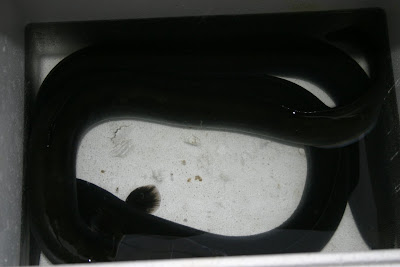
Feeling rather nervous throughout the week, it was finally Friday and off I went to Chorlton full of trepidation. In the shop, Dave asked me to come behind the counter where there they were – three freshwater eels swimming around in a big water-filled box. I remained as calm outside; inside, I was bricking it. What the hell!? I’m going to have to do away with three eels. I’ve never killed anything in my life, houseflies aside. I’d like to point out that Dave Yarwood is a total star for this – the amount of effort he put into getting hold of these eels for outweighed the effort I put in prepping or cooking them. He had to drive all the way to Sandbach at some god-awful time in the morning only to get there to find no one around. He did find a note on the door saying the eels were in a bag in the stream round the back!