Showing posts with label welsh. Show all posts

Monday, September 2, 2013

#382 Laverbread as a Sauce


The third in a laverbread trilogy… the first post #352 Laverbread and Bacon tells you a little more about the mysterious iodine-tanged, deep-green gelatinous goo. Thanks to Jane Grigson it is goo I have grown to enjoy very much, and something I would never have tried had I not undertaken this project. Whenever I visit Wales I always come back with a tub of the stuff. Cheers Griggers!

This is a very quick and easy recipe that cleverly uses the flavour of orange to cut through and temper the very rich seaweed. It goes with roast lamb, ‘especially roast lamb and new potatoes’. It also goes with most fish; in Wales it is often eaten with cockles. Jane says that a hotelier friend of hers served it with lobster and it was ‘a most successful combination’.
Heat up 8 ounces of laverbread with the grated zest and juice of an orange, then season with lemon juice, salt and pepper. That’s it!

#382 Laverbread as a Sauce. This was a delicious sauce that was much lighter and more accessible than the sauce in #353 Roast Rack of Lamb with Laverbread, which was not for the faint-hearted. Lovely and light, I give it 7.5/10.

Wednesday, September 12, 2012

#353 Roast Rack of Lamb with Laverbread


A second post involving the Welsh speciality laverbread; a deep green gelatinous sauce made from well-stewed seaweed known locally as laver (see the previous post). I still had some left over for this recipe which I made for my friend Charlotte – a veteran of my cooking, poor woman – as it was her birthday and luckily she requested lamb.

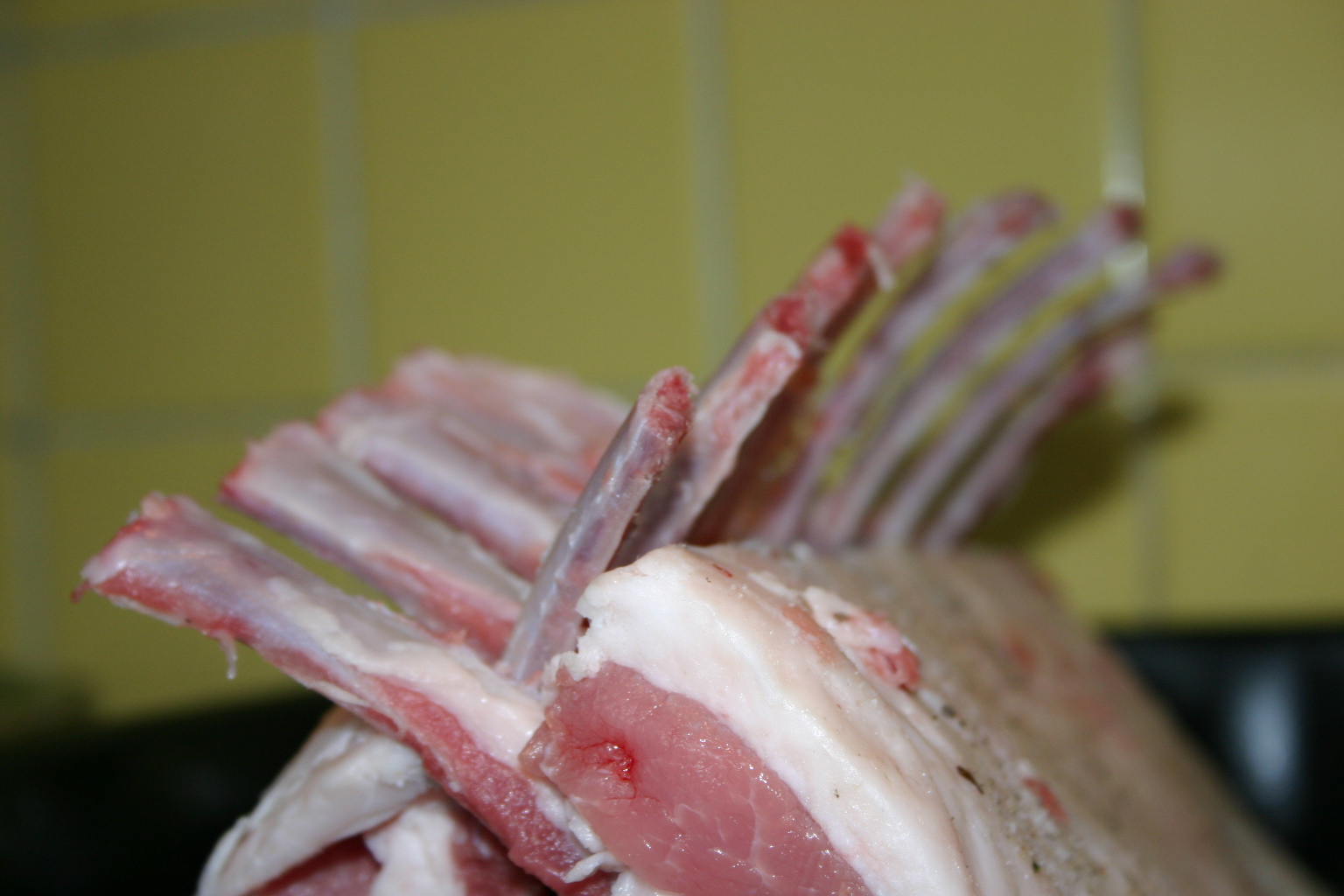
This is a recipe that I couldn’t do when I was in America because what you don’t want are nice pre-butchered racks, but a whole best end of neck. This is the upper part of the back and ribs that sequesters the beautifully tender lamb cutlets. If you can, wait until the lamb are a little older; these muscles don’t do much work so they don’t have as much flavour as, say, leg. Older animals have worked a bit longer so there is some make up in the flavour department. Also, they’re much bigger so you get more meat in your best end of neck.

Anyways, ask the butcher for one best end of neck, then ask him (or her) to split it down the centre, removing the backbone. Take the meat home, including the bones that he removed and you paid for!

Now prepare the lamb ready for roasting by cutting away any fat and meat from the ribs, don’t go too far down – maybe and inch and a half at the wider end and an inch at the thin end.


You should end up with two racks that can be propped up against each other with bones interlacing like fingers. Now take a clove of garlic and slice it thinly. Make holes down the fatty sides of the racks with a very sharp pointy knife and slot a sliver of garlic in each one. Season the lamb all over and put it in a roasting tin so that the ribs criss-cross.


Cover the exposed bones with a piece of foil so that they do not burn. Roast the lamb for 45 minutes at 220C (425F) for pink lamb, going up to 60 minutes for well-done (though cooking it well done would be a travesty in my humble opinion).

Next, make the gravy by first making a lamb stock from the bones and trimmings (this bit can be done well in advance). Add them to a saucepan with a carrot and a tomato both roughly chopped, a pint of beef stock and some salt and pepper. Bring to a simmer and let it tick away for a couple of hours or more if you can. Pass through a sieve and cool. Remove the floating fat and return to the pan with a glass of white wine or vermouth. Reduce until you get a well-flavoured stock. Lastly, slake a tablespoon of cornflour with a little cold water and stir into the stock to produce a nice gravy.

When the lamb is ready, take it out of the oven and cover with foil and let it rest whilst you make the laverbread sauce. Melt 3 ounces of butter in a saucepan and add a pound of laverbread. When hot, stir I the juice of 1 lemon and 2 oranges. Season with salt and pepper.

Place the lamb in the centre of a serving dish, pouring any juices in the gravy. Pour the sauce around the edges of the lamb and then decorate with thinly sliced oranges.

#353 Roast Rack of Lamb with Laverbread. Well the meat (which I cooked pink) was absolutely delicious, tender and well-flavoured. I wasn’t sure about the laverbread at first – it not being cut by the bland oatmeal like in the previous recipe – but I soon got used to it. The taste is very strong, but when eaten with the lamb you can see why they are eaten together so often. The gravy too was excellent; mild and not in the slightest bit greasy as lamb gravy can so often be. 9/10


Friday, August 31, 2012

#352 Laverbread and Bacon


A couple of weekends ago, Hugh and I popped down to Swansea for a wedding. It is a very nice city, with a very nice market. Whilst there I was very keen to get hold of some Welsh laverbread; there are a few recipes that use it so I bought a couple of tubs. I am always keen to try new foods and I had never eaten laverbread; always excited to see another species added to my list!
Laverbread does not contain any bread, but is in fact a species of seaweed found on the rocky seashore of Wales and is rarely seen outside of the borders. It is however, available online pretty easily if you’re not in or near Wales.
Plate from an unknown book - laver is number 4
 
According to my Traditional Welsh Recipes teatowel, to make laverbread, you need wash your laver (the algae Porphyra laciniata) and, without any additional water, simmer it until it becomes dark green gelatinous pulp – about 4 hours. Drain the leaves and chop them, adding salt to taste; and there you have it, laverbread, or bara lawr as the Welsh call it. Laverbread is traditionally fried in small balls or patties in bacon fat. It doesn’t take long because the laverbread is already cooked.
 
There are several seaweed based recipes in English Food, I have already covered one using the seaweed dulse, yet no one in England really eats it, and the tradition is slowly dying in the two remaining seaweed-eating nations in the British Isles: Wales and Ireland. In the past everyone used to eat it, but like many foods labelled ‘peasant food’ a stigma was, and still is, attached. It is strange that in most other countries people are so enthusiastic about their peasant foods – they are the comfort foods! – yet most of us turn our noses up at them.
Didn’t mean to get into a lecture there, but whatever falls out of brain ends up on the post. Anyways, as a rookie to the ways of laverbread and how to cook it, it went for this simple recipe that would hopefully be a good introduction.
Take a pound of prepared laverbread and mix in enough fine oatmeal to make soft, coherent dough. Roll into balls and flatten slightly. Fry in bacon fat for a few minutes per side or until nice and golden brown.
 
Serve with bacon in a mixed grill or a fried breakfast. I did something a little healthier and used the bacon I fried to flavour vegetable soup, and used the laverbread patties almost as dumplings.
#352 Laverbread and Bacon. Well I have to say I was impressed with the laverbread. I was subtly flavoured with iodine just as mussels and oysters are, but there was no fishiness to it. If I was living in Wales, laverbread and bacon would definitely be on my Sunday breakfast list. 7/10.
 

Saturday, July 14, 2012

#346 Pice ar y Maen (Welsh Cakes on the Stone)


The griddle (or girdle) cakes in this book have been a bit mystery to me in that there are a fair few, so they’re obviously greatly-loved, yet they have all been rather dry, often with the raw taste of flour and more like a bit of cooked, badly-made, pastry. The problem is, I don’t really know what they should be like in consistency as I have never eaten one outside of Neil Cooks Grigson, and there is often little guidance from Jane as to how much liquid goes in. This time I am going to add more liquid so that it is more like a biscuit dough to see if this makes a difference.

Pice ar y Maen are traditionally made on St David’s day in Wales, but like the pancakes made on Shrove Tuesday, they’re made all year round too. Apart from the inclusion of the spice mace in the recipe, it’s made up of ingredients that are likely to be in the store cupboard.  

Sift one pound of flour with a teaspoon of baking powder, a good pinch of salt and a teaspoon of ground mace


Next rub in with fingers, pastry blender, mixer or processor 4 ounces each of butter and lard. Stir in 4 ounces of raisins or currants and 6 ounces of sugar. Now beat in 2 eggs along with a little milk. You need a dough that is soft, but not so much that it falls apart and sticks to the rolling pin and worktop. I prefer to be generous with the liquids.


Strew plenty of flour and roll out thinly – if the dough is too sticky to do this easily, knead in some more flour. Cut out into dinner plate-sized rounds, though I think a 3 inch diameter round works best as they are easier to turn.

Heat a little bit of lard in a heavy-bottomed pan, cook for about 3 minutes per side.

Rather than serving with butter and syrup, Griggers says you should turn them in the extra sugar.


#346 Pice ar y Maen (Welsh Cakes on the Stone). Well I have to say that these have been the best of the griddle/girdle cakes so far – the other ones have been dry (though I think this difference is due to the fact  I have become a better cook).  They were light and a little stodgy – in a good way – they were certainly sweet enough and they sent the delicious aroma of mace into my kitchen as they cooked. Very good, though I did have to add a little butter, I must admit. On the strength of this, I think I need to revisit the other girdle cakes. Very good 8/10.

Friday, March 11, 2011

#280 Welsh Cinnamon Cake

Known as Teisen Sinamon in Welsh, this is a mysterious cake. Griggers doesn’t really give any history behind it in the book. She says that the recipe is by Mrs Bobby Freeman (who has written a book of Welsh cakes and buns). She also says that it’s bit of a pity that chefs don’t make traditional dishes enough in their restaurants anymore. I did find after a little research that is a Victorian recipe – thanks Victorian Recipes of Wales teatowel! I’m not actually sure if it is a cake – it’s more like a giant biscuit with some meringue on top. Quite American really.
I made this cake on request for my mate Chandra’s birthday the other day. I think it went down quite well at work.
Cream four ounces each of butter and sugar in a mixing bowl and then beat in two egg yolks (reserve the whites!). Sift eight ounces of plain flour, a rounded teaspoon of cinnamon and half a teaspoon of baking powder and mix them in stages into the creamed butter and sugar. Knead this mixture together and roll it out to line a nine inch flan tin with a removable base. Actually rolling it out is a total pain in the arse because it breaks up very easily. Instead spread it out over the base of the tin using your knuckles, pushing the dough up the edges and make it neat using the edge of a measuring cup. Bake for 20 minutes at 200°C (that’s 400°F). Remove from the tin and cool on a wire rack. Heat some apricot jam with a little water to make a glaze and paint it thinly over the cake. Remember those two egg whites? Add another one and whisk until the stiff-peak stage. Then add three tablespoons of caster sugar and whisk again until the meringue becomes silky and creamy. Pile into the centre of the cake and make decorative swirls and spikes. Bake again at 180°C (350°C) until the meringue is a nice golden brown – about 10 or 15 minutes. Take out and cool on the rack again.
#280 Welsh Cinnamon Cake. Is it a cake? Is it a cookie? We just don’t know. It was very nice though – plenty of warm cinnamon spice. It was a bit stodgy too, but in a good way. I’m not sure about the meringue topping though. Not a bad one, by any means. 6.5/10.

Monday, March 7, 2011

#278 Crempog Las

Well Shrove Tuesday is almost here, so I thought I’d provide a pancake recipe from English Food. This one is perhaps a more alternative recipe as it is most definitely savoury rather than sweet, and best served up with sausages, bacon and eggs as a breakfast dish rather than for a Pancake Day evening pig-out. In America, people seem to be having much more fun with their Mardi Gras celebrations...
The Welsh seem much more adept at pancakes than the English and I suppose that’s why there are so many Welsh recipes in the Pancakes and Griddle Cakes section of the Teatime chapter of the book. If they weren’t counted, there would be slim pickings. Crempog Las, by the way, translates as green pancakes in Welsh (check out this site for more information on this dish and other Welsh dishes). I didn’t have high hopes as there has been a bad run of recipes from this section…
The other reason why I wanted to cook these pancakes is that I found a pack of sausages that I bought from Harrison Hog Farms. They have a stall at the Rice University Farmers’ Market and breed pigs that look suspiciously like Gloucester Old Spots; a fine old English breed, so I thought they can’t be bad. Naturally, I put in them in the freezer and promptly forgot about them. Even though I have only been in my Texan apartment for five months, I have managed to almost fill my freezer with bits that I see in shops and left overs like wine, egg whites, breadcrumbs and what-not that I expect one day will come in useful. I decided that it needs emptying. It is for the same reason that later on this week I will be doing oxtail soup.
Anyways, I have wittered on far too much:
Using a whisk, mix together four ounces of plain flour, a large egg, a dessertspoon of finely chopped parsley, a heaped teaspoon of finely chopped shallot and enough milk to make a thick batter. Season with salt and pepper. Fry the pancakes in some oil or grease  over a moderately-high heat until golden brown – two or three minutes a side should do it. That’s it. Serve with butter or as part of a fried breakfast.
#278 Crempog Las. These were delicious! A subtle savouriness from the slightly sweet-acrid shallot and the grassy freshness of parsley made them very morish. I am definitely adding these to my breakfast arsenal. Give them a try, they are so very, very easy. 7.5/10.

Sunday, May 23, 2010

#243 Spiced Welsh Mutton 'Ham'

Well hello there! No I haven’t died on you or anything. I’ve just been uber-busy with my thesis writing and hardly had time to do any Grigson-related cookery. Here’s is one that I actually did a couple of weeks ago but haven’t been able to tell you about.

The cured meats from the book have all been pretty successful and this one sounded nice and easy, plus would keep me in butties for the foreseeable future. I wasn’t sure how it was going to turn out because we don’t really cure lamb to make ‘ham’ do we? Unless I’ve been missing something all these years.

Anyway, here’s how to make to your spiced lamb ‘ham’:

First of all select your leg of lamb or mutton – you need one that weights about 6 pounds. Place it in a large pot or tub that has a well-fitting lid and rub it all over in a spiced salt mixture for curing. To make the spiced salt, mix together 4 ounces of dark brown sugar, 8 ounces of sea salt, ½ ounces of saltpetre, an ounce each of crushed black peppercorns and allspice berries, plus a heaped teaspoon of coriander seeds. Make sure you rub it in well, ensuring you get down between meat and bone. Keep it in the tub in a cool place and turn it over every day, rubbing in the juices and spices for 14 days.

Then, rinse any excess spices away from the surface of the leg and place in a large pot and cover with water. Bing slowly to a simmer and cook as gently as possible with the lid on for 3 ½ hours. Let the lamb cool in the water for a couple of hours, remove it and, wrap it in clingfilm or greaseproof paper and let it finish cooling under a weight. It keeps in the fridge for ages as long it is wrapped up or kept in Tupperware. Griggers says that if you have a smokehouse nearby that will let you put the cured but uncooked leg in, then do so! I haven’t, so I didn’t!


#243 Spiced Welsh Mutton ‘Ham’. This was a revelation! I do not know why we don’t cure mutton and lamb anymore. Absolutely delicious. The lamb meat was succulent and flaky just like corned beef and the spices cut through the richness of the fat. Best cured meat so far. 8.5/10

Sunday, May 2, 2010

#242 Cacen Gri (Griddle Cakes)

It’s been a while Grigsoners. I am very busy at the moment – and will be for the next couple of months – writing my PhD thesis, so forgive me if the blog entries become a wee bit thin on the ground. The recipes that I can do are those that don’t require difficult-to-get items or dinner parties so I’m a little limited seeing as I spend most of my time in a library these days.

Anyway, enough of that.

These Welsh griddle (or girdle) cakes seemed by the recipe that they would be absolutely delicious. Indeed girdle cakes must be delicious because there’s a few recipes in the book. However, the last time I cooked some (Singin’ Hinnies) they were pretty awful. Grigson doesn’t give any background on Cacen Gri, though I have noticed that there are lots of Welsh recipes – perhaps more than English ones – in the part of the book devoted to griddle cakes and pancakes. Funny that, because when I think of Welsh specialities, I think of leek pie and rarebits not pancakes. They must be terribly fat as the amount of butter and lard in this is huge!

Start off by sieving a pound of flour and a teaspoon each of baking powder and salt into a bowl. Rub in four ounces each of cubed butter and lard. Mix in three ounces of mixed dried fruit and peel and an egg plus a little milk to form a dough. Leave to rest in the fridge for a little while and then roll out thinly and cut into plate-sized rounds. Grease a large pan with a little lard fry the griddle cakes for just two minutes a side on quite a high heat. Don’t overcook them as they go very dry very quickly. They should puff up a little and gain brown spots. Stack them on a warmed plate, add a good knob of butter between each one, keeping them nice and cosy in a warm oven. I served them with some very un-Welsh maple syrup too.


#242 Cacen Gri (Griddle Cakes). I wasn’t sure if I liked these or not. The first batch was over-cooked and all powdery. I soldiered on a tried again though and I think that they were okay. No more than that though. They were still pretty claggy and need lots of butter and syrup. Perhaps that is the secret to these girdle cakes – any amount of flour and fat will taste fine if smothered in enough melted butter and syrup. 5/10.

Monday, November 30, 2009

#209 Chicken and Leek Pie from Wales

During this rubbish weather (God, I am so English – all I do is talk about the weather) there is nothing like a good pie. The Farmers Market in Manchester Piccadilly Gardens just happened to be on as I was walking through and I saw a stall selling some very nice free range farm chickens and so I snapped one up. I then consulted the book for chicken recipes and decided on this. It seemed a little bit like the pork and apple pie I did a while ago in that there is no gravy or sauce per se but runny juices instead. I was slightly concerned about this as it was a major short-falling in the pork pie. Anyways, I have cook everything in this book whether I like it or not.

It is best to start this pie the day before you want to cook it, or at least in the morning. Start by placing a roasting or boiling chicken in a close-fitting pan along with a quartered, unpeeled onion, two tablespoons of chopped celery (a stalk, in other words), a bouquet garni and some salt and pepper. Place a close fitting lid on top, bring to a boil and simmer until cooked. The cooking time will be dependent upon the type of chicken you have – around 45 minutes for roasters, and at least an hour for boilers. Let the chicken cool in the stock (leave overnight if you want). Remove it and strip the carcass, cutting the meat into nice chunks. Skim the stock – if it seems a bit bland, add more seasoning or return the bones to the pot and simmer again. You could also reduce the stock after straining it too.


Arrange the pieces of chicken in a pie dish along with 4 ounces of sliced ox tongue that has been cut up. Next, wash, trim and slice a load of leeks – Griggers says eight in all, but I reckon that that it all depends on the size of your pie dish. Either way, blanch them for two minutes in salted water before draining and adding to the pie dish. Chop two tablespoons of parsley and sprinkle that over and then ladle the stock over the lot until it comes up about half way up the chicken and veg. Season well. Cover with shortcrust pastry (the amount will depend on the dimensions of your pie dish). To make sure you get a good seal, when you roll it out cut a strip of pastry and glue it around the rim of the dish with some beaten egg. Brush glued pastry with more egg and lay the pastry over. Press it down, make a central hole and brush the top with egg. Bake at 230⁰C for 20 minutes, then turn the oven down to 180-190⁰C for another 20. Allow to cool a little before you eat it. It had it with mash and peas.

#209 Chicken and Leek Pie from Wales. This was a really good pie – the stock was very flavoursome and ensured the chicken remained very moist. I’m not sure what the point of the tongue was though. It is also very nice cold – the stock cools to become a nice, rich jelly; though that kind of thing is not to everybody’s taste. Give it a crack! 7/10.

Sunday, June 7, 2009

#155 Welsh Rabbit (Rarebit)

Apparently it is incorrect to call a Welsh rabbit a rarebit, it is a “false etymological refinement”. There are, in fact, three types of rabbit: Welsh, English and Scottish. The Welsh is the classic, but I can’t find anywhere that states it was the original rabbit, though people assume it is. I suppose it’s one of those dishes that have just been around for a long, long time. Also I have no idea why they are called rabbits, but there are theories abound. One is that the Welsh peasants of yore were not allowed to eat rabbits caught in hunts by the nobles, so they substituted it for cheese (which has, of course, always been a popular staple in Wales). That’ll do me.

These days we are used to a very thick cheese topping piled on our toast for Welsh rabbit, but traditionally it was meant to be quite liquid so it soaked into the toast whilst it grilled.

For 2 slices of toast

Toast two thick slices of toast. Meanwhile gently melt 4 ounces of good grated Cheddar (or Lancashire or Double Gloucester) with 3 tablespoons of ale (or milk). Stir until the mixture becomes a thick, liquid cream. Add an ounce of butter to the melted cheese, alongside some salt and pepper and some mustard. Taste and add more seasoning or mustard if you like. Place the toast in a heat-proof dish and pour the cheese mixture over it. Place under a very hot grill until the cheese toasts nicely and develops brown spots.


#155 Welsh Rabbit – 6.5/10. It may not look as nice as a more modern Welsh rarebit, but how could toasted cheese and mustard possible taste bad? It was quite unusual having the runny cheese soaked up into the bread, so although it was delicious, I think I prefer the cheese to be stacked on top, with an egg yolk include plus a bit of Worcester sauce. That said, I did hit the spot! I think I could eat some form of cheese on toast every day if I let myself.

Friday, April 3, 2009

#133 Welsh Supper Herrings

After the creamy and rich oyster loaves last night, I thought I’d go for something a little bit more fresh-tasting and the Welsh Supper Herrings seemed to fit the bill. I chose herring because, like oysters, I’d never knowingly tried them except, of course, in the form of kippers. Herring are quite cheap as are most of the other ingredients so it didn’t break the bank. The odd ingredient here is the Bramley apple, but apparently it’s a traditional thing, herring and apple. First I’d heard.

Gut, clean, descale, behead and fillet a pound of herring – ask your fishmonger to do this, I tried to fillet them myself and was reasonably successful but was a bit of a ballache. Now mix an ounce of softened butter with a tablespoon of mustard made up from mustard powder (Why? Because Griggers says so, that’s why). Spread the butter over the cut side of the fish fillets and roll them up.

Next get to work on peeling and then finely slicing a pound and a half of firm potatoes – Jane recommends using a mandolin for this. Please, please, please be very careful here – I managed to slice a piece of my thumb off doing this last night so watch out. You have been warned. Don’t go suing me if you open a vein… Plunge the potatoes into boiling salted water for a minute she says – though I would do them for 2 or maybe even three (see below). Then slice a large onion and two Bramley (or other cooking) apples that have been peeled and cored. No need for the mandolin for those. Use a little more softened butter to grease a pie dish and make a layer using half the potatoes, then half the apples and half the onions, seasoning as you go with salt and pepper. Next, the rolled up herring fillets and sprinkle them with half a teaspoon of dried sage (Why not fresh? Because Griggers says so, that’s why). Then add the remaining apple, onion and potato, adding a brief painting on of melted butter to the last layer of spuds. Pour boiling water so it comes around half way up the dish. Bake for around half an hour until the potatoes are cooked.


#133 Welsh Supper Herrings – 3.5/10. Not sure if this was a bad dish or a bad recipe for a good dish. The potatoes, apples and onions were very nice – the apples especially lifted it, but the potatoes were not cooked after half an hour even though I blanched them in the boiling water. They were done after an hour, but unfortunately this meant that the herrings had cooked down into a mush not unlike cat food. So pretty disappointing seeing as I almost sacrificed a digit for it. Hey-ho, such is the nature of this undertaking…

Wednesday, December 17, 2008

#98 Cawl

Butters and I went for a nice walk around Chorlton Water Park and the Mersey Valley. We lucky in that it wasn’t totally pissing it down with rain, as the weather has not been good of late. It was still pretty chilly though so I wanted to make something simple, nourishing and warming for when we got back. I plumped for the Welsh soup, Cawl (pronounced “cowl”, according to Griggers). Cawl is simply Welsh for soup, but it’s far from a light soup-starter; it’s a meal in one. I assume it’s a peasant dish; it is simple in its ingredients and methods, is cheap, and requires time to make it well. It’s basically the Welsh equivalent of Irish stew or Cock-a-leekie. What I like about this one is that the meat is cooked as a joint and sliced at the end and served with the vegetables and soup. To be really Welsh, marigold flowers can be added as a garnish, but I thought that was going a bit too far…

These measures make loads of Cawl – enough for 6 to 8 people.

Start off by browning your meat in some beef dripping; you need pounds altogether, either beef brisket of shin of beef, but best is to use one pound of beef and a pound of smoked hock, gammon or bacon. I went for brisket and a giant piece of smoked bacon. When browned, put in a large saucepan or stockpot. Next, brown 2 sliced onions and 3 carrots, parsnip, turnips or some swede cut into chunks; a mixture is best. Once they are browned, add them to the meat and cover with cold water, add salt and two stalks of chopped celery. Bring to the boil slowly, skimming off any scum that may rise to the surface. Add a bouquet garni (I used parsley, thyme and bay), sea salt and pepper to season, turn to a very low heat and simmer for at least three hours. I actually did all this the day before, so that we didn’t have to wait very long to eat when we got back.


About half an hour before you want to eat, add a pound of small potatoes (or larger ones cut up), and ten minutes before add a small white or green cabbage that has been sliced. When the potatoes are cooked the soup is ready. Finely slice 2 or 3 leeks and sprinkle them on top of the soup; the heat of the soup will cook them. Remove the joints and slice them up, putting some of each kind in each bowl, along with some of the veg and stock.

#98 Cawl – 7/10. A delicious, warming and beautifully clear soup. The meat was falling apart and the smoked bacon gave the whole thing a really delicious flavour. Definitely one of the best soups so far. This will become a staple winter dish, I think.

Monday, December 8, 2008

#97 Welsh Light Cakes

For breakfast the next day, Charlotte and I wanted something hot and homely and went down the pancake route. I spotted this one as Charlotte is half-Welsh so I thought it befitting. These are great they’re made from a thickish bubbly batter that contains cream of tartare and soured cream – two secret ingredients. They’re served in quite an American fashion – piled up high with slices takes out of them. Get the made - they’re easy, so you get back much more than you put in!

Beat together 6 rounded tablespoons of plain flour, 2 of sugar and 3 of soured cream along with a pinch of salt and 3 eggs until smooth. Next, mix together ½ teaspoon of bicarbonate of soda and a rounded tablespoon of cream of tartare with 4 tablespoons of water. Quickly add it to the batter and stir in enough milk or buttermilk to make a batter that’s “not too thick” – a tricky one when you’ve no frame of reference; I think the consistency of thick double cream.


Now heat up a frying pan or griddle and add a little oil. Coat the pan and pour off any excess. Ladle a small amount in the centre of the pan to make small pancakes. Don’t swirl them around like crepes, they should be thick. After a minute or two flip it over and cook for another minute. Pile them up on a plate, spreading each one with butter. Serve in wedges with something nice and sweet – maple syrup or, as we used, golden syrup.

#97 Welsh Light Cakes or Pancakes - 9/10. Officially my favourite pancake. I know you can make crepes with normal average store-cupboard ingredients, but these are something special. Light, fluffy and slightly sour in taste, they went perfectly with the sweet golden syrup. Whenever anyone stays over, these will be made for breakfast every time. Me and Charlotte liked them so much we made seconds! Oink!

Tuesday, September 2, 2008

#76 Teisen Nionod (Welsh Onion Cake)

If you are on a budget, this dish is certainly for you - it contains, basically, onions, potatoes, butter, salt and pepper. There are variations on the dish that include other ingredients, but essentially that’s it. Don’t be put off by it, it’s very tasty indeed and hearty too if you serve it with bread or roast meat. Greg and Joff were coming round so I thought it was a fine reason to do some recipes. This one is very much like the Pan Aggie/Haggerty that I made ages ago. I’ll give the version I did, but supply you with the additional bits and bobs you can add.

Start off by slicing 2 pounds of peeled potatoes with a food processor or mandolin. Put the slices in a bowl of cold water to rinse the starchiness away and dry them on a clean tea-towel. Next, slice a pound of onions into thin rings, do this by hand though as they cook quicker than potatoes and don’t need to be super-thin. Grease and line a baking dish with foil (if you want to turn out the ‘cake’ at the end), and start layering the potato followed by the onions. Season and add small pats of butter between each layer, repeat as many times as possible, but make sure you finish with a layer of potato; all-in-all aim to use 3 to 4 ounces of butter. Then, melt a final ounce of butter and pour it over. This is the basic dish, but I added a small (150ml) pot of cream and six tablespoons of water to it so that it was a sort of potato Dauphiniose. Cover with another layer of foil and bake for 1 ½ hours at 180°C, removing the foil in the last half hour, so the potatoes crisp up. Turn out onto a large serving dish if you like, and serve with bread.

You could add a quarter of a pint of beef stock instead of cream. Pickles go very well with it if you are not using cream in the dish. You could even place a small joint of lamb on top of the vegetables – though add only a little stock and use only the melted butter. Skim off any excess fat before serving it up.

#76 Teisen Nionod (Welsh Onion Cake) – 8/10. This is definitely one the best dishes so far. It’s easy and cheap and delicious. There are many variation of this dish it seems – Tyneside, Wales and Yorkshire all have their variation on essentially the same recipe – and each time I cook them I’m always surprise how tasty they are. Go and cook it – plus, with the credit crunch and all, you'll be doing your bank balance a favour!

Wednesday, September 19, 2007

Recipe #6 - Wyau Ynys Mon

Last night I was craving stodge - it had to be veggie stodge too as Greg was staying over. What did I find? (#6) Wyau Ynys Mon, or Anglesea Eggs. It consisted of 3 main parts: a ring of potato that's been through a vegetable mill mixed with mashed stewed leek; nestled in the ring eight quartered hard-boiled eggs, no less; and finally a topping of cheesy sauce made with flour, butter, milk and a good mature cheddar. Add an extra sprinkling of cheese for good measure and bake until golden brown on top.

All pretty straight-forward to do - except the veg strainer on the Kitchen Aid does not mill spuds very well as some website said it would...I think I will invest in a proper vegetable mill.

The dish was actually pretty bland, but was strangely satisfying. Greg and I ate a massive portion and continued to get fuller and fuller for a while after we'd eaten it. In fact I was still full this morning! I made so much I've got to have it for tea again tonight!

Here's what Greg said:
"Anglesey Eggs. Is all British food entrails and stodge? If you live on a windy peninsula I guess you need food that keeps you warm 10 hours after you've eaten it, and this is perfect for that. Buttery leeks (haha) and eggs together are a sensation but you'd need an iron constitution, or at least to eat smaller portions than we did, to indulge more than once a year. It's more filling than anti-matter but so delicious. I'd put mashed-up ready salted crisps in the cheese topping to jazz it up but that's just me, I aint no purist. 4/5 again I think. Marks are still high but veggie options running low. Check out the vid of Neil making potato worms with ye olde Kitchene Aide to whet your appetites."

My score:
#6 Wyau Ynys Mon: 2/5 - homely stodge, great on wet winter days but lacked excitement

Monday, September 17, 2007

Recipes 2-4 - Glamorgan Sausages, Olde Worlde Mushrooms and Peas


I've been away from a computer for a few days - I still don't have the internet at home and I had to go back to Leeds at the weekend because my brother Ady and his good lady wife Nads had a little boy called Harry. He's the cutest and I'm NOT biased! Now I've got some catching up to do. The hat trick meal went quite well although I did get a little flustered and rushed through the making of the Glamorgan sausages - they were far too big and didn't cook through properly. They were also a bit well done - au creole I should say - because I lost concentration when dishing up. However, they can be done well in advance, so next time I'll be better prepared. They're a definite veggie alternative. Doing them in the food processor makes light work of it too - although be careful, I've sustained my first injury on one of the blades! The fricassey of mushrooms was brilliant; the taste and aroma of the mace and nutmeg were warming and so very Medieval! The Grigson talks about the English way to cook (#4) green peas - i.e. with mint and sugar in with the water - as the only way to do them yet I had never actually eaten them this way. Well, I certainly agree and it will now be the only way I shall cook peas in the future!
For the Glamorgan sausages:

Start by mixing together 5 ounces of grated Caerphilly or Cheddar cheese, 4ounces of fresh white breadcrumbs, 2 tablespoons of finely –chopped leek or spring onion and a generous tablespoon of chopped parsley. You can quicken the whole process by simply reducing those ingredients into breadcrumbs in food processor. Now mix in 3 egg yolks, half a teaspoon of thyme, a level teaspoon each of salt and mustard powder and some pepper. Bring the mixture together and form into around 12 small sausages. Dip each one in egg white and then coat in some dried breadcrumbs. Fry gently in oil or lard until golden.

The recipe for ‘A White Fricassey of Mushrooms’ comes from Hannah Glasse and I shall simply quote it as Griggers has done:

“Take a Quart of Fresh Mushrooms, make them clean, put them into a Sauce-pan, with three spoonfuls [tablespoons] of Water and three of Milk, and a very little Salt, set them on a quick Fire and let them boil up three Times; then take them off, grate in a little Nutmeg, put in a little beaten Mace, half a Pint of thick Cream, a Piece of butter rolled well in Flour, put it all together into the Sauce-pan, and Mushrooms all together, shake the Sauce-pan well all the Time. When it is fine and thick, dish them up; be careful they don’t curdle [ don’t let them boil]. You may stir the Sauce-pan carefully with a Spoon all the time.”

The peas were simply a cop out: make sure you boil them with plenty of salt, sugar and mint!

Here's what Greg reckons:
"13th Sept: Glamorgan sausages, mushroom fricasee, minty peas, new potatoes. As a combo it works really well. The mushrooms are creamy, reminded me of the really nice chicken supreme we used to get at school, the peas are sweet n fresh, the sausages are comforting stodge, sits together a treat. The mace was most exciting , looks like pork scratchings, smells like sarsaparilla, gives the mushrooms an exotic little edge. I'd put more in than she says, it could take it. The peas were lovely, could eat a huge bowl by themselves, it's not quite the same as just having peas with mint sauce either, you get all the sweetness first and a rush of mintiness last, totally moreish. Sausages were grand but recipe said make 12, which the monkey reduced to 4, bit of an error as they were not quite done through so still a bit leeky. The cheese will never fully melt anyway as it's not fatty. Potatoes perfect complement. Sausages: 3. Mushrooms: 4 (my fave). Peas: 4. (I'm saving 5 for something amazing!)"

My personal ratings are:
#2 Glamorgan sausages: 3/5 - next time I'll do them better and hopefully they'll graduate up to 4/5!
#3 A Fricassey of Mushrooms: 4.5/5 - a brilliant way to serve mushrooms as a veg with a Sunday roast.
#4 Green Peas: 4.5/5 - quintessential English delight