Showing posts with label beef. Show all posts

Wednesday, January 17, 2018

6.1 Beef & Veal - Completed!

#213 Boned Roast Sirloin

The National tendency has always been towards beef, the roast beef of old England.
Jane Grigson, English Food

 I have now completed the Beef & Veal section of the Meat, Poultry & Game chapter of English Food. It’s certainly had its highs and lows and has covered quite a broad set of dishes; introducing me to the delights of the underused cuts such as shin of beef, marrow bones and wonderful sweetbreads as well as the delectableness of the pairing of beef with oysters.
#319 Marrow-Bones

Britain has been a world leader in both producing and cooking beef; the British countryside being the perfect environment for cattle. We were experts at roasting beef on the spit, it was elevated to our national dish in the early 18th Century when beefsteak clubs were opened in London and we were Christened by the French as rosbifs.
Selective breeding to produce high-quality and high-yield breeds, such as Aberdeen Angus, began in earnest in the mid-18th Century, coinciding with the movement of folk from countryside into the cities to eke a living. In these places, most households couldn’t be self-sufficient and keep their own livestock.
A century later, the population had doubled and we as a country, had to import meat from other countries. It was this point, I believe we started on the road that has led us to pre-packaged meats in plastic trays, losing our connection with nature and our own food chain.
It is nigh on impossible to buy really good beef in a supermarket; carcasses are rarely hung for the three to four weeks required, and if they are, they end up getting vacuum packed, drawing out all the moisture. Good beef should be dark red (not supermarket pink!), dry with just a slight stickiness, marbled with fat and covered in ‘a good layer of fat’, according to Hugh Fearnley-Whittingstall in his Meat Book.

#204 Minced Veal & Eggs
Veal is slowly losing its standing as a taboo food; in the UK the crate system is illegal (unlike in mainland Europe and the USA). UK calves can walk around quite happily and because of this exercise, their meat is not white, but a pale pink and for that reason is called rosé veal. For more on this, read this clumsily-written early post.
Low point: the BSE crisis

Because of the BSE crisis at the end of the last century, and the safeguards put in place in its aftermath means it is very difficult to source UK calves’ brains, so I had to use a Dutch supplier to cook the two recipes that require them. See this post for more information on the BSE crisis.

Calves' brains

This section of the book covered quite a lot of ground in its sixteen recipes; there were prime cuts, underused cuts and offal recipes as well as two recipes for Yorkshire pudding. All the recipes from this section are listed below with hyperlinks and the scores I awarded them. It scored a mean mark of 7.4 (and a median and mode of 8.5, for those who like their stats), making it the third highest score for a section or chapter so far. It should have scored much higher because three recipes scored full marks! It’s great that a prime #213 Roast Sirloin can score the same as #41 Shin of Beef Stew – proof that ‘low status’ cuts are not poor quality. You really must try the high scoring recipes from this chapter.
The average was dragged down somewhat by the vileness of #411 Calves’ Brain with Curry and Grape Sauce. It really was bad, not because of the brains, but because of that awful cloying sauce. I don’t know what Jane was thinking when she decided to include that recipe in the book! My poor cooking of tougher cuts didn’t help the mean score either; #11 Braised Beef with Carrots being a case in point, I know now that one does not actually boil the meat, but very gently simmer it. The two Yorkshire pudding recipes weren’t great either. Hey ho.
I do notice some glaring omissions in the book – there are recipes using ox cheek or calves’ liver (tongue does appear in the Cured Meat section). Plus, there is no beef Wellington and I would have expected at least a mention of mock turtle soup. I would have liked to have seen some roast veal recipes too. Hey-ho, at least I have some subjects to write about on the other blog.
If you can think of any classic beef & veal dishes not listed below, please let me know in the comments section.


#51 Shin of Beef Stew part 1 & part 2 10/10


#317 Skuets 8.5/10

Friday, May 3, 2013

#375 Boiled Silverside of Beef


Here’s a nice simple recipe that really shows off simple English cooking at its best. When I first started cooking boiled meats for the blog, it was always a disaster because the meat was tough and all of its flavour seemed to just dissipate away. It is for these very shortfallings that English food is viewed as bland and boiled to death. Here a joint of beef is ‘boiled’ with plenty of stock veg and spices, but really ‘boiled’ is the wrong word to use entirely because it’s poached rather than boiled. The most you want the water to be doing is giving off the odd tiny bubble and gurgle, a temperature of about 80⁰C. As soon as I realised this error, boiled meats have been coming out tender and delicately-flavoured, so I was looking forward to this nice, light recipe that seemed perfect for early spring.

It’s worth giving a few more pointers for perfect boiled meats: First, use a closely-fitting pot so that the vegetables can lend maximum flavour and so the meat juices don’t become too dilute. Second, use the best ingredients you can afford because it makes a world of difference to the finished dish. Try and get meat that has been hung properly by a real butcher, that pink nonsense you buy in the supermarket will simply not do. Lastly, season, season, season! Simple cooking like this depends on a good seasoning of salt and black pepper.

Although this recipe uses a piece of fresh meat, it is really a footnote to #161 Boiled Salt Beef & Dumplings and so appears in the Cured Meats part of the Meat, Poultry & Game chapter and not the Beef & Veal section.

Once you have your silverside of beef, you need to calculate the cooking time which I described in #150 How to Cure Meat in Brine.
 
Put the beef into its close-fitting pot along with the vegetables and spices from #161 Boiled Salt Beef & Dumplings, which were: 2 large unpeeled onions studded with 8 cloves, 2 blades of mace, a small bit of nutmeg and plenty of black pepper. However, seeing as this meat is fresh meat and not strongly-flavoured cured meat, it will need a bit of a helping hand, so add also a parsnip, a carrot and a piece of turnip gives some extra flavour. Cover with water, bring slowly to a gurgle and simmer gently until cooked.
When ready, carve slices and serve with boiled potatoes, carrots and horseradish sauce. Although Jane doesn’t say it, I also added a couple of ladlefuls of the cooking broth to produce a meal not unlike #98 Cawl [which appears to have not been proof-read before posting].
#375 Boiled Silverside of Beef. I knew Griggers wouldn’t let me down on this one! It was beautifully and subtly flavoured with the sweet vegetables and meat itself was so tender. It really makes a great alternative to a roast on a summery Sunday. I reheated the next day and the broth was even better flavoured. Any broth left over makes ‘beautiful soup, says Lady Jane. 8/10

Wednesday, January 9, 2013

#366 A Fine Way to Pot a Tongue


Jane Grigson gives this recipe no introduction or explanation, but one can tell from the title that this was an old recipe. It consists of a tongue inside a boned chicken that covered in butter and baked. After a quick sift through the cookbooks, I found that it is adapted from a recipe of Hannah Glasse’s that appears in the 1774 book The Art of Cookery, and the original is a little more ostentatious:

‘Take a dried tongue, boil it till it is tender, the peel it; take a large fowl, bone it; a goose, and bone it…Put the tongue into the fowl; then season the goose, and fill the goose with the fowl and tongue, and the goose will look as if whole. Lay it in a pan that will just hold it, melt fresh butter enough to cover it, send it to the oven, and bake it an hour and a half…this will keep a great while, eats fine, and looks beautiful. When you cut it, it must be cut cross-ways down through, and looks very pretty…’

It resembles recipe #322To Make a Goose Pye.


Here's Jane's recipe (in my words):
First of all you need to tackle your pickled ox tongue – you can buy these from your butcher pretty cheaply as I did this time, but you might want to have a go. I usually do this but the butcher didn’t have any fresh (which is understandable seeing as very few people buy them nowadays). Have a look at the post #150 How to Cure Meat in Brine for some guidance on this. Once pickled, you need to poach your tongue for 2 to 3 hours and then peel it. You don’t need to press it or anything, but see #258 Boiled Ox Tongue: To Serve Cold and #331 Boiled Ox Tongue: To Serve Hot for more information on this.
Next, bone a 5 to 7 pound chicken. This isn’t as difficult as you think. I’ve given instructions already on how to do this in the post #322 To Make a Goose Pye. In fact this is easier because the chicken can be first split down the back with poultry shears or a hefty knife. Of course, you could ask your butcher to do it – you might have to flutter your eyelashes a little though!
Now trim your tongue, cutting off the root to remove gristle and the front portion of the tongue so that it will fit snugly within the cavity of the bird.

Before you fit it, make a spice mix from the following: a teaspoon each of ground black pepper, ground mace and ground cloves plus ½ a freshly-grated nutmeg and a level dessert spoon of sea salt.
Flip the bird over with the cut side facing you and rub in around two-thirds of the spice mix into the cavity, then place the tongue inside and wrap it in the chicken. Quickly but carefully turn the bird over to produce a surprisingly normal-looking chicken. Pop it into a close-fitting ovenproof casserole dish and rub in the remainder of the spices.


Now get on with gently melting the butter – the amount you need will depend upon how well the chicken fits into its pot. I needed four 250g packets of butter in all – that’s 2 ¼ pounds approximately. Once melted, pour it over the chicken so that it just covers it.


Pop on  a lid and bake at 200⁰C (400⁰F); if your casserole is very full, as mine was, it’s a good idea to put a roasting tin on the floor of the oven as the butter will bubble hard. When it is bubbling and boiling, turn the heat down to 180⁰C (350⁰C) and bake until cooked through. After 45 minutes see if the chicken is cooked: use either a meat thermometer (the meat should be a temperature of 73⁰C, that’s 163⁰F) or a skewer and check for any pink juices. If it’s not quite done, bake for another 10 minutes before checking again.
When cooked, gingerly take the chicken out so it can drain on a rack and pour the butter and meat juices into a bowl. Let everything cool before boiling the butter up in a pan – however, make sure none of the juices go in. Put the chicken back in its pot and tip over the butter.


You need to leave chicken for at least 36 hours before slicing it and eating with wholemeal bread spread with the spiced butter. If you want to leave it longer than 36 hours,  add more butter to fully cover the chicken.
#366 A Fine Way to Pot a Tongue… and what a fine way it was indeed!  The tongue was salty and tender with blander spiced chicken that actually balanced it very well. The spiced butter was unbelievably tasty. Three cheers for Hannah Glasse! 9/10


Saturday, April 21, 2012

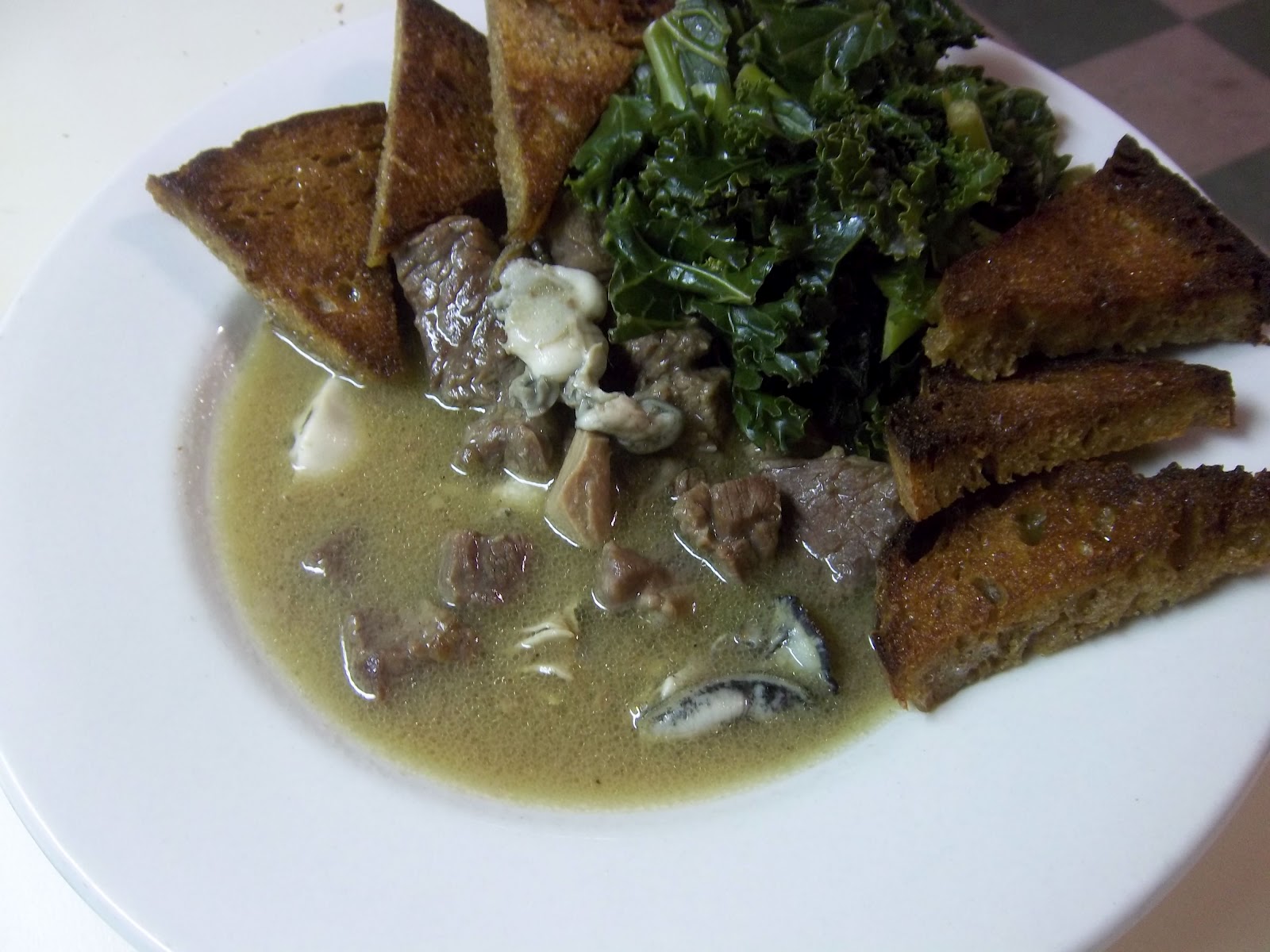
#338 Beefsteak Stewed with Oysters


This is the third and final recipe that uses the classic combination of beef and oysters. I was so dubious about it at first but now I relish and look forward to recipes like this. This one is a simple stew that is easy to prepare and uses few ingredients. It probably was at its peak of popularity in Victorian times – I have mentioned before a few times how oysters were so cheap they were used as a seasoning. The final product isn’t overly fishy as one might expect.

This will feed between 3 and 5 people depending upon greediness.

Start with your oysters; you need to prepare 18 of the buggers. However, this is only if you are using the small British ones, if you are using the large Pacific or Atlantic ones, you can get away with half or even a third of the amount. Luckily, being in the USA at the moment it is pretty easy to find the little bivalves pre-shucked in tubs in their own liquor. If you can’t get hold of the pre-shucked kind, I hear you can easily open them by putting them flat side up in the freezer and when the oysters fall asleep they open up. I have never tested this so it may all be nonsense. However you get your oysters, make sure you drain them well through a sieve and keep the liquor.

Next, the beefsteak – any kind ‘will do for this recipe, from chuck to rump’ – you need 1 ½ pounds in all. Cut it into large neat pieces and season well with salt and pepper. Melt 2 ounces of butter in a large deep pan with a lid and brown the beef, in batches if necessary. Once that job is done, add around ½ pint of water and the oyster liquor. Cover, bring to a simmer and cook until tender between one hour and 90 minutes depending on the cut of meat.

Whilst it gently bubbles away, mash together ½ ounce of butter with a rounded teaspoon of flour.  When the meat is ready, add 2 ounces of port and stir the butter and flour mixture in small knobs until the sauce thickens. You might not want to add it all. I like a sauce on the thick side so I did. Don’t let the sauce boil hard though. Next add the oysters – if large, cut into two or three pieces – and season with salt and pepper. Heat the oysters through for a couple of minutes – no longer, or they’ll be rubbery.

‘Serve very hot’, says Griggers, with triangles of bread fried in butter ‘tucked around the sides’.

#338 Beefsteak Stewed with Oysters. I love this combination so much! What a shame there are no more recipes left like this. The water had become a rich but not overpowering sauce that goes so well with the iodine-scented oysters. The fried bread was a great contrast in texture and the recipe is so easy and quick compared to a pie or pudding too. It is such a shame that oysters are so expensive. I am wondering if mussels could be used as a substitute. This one is going to remain a staple whilst I am in the USA where oysters are cheap! 10/10.

Wednesday, February 8, 2012

#331 Boiled Ox Tongue: to Serve Hot


I know what Othello needs; more tongue...

There was a time when I would shudder at the thought of eating some tongue, but now because of this blog, I look forward to it. After all it’s just a muscle like any other in the body, and no meat-eater turns their nose up at the muscle bits (although, as an aside, the tongue isn’t like any other muscle in body because it is the only one that isn’t attached at both ends).

In the earlier recipes, I wasn’t so good at boiling meat – I always had too high a flame burning beneath the stockpot. What any meat needs is a nice slow simmer – as slow as possible, the water should be scalding and letting up the tiniest gulping bubbles.

You can buy pre-pickled tongues from any good butcher quite cheaply; when I paid a visit to the butcher back in Manchester, I noticed they were selling them for just £2.50 each! If you want to do it from scratch, I have already written how to pickle an ox tongue (recipe #150) and how to boil and prepare one for Boiled Ox Tongue: to Serve Cold (recipe #258). So all I need to do for this post is tell you what you need to do to eat it hot…

Once it has been skinned and trimmed, Grigson gives her orders: ‘[s]lice the tongue whilst still hot and arrange it decoratively on a large shallow serving dish. Cover with a suitable sauce, boiling hot, place in the oven to heat through for about 10 minutes.

But what sauce? Jane says that the typical English way is to serve Madeira sauce, though strangely she does not give a recipe for it (I shall hunt one down and add it to the other blog in due course…). She does, however, give us an alternative and that is an “unusual” black cherry sauce, but you’ll have to see the next post for that recipe…

#331 Boiled Ox Tongue: to Serve Hot. This has got to be the best tongue recipe so far (there is only one more left) – it was so tender, hardly any chewing was required and the brine give a good, subtle curing. It reminds me of extra-succulent corned beef in fact. I know many turn their noses up at offal, but have a go, it is really good food and I have yet to eat a bit of animals I haven’t liked. 8.5/10.

Friday, December 9, 2011

#320 Steak, Kidney and Oyster Pie

A while ago I made an extremely similar recipe – steak, kidney and oyster pudding. A seminal English dish that I had saved for the landmark 200th recipe. This pie essentially follows the same history (and recipe) as the pudding – the combination of the three main ingredients seems to start with Mrs Beeton. I have found similar recipes going back further like oyster pie, beef-steak and oyster pie, veal and oyster pie and calves’ foot and kidney pie. I could go on, but I shan’t, I think you get the message. The pudding was delicious so there was no way this could be a fail...

+
=

It is worth mentioning my supplier for the beef again - I got it from Missouri Grass Fed Beef, the boss, Jeremy, gave my the kidney for nothing as well! Good man.
This pie uses exactly the same filling as the pudding, so click the link here to find out how to make it; it’s pretty straight-forward stuff. The important thing to note is to check how much and how watery the gravy is before you add the oysters – if there is alot, strain the gravy and boil it down until it darkens and thickens. You need to make it thicker that you would think, because you add oyster liquor to it when it has cooled.
Put the cold filling in a pie dish and get the pastry ready. You can use either puff or shortcrust pastry for the pie. I went for puff. Roll the pastry out and cut strips of pastry about half an inch wide to cover the rim of the pie dish, using water as glue. Griggers says to let the strips hang inwards a little to prevent hot filling from leaking out.

Brush the pastry rim with more water and cover the pie. Crimp down the edges so that the pastry is well-secured. Then Jane says to scallop the edges if you have shortcrust pastry or nick the pastry if puff pastry, after that make a central hole and a leaf design from any trimmings. I hardly had any trimmings left as I didn’t really have enough pastry. Lastly, make a pastry rose with a stem and fit it loosely into the central hole, then give the whole thing an egg glaze.

Bake for around 45 minutes at 220-230⁰C (425-450⁰F).

#320 Steak, Kidney and Oyster Pie – well I already knew this was going to be good seeing as I have essentially made this before, but just to reiterate: absolutely amazing. The combination of rich wine gravy, the metallic kidney and the creamy iodine finish of the oysters is fantastic. Mrs Beeton should be made a saint! 9/10.

Wednesday, December 7, 2011

#319 Marrow-Bones

If you are looking for a historical recipe that goes far far back, you would find it hard to do better than some nice marrow bones. In fact, this one goes so far back it predates humans themselves. We humans belong to the genus Homo – we are Homo sapiens – and there have been over a dozen now extinct Homo species discovered. Palaeontologists have found very good evidence that individuals of the genus Homo were making tools for extracting the nutritious bone marrow from the prey animals they hunted. To give a little perspective, Homo sapiens arose around 200 000 years ago, so this behaviour has been around for ten times as long as we, as a species, have been on this planet. Crazy shit, man.

It is hypothesised that the ability of these intelligent creatures to crack open the bones of animals, helped snowball the evolution of their intelligence, increasing the size of their brains and the complexity of their tools over evolutionary time. Eventually the invention of controlled fire came about during the early stone age. Here, early humans and Neanderthals learnt to roast bones as well as other things like seeds to make foods easier to digest and more palatable. Go back 7 700 years, and late stone age man was taking part in large-scale hunting, butchering, cooking and feasting – according to the findings at an archaeological site in Holland. What was the apparent favourite? Bone marrow of course!
Stone mauls like this were used to crack open marrow bones.
Many have been found in Alaska, Canada and Australia

The bone marrow was prized because it contained a huge amount of energy in the form of fat, which allowed them to spend a larger portion of energy to brain production, fuelling the evolution of brain size itself. These days bone marrow is only fit for dogs it seems, and yet if you go back a century or two, bone marrow is a pretty common ingredient. Grigson points out that Queen Victoria herself dined on bone marrow on toast every single day. That said, these forgotten cuts are getting attention once more; the excellent nose-to-tail chef Fergus Henderson’s signature dish is roasted marrow bone.
Queen Victora obviously put away a few too many marrow bones!

I managed to get some marrow bones from an excellent farmer in Missouri called Jeremy Parker who sells top-quality grass-fed beef (a big deal in America). His company is called Missouri Grass Fed Beef (here’s the link) and if you get the chance, get hold of some. I met him at the local farmers’ market and he very kindly cut me some bones right from the centre of the leg bones. It is sometimes possible to buy the marrow already extracted, but it usually costs a fortune.
If you want to have a go at cooking your own bone marrow, you will need one centre-cut piece of marrow bone per person between four and six inches long.

Make a thick paste of water and flour to cover the end of the bones and wrap the ends tightly in foil. The paste cooks and forms a barrier, preventing the marrow from leaking out.

Next, tightly wrap the entire bone in more foil and stand them up in a suitable cooking vessel such as a deep stockpot or fish kettle. Add water to at least half way up the bones and bring to a boil before turning the heat down to a good simmer. Cook for two hours, and remove the foil, peeling off the dough-plugs from the ends. Serve stood upright on a plate with slices of dry toast to spread the marrow on.

All you need is a little salt to sprinkle over. If you are the posh type you can buy some marrow spoons to eke out the marrow. We used teaspoons and lobster scoops instead, but skewers and knives would probably work too.
#319 Marrow-Bones. My goodness, these were so delicious. The marrow was extremely soft and well-flavoured. You could tell the marrow was massively high in fat – it seems to almost effervesce in the mouth. It was extremely satisfying to dig in with various implements to extract all the goodness. I now understand why this was the most sought-after part of the animal. I also now know that no dog of mine will be getting the marrow bone! 9/10.

Monday, June 6, 2011

#296 Tongue and Mushroom Crumble

Around fifteen minutes after deciding to cook all the recipes in English Food, I had a first proper look through the good book. It was then I realised that some of the recipes were pretty bizarre, and this one stood out; I had not eaten tongue then, but now I have done a couple of tongue-based recipes so I wasn’t squeamish. Though a tongue crumble is still a bit weird. I made this and took it round to a small gathering of friends to try. There were mixed attitudes…

There’s not much of an introduction to this recipe – Griggers says nothing about it in the book and after an internet search, I was also none the wiser. Recipes did crop up, but there was, alas, no background or history to it. Here’s a nice painting with an ox tongue in it though:

Calf's Head and Ox Tongue by Gastave Caillebotte, 1882

To make the dish, you need to start with pickled tongue weighing around 3 ½ pounds – you can use any tongue you like: ox, calf or pig (I went with ox). You can pickle them yourself (look here for a post that fills you in on this) or get them pre-brined by the butcher. The tongues should be just lightly brined, so if you are doing your own, just leave them in the brine for a day or two. If it’s from the butcher’s shop, you’d be best to soak the tongue(s) overnight in cold water as they may have been in his brine crock for quite a while.

Place the tongue(s) in a stockpot along with a chopped onion and carrot, a bouquet garni and half a pint of dry cider. Top up with water to just cover. Bring slowly to the boil, skim if you need to, and simmer very gently until cooked – this could be one hour for pig, 90 minutes to two hours for calf and three hours for ox. You can tell a tongue is ready if a skewer goes in without much resistance. Don’t worry if you cook it too long, as long as the water was barely simmering, the tongue will still be moist, this because tongue is a fatty meat, around 70% fat in fact.


Take the tongue out of the pot, but keep the stock, let the tongue cool slightly so you can peel the skin off and cut away the sinew from the blunt end. There are some quite large blood vessels and sinew running along the underside of a tongue, so turn it over and cut that away too.


Now slice the tongue, removing any more gristle as you go – there is none as you approach half way. Arrange the tongue on the bottom of a buttered ovenproof dish. Next cook down 4 ounces of sliced mushrooms in one ounce of butter and scatter them over the tongue. Whilst they are cooking, finely chop a medium onion and cook it gently in two ounces of butter – cover the pan so it doesn’t brown. Once softened, stir in a rounded dessertspoon on plain flour and let it cook for a couple of minutes. Whisk in 6 tablespoons of dry white wine. It will instantly thicken. Thin it out with some of the stock until you have a sauce the consistency of thin gravy. Cook for a few minutes, adding more stock should the sauce become too thick, season and pour it over the tongue and mushrooms.

Next, make the topping by making some fresh white breadcrumbs using a blender. Griggers says to use 1 ½ ounces of bread, but you may need more. Sprinkle this over the tongue and sauce and bake in an oven preheated to 190°C (375°F) until all is bubbling. Because everything has been cooked already, it is just a heat-through that’s required, so it can all be made in advance.

Hannah gets a good lungful of tongue.
That sounded less gross in my brain than when read out loud.

#296 Tongue and Mushroom Crumble. Like most of the weird recipes in the book, this savoury crumble was pretty good. The corned tongue was very tender indeed and well flavoured too, and the mushroom lent an earthiness that always goes well with anything beefy. Much, much better than I expected 6.5/10.


Saturday, November 13, 2010

#258 Boiled Ox Tongue: To Serve Cold

Hello there Grigsoners! No, I’ve not died, I have simply been a lazy bastard. I am going to stop apologising for my blog-tardiness and try my very best to pull my finger out. All that said, I have been preparing this recipe on the sly for the last few days. I went to Central Market with Gerda from the lab a while ago and found that quite alot of the ingredients that are tricky to get hold of in the UK are actually much easier to get hold of here in Texas. In the meat section, I happened upon an ox tongue and I knew that there are quite a few recipes using ox tongue specifically so I thought I’d grab it and do something with it later.

I decided upon this one – Boiled Ox Tongue: to Serve Cold, because I could take it into work and force my new labmates to eat it and (hopefully) put some comments on here! The recipe calls for a 2 ½ to 5 pound pickled (i.e. brined) ox tongue – these you can order form your butcher (in the UK at least). I thought I would pickle it myself using this now tried-and-tested brine method from English Food. The tongue needs 5 to 7 days in the brine tub, but there is no maximum time really - you can’t oversalt anything, because you can soak it in water for 6 or so hours beforehand. It’s recommended you do this with a pickled tongue from the butcher’s shop.


The tongue before brining
 Anyways, after you have soaked your tongue place in a stock pot and cover with cold water or a light stock. Bring it to the boil and skim any scum that appears at the water’s surface. Turn the heat down to the merest simmer. After half an hour, taste the water – if it is horribly salty, thrown the water away and start again. Add some stock vegetables: an onion studded with a couple of cloves and a chopped carrot and celery stick. Add also a bouquet garni and 12 crushed black peppercorns. Allow the whole thing to simmer for a total of 3 or 4 hours (don’t forget to include that first half hour!). The tongue is cooked when you can insert a skewer with ease.

The pressed but unsliced tongue
Remove the tongue from the water and allow it to cool slightly. Peel away the skin and remove any gristly bits from the thick end. The tongue is now ready to be pressed. Coil the tongue and place it in a 5 or 6 inch loose-bottomed cake tin with base removed. If you can’t get hold of one (I couldn’t) you could invest in a proper tongue press. I actually used a straight sided mixing bowl that I happened to have and it worked very well. Place the tin base on top (or something similar) along with a couple of tins of food and allow to cool and press for several hours or overnight. When cool, transfer to the fridge.


When you are ready to eat it, slice it thinly and serve with a salad and some horseradish sauce so says Lady Jane Griggers. If you want to be all Victorian about it ‘press the tongue into a slipper shape, and then decorate it with aspic jelly and bits and pieces’. However, The Grigson goes on to say: ‘I think we have lost sympathy with over-presented food of this kind: it always arouses my suspicious – I wonder what the caterer is trying to conceal.


FYI: the tongue is the only muscle in the body not attached at both ends.

#258 Boiled Ox Tongue: To Serve Cold. I’ve not had much experience of eating tongue, except the kind you get already sliced for sandwiches and always found it a little bit on the tasteless side and have never really cared for it. This was much better, though didn’t pack much of a flavour-punch; which was a shame because when I pulled it hot out of the stock, it smelt absolutely delicious. Perhaps I over-cooked it. Anyways, this tongue was wonderfully tender and moist due to its high fat content and gelatinous qualities. Nice, but I’m not doing back-flips: 5/10.

Tuesday, February 16, 2010

#225 Cockie-Leekie

And my lords and lieges, let us all to dinner, for the cockie-leekie is a-cooling.”

Sir Walter Scott, to his dinner guests

Cockie-Leekie, or Cock-a-Leekie, is a very Scottish dish, or so I thought. Apparently it turns up in several versions in Scottish and Welsh cook books and a rather complicated recipe in an English cook book where it is called Hindle Wakes. It appears in English food, but I haven’t done it yet.

So it is not necessarily exclusively Scottish. It is also not a soup. It’s a good, hearty and simple dish: beef, chicken, leeks and prunes all stewed together. All you need is some slow cooking time. Have a go and make it for a lazy Sunday dinner as I did. It serves at least 6 people:

Start off by placing a two-pound slice of stewing steak in the bottom of a deep stockpot. Cover with water and bring it to a boil slowly, skimming off any scum as it rises to the top. Simmer for an hour and hten season well with salt and pepper. Meanwhile trim three pounds of leeks and tie half of them in a bundle. When the hour is up place them in the pot. Simmer for a further half an hour before adding a whole chicken or capon and sit it on top of the beef (you can use a boiling fowl; if so, add it when you add the leeks). The cockie-leekie now needs to simmer gently for an hour and a half. Twenty minutes before it is ready remove the bundle of leeks and add a pound of prunes. Now slice the remaining leeks up and add those in the final five minutes. Easy.


To serve it, place some beef and a piece of chicken in large bowl and cover with the thick, dark and rich stock. A meal in itself, though I did some boiled new potatoes too.

#225 Cockie-Leekie. Really good food, especially for this time of year when all is miserable and wet outside. This is home-cooking at its simplest and finest. The stock produce from the beef and prunes was lovely and rich, but did not detract from the subtly-flavoured chicken. Really good one this one. 7.5/10.

Tuesday, December 29, 2009

#213 Boned Roast Sirloin

This Christmas – 2009 – was the year we did not have turkey. This was the first time ever, and I have to say it wasn’t missed (at least not by me, anyway). Instead it was roast pheasant and roast beef, not any roast beef though, but roast sirloin. Griggers says that if you cooking beef for a special occasion and you want to be sure of good beef, go for this cut. She suggests getting it from Harrods, but I didn’t go that far. Instead I went to a very good butcher’s shop in Pudsey, my home town, called Bentley’s. It’s won many an award so I thought I would mention them.

A roasting joint such as this needs little doing to it – place it in a roasting tin and season the fat with saltr and plenty of black pepper. Place in a very hot oven – turn the heat as high as possible and leave for 15 minutes, turn the oven down to 180⁰C and roast for 15 minutes a pound for rare meat. Serve with the usual horseradish etc.


FYI: I bought a meat thermometer so I could be absolutely sure of perfectly cooked meat. I did it medium, though I would have done it rare if it were just me eating it. If you have one then follow these temperatures: up to 60⁰C gives you rare beef, 60-70⁰C gives you medium and 70+⁰C gives you well-done beef.

FYI2: there is a common story about Henry VIII eating loin of beef at a banquet and thought it was so delicious that pronounced it ‘Sir Loin’. This is unfortunately a lot of nonsense, though I wish it were true. This cut of beef got its name is from the French sur loin, meaning above the loin.

#213 Boned Roast Sirloin. This was the best roast beef I’ve ever had in my life! It was as soft as butter and tasty and all the better for adding only salt and pepper. No messing about with extras here. It beat the rib of beef hands down. Absolutely gorgeous. Go cook some next time you have something special to celebrate – this is an order! 10/10

Monday, November 23, 2009

#207 Sussex Stewed Steak

Stewed steak is one of the things that remind me of being a kid back home in Pudsey, Leeds. My Mum used to do stewed steak with dumplings sometimes and it was delicious. It’s odd, however, that I’ve never had it anywhere other then my Mum’s; nobody else seems to eat it. I don’t what it has to do with Sussex either. This recipe is pretty much exactly what my Mum did, except for two main differences: this uses one big piece of steak and has additional flavourings. This is a very easy recipe and perfect for these times of filthy weather that seems to keep your socks permanently soggy and your mind on sunnier times. Give it a go.

Start off with a nice two to two-and-a-half pound slice of either top rump or chuck steak. Make sure it is well trimmed. Season both sides well with salt and pepper and coat with flour. Place it a well fitting ovenproof dish, and cover with sliced onion; use a large one. Now add six tablespoons each of stout and port and two tablespoons of either mushroom ketchup or wine vinegar. Cover tightly with foil and place in an oven preheated to 140⁰C for three hours. That’s it! Serve with mashed potato and field mushrooms, says Griggers.


#207 Sussex Stewed Steak. This took me right back to my childhood. The delicious thin gravy with a hint of rich booze and wonderfully tender beef cooked slowly – it’s what rainy November evenings were made for. 8.5/10.

Tuesday, November 17, 2009

#205 Potted Tongue

There are several recipes in English Food that involve tongue; a bit of the animal now much ignored by most, including me. It’s one of the few things I’ve never tried, so I thought I should make sure my first foray into tongue cookery a simple one. Potting is nice and easy as long as you have a food processor or blender, plus I always need sandwich fillings for work. It uses eight ounces of cooked tongue – this can be calf’s or ox tongue, pickled or fresh. The calf’s tongue that I got from Winter Tarn was exactly eight ounces in weight after it had been cooked and trimmed. However, if tongue is not your bag then you can use beef, salt beef, venison or any other game.

Chop the calf’s tongue and place in a blender or food processor – use a blender for a smooth finish, a food processor for a slightly coarse one – along with four or five ounces of clarified butter, some salt, pepper and mace (if you are potting a different meat, you could use a different spice or even a couple anchovy fillets). Blend until the right consistency and place in pots, making sure you pack them down well and leave flat surface. Pour more clarified butter over to form a seal.


#205 Potted Tongue. In Yorkshire, potted beef is still quite popular, but for me, the tongue did not work quite as well as I’d hoped. The tongue tasted okay when it had been cooked, but perhaps stronger tasting cured ox tongue would have been more appropriate. Oh well, never mind – you can’t win ‘em all. 4/10.

Thursday, November 5, 2009

#202 Pressed Beef

A quickie this one.

I wanted to do a recipe from the cured meats section of the book as I haven’t done many of them and I didn’t want to start getting behind. This one appealed to me because it was similar to the salt beef recipe I had already done and I knew that the cold, pressed beef would keep me in sandwiches and snacks for the week, plus the cooking process would produce a nice stock which could be turned into a lovely soup. I also thought that you don’t really see salt beef these days in supermarkets etc, and then by total coincidence my workmates and I went to the very good café in the Whitworth Art Gallery (which makes up part of Manchester University’s campus) and what was on the menu? Salt beef sarnies! I may be some kind of soothsayer.

To make your own pressed beef you need a joint of silverside – go for somewhere between 2 and 3 ½ pounds in weight, I reckon. You can use either fresh or salted for this. If you want to do pressed salted beef, you can buy it from your butchers, but it is much better if you make your own. I did – follow the instructions on brining on this earlier post if you want to have a go. Next, you need to boil the beef joint – follow the instructions on this post here for how to do that (I love how the blog is becoming self-referential!) you can follow the same recipe if you’re using fresh beef too. Leave the beef to cool in the broth for a couple of hours before removing and wrapping well in cling-film or foil. It now needs to be pressed overnight; either use a tongue press or place it under some very heavy weights. I used an upturned loose-bottomed cake tin so I could precariously balance a cast-iron griddle pan, an earthenware jug and some tins of food on it with at least some attention to health and safety.


Next day, you can slice the beef as you need it. Make sandwiches using rye bread, pickled gherkins and horseradish sauce (I also added some mayonnaise). Alternatively serve with an avocado salad.

#202 Pressed Beef. This is absolutely delicious. So much more tasty and such better quality than any supermarket pre-sliced nonsense. I would really recommend trying the curing, cooking and pressing yourself, it’s doesn’t take much effort at all and the pay-off is great. The beef is firm and deliciously sweet and salty. The spices – particularly the mace – come through beautifully and compliment the beef so well without drowning out its flavour. 8.5/10.

Tuesday, November 3, 2009

#200 Steak, Kidney and Oyster Pudding

As promised, a dish that is more English that roast beef and Yorkshire puddings, at least I think so anyway. It may be because I’m a Northerner, but I also think (and I could be wrong here) that although it is very English, it hasn’t travelled to other countries as well as, say, roast beef. In other words, it’s a sort of hidden gem. I have been saving this one for number 200 for a while, though I did change my mind a fair few times.

The seemingly unusual ingredient here is, of course, the oysters. The recipe is surprisingly recent: it appears as a steak pudding in a book by Eliza Acton in 1845 and the kidney turns up in Mrs Beeton’s Household Management nearly fifteen years later. In those days folks living near the coasts were falling over oysters – they diminished however due to a combination of an increased population eating them and the increased pollution created by all those extra people. No one wants a shitty oyster. However, before this, they were cheap and the preferred alternative to the very pricey mushrooms that the posh gentry would have enjoyed. It was only since around the Second World War that mushrooms have been cultivated on a large scale, before that they acquired by foraging: limited and very seasonal. Of course, these days it is the mushrooms that are ten-a-penny, and the oysters that break the bank. That said, native oysters are in season at the moment and the ones I bought from Out of the Blue in Chorlton were just sixty pence each.

This pudding is a pretty posh all-out one; giant, full of rump steak, red wine and extra beef stock plus both mushrooms and oysters:

To begin, make the filling: cut two pounds of trimmed rump steak into one inch cubes and then slice a pound of ox kidney (or veal, if you’re being really posh), removing any fat or gristly bits on the way. Toss these in two tablespoons of seasoned flour. Chop a large onion and fry it gently in two ounces of butter until nicely softened, remove with a slotted spoon, turn up the heat and then hard fry the beef and kidney. When brown transfer to a casserole dish (or, if you have a cast-iron one that goes on the hob you can keep it all in there. Deglaze the pan (or casserole dish) with either a pint of beef stock, or half-and-half stock and red wine. Now slice 8 ounces of mushrooms and fry them in an ounce of butter. Add these along with the cooked onions and a bouquet garni to the meat. Cover with a lid and cook in the oven for 1 ½ hours at 140-150⁰C. You can do all this the day before if need be.

Next, open the oysters: Griggers suggests 18-24 oysters, though makes them an optional ingredient for the pudding. I went for a dozen as I didn’t want to go bonkers with the spending. Add them, plus their liquor to the meat. I’ve written about opening oysters before.

To make the suet pastry, use a knife to mix together 10 ounces of self-raising flour, a teaspoon of baking powder, ¼ teaspoon of salt, ground white pepper, ¼ teaspoon of thyme and 5 ounces of chopped fresh suet (use the packet stuff if you can’t get hold of it). Now add cold water little by little to the mix, stirring with the knife. Use the minimum amount of water that will bring the pastry together, using your hands towards the end. If it seems too wet, add more flour. There’s enough pastry to line a three pint pudding basin, so roll it out in a circle large enough and remove a quarter of it (you’ll use this later). This’ll make it easy to line the basin – use water as glue to stick down the ‘hem’. Spoon in the mixture and then roll out the reserved quarter into a circle to make the lid. Place this on top and fold any surplus edging over it and glue it with more water. Secure the lid if using a plastic basin, or cover with buttered, pleated foil secured with string. Place in a steamer and cook for one and a half hours; don’t let it boil dry. Turn it out onto a plate and serve immediately.


#200 Steak, Kidney and Oyster Pudding. The poshest pudding in the world! It was very, very good though. The beef and kidneys were very tender and the gravy was good and rich. The real revelation was the oysters – at first I wasn’t very sure about them, but it was a taste that was acquired very quickly. They provided a mysterious iodine tang to the whole thing. The original surf ‘n’ turf! The only thing I would change is the amount of pastry - there was barely enough to line the basin, making it split open when it was turned out! 9/10.