Showing posts with label cured fish. Show all posts

Sunday, July 6, 2014

#395 Red Herrings


Here’s a recipe – or, rather an entry with advice – from English Food that I thought I would never get to cook for two reasons. The first was that I suspected that Jane was having a little joke at our expense and that her entry on red herrings was actually a red herring in itself! Having only ever used the expression and never laying eyes on the food, the penny did not drop for a good while that the saying must have come from somewhere. So, after looking in a few other books I decided red herrings were, in fact, real.

The Red Herring Freehouse, Great Yarmouth
According to Jane’s entry, they are made in Great Yarmouth, and although they have fallen out of favour her in the UK, they are shipped over to the Caribbean in their droves where they are still a very popular food, indeed, a staple food:
Once they were slave food, now they are a food for the poor, a cheap, storable, provider of protein.
So if they are made in abundance on the south coast of England, a few must escape the net and show up in England itself, right? First I looked online, then in Afro-Caribbean shops in Manchester. Not a whiff. Then, when I lived in America, I detected a scent; apparently they are widely available in Afro-Caribbean stores. Well, not in any of the ones I looked in!
I was ready to give up hope, but then, when I returned to Manchester after my two-year hiatus, I eventually found somewhere that sold them, and that place was an online store called the Smelly Alley Fish Company, Reading. Hooray!
I ordered four and eagerly awaited their arrival. In the meantime I had to work out what to do with them.


Before I tackle any recipes, I’d better tell you what a red herring actually is.
A red herring is a heavily brined and smoked whole herring, rather like a bloater, except it is brined for at least a week, dried, and then cold smoked for at least four weeks. It is this extreme curing that gives both its red coloration and its unbelievably long shelf life so that it can easily survive long journeys and the humidity of the Caribbean.
The red herring cure originated in Scotland, but the herring fished in the North Sea were fatty; making them delicious, but decreasing their shelf life. However, the herring caught off the south coast of England at Great Yarmouth had little fat, and therefore were perfect for trade, eventually outcompeting Scotland.
Red herrings were a staple food for poor people living inland during the Middle Ages, especially during Lenten days, and predated the kipper, which is a relatively new invention.
I love Dorothy Hartley’s description of them from her 1954 classic Food in England:
Red Herrings are a form of super-salted bloater, very popular on the western seaboard, specially [sic] in Ireland. They produce a terrible thirst – all artists seem to like them: I cannot account for this. Rudyard Kipling makes his “Hal o’ the Draft” cook salt herrings in the Cathedral, but he provides the only corroborative authority that I can produce for this notable dietetic discovery.
Note: At Hogmanay, if the [sic] Glasgow friend wishes you well, he slips a red herring down his sleeve into the palm of his hand as he grasps it.
Next New Year’s Eve, I shall try that trick.
Now we know what a red herring is, why is it used in the famous idiom? Red herrings were used as a method of training hunting hounds. A false trail using the pungent red herring would be laid so that the training hound or hounds could be taught to ignore the obvious strong scent and pick up the faint and subtle scent of their hare or fox quarry. Hence, when someone is falsely distracted from their path or purpose, they have been given a red herring. Every day’s school day.
So what do you do with your red herring, once you have found it? Well, here are Jane Grigson’s instructions, which as per the rules of the game, I must follow:
If you ever manage to buy some, soak them well in water or milk. Then grill them or toast them in front of the fire, basting them with butter or olive oil. Serve them with scrambled eggs or potatoes mashed with plenty of butter. Or think of them as anchovies, to be used as a relish rather than a main food.
All good so far, but they are so dry, I wasn’t sure how long to soak them for. Hours? Days? I needed more instruction.
In Good Things in England (1932), Florence White gives us an 1823 Great Yarmouth recipe:
  1. Choose those that are large and moist.
  2. Cut them open, and pour over them some boiling small beer.
  3. Let them soak half an hour, then drain and dry them.
  4. Make them just hot through before the fire, and rub them over with cold butter.
  5. Serve with egg sauce or buttered eggs; mashed potatoes should also be sent up with them.
All well and good, but mine were not moist, but as dry and hard as if mummified.
Here’s a recipe from a lady called Meg Dodd’s, via The Scots Kitchen: Its Lore & Recipes (1929) by F Marian McNeill:
Skin, open, and trim red herring. If old and dry, pour some hot small beer or water over them and let them steep a half-hour, or longer if hard. Broil them over a clear fire at a considerable distance, or before the fire; rub them with good oil or fresh butter while broiling, and rub on a little more when they are served. Serve them very hot with cold butter, or with melted butter and mustard, and mashed potatoes or parsnips.
And finally, from the Smelly Alley Fish Company’s own website:
To cook them, soak for 48 hours, then fry with tomatoes - a great breakfast! They are great as they are (they don't need to be cooked), and as they are very salty, you might need a pint of beer to drink with them.

I took Jane’s instruction and soaked them in milk, in the end, overnight. The next morning, the house awoke to the pungent smell of soaked red herrings. I fished them out of their now rufous milky marinade and grilled them smeared in butter, serving them with eggs for breakfast.
They were still pretty dry after all that soaking, though the roes found inside were nice and soft, and quite possibly the saltiest things I have ever eaten in my life. Trying to eat the flesh of the herring was tricky as it could not be parted easily from the bones. I had, as warned, a huge thirst, and the smell of red herring had still permeated my little terrace a week later.
#395 Red Herrings. What to say of red herrings!? Well they did taste good, but they were so unbelievably strong in flavour, and so difficult to eat (think fish jerky) I barely ate half of one. I think I need to revisit them following advice from those other recipes. A slow simmer in some hot milk might be a good idea, to help rehydrate the fish, or give a two-day cold soaking, but I think that it might be best cut with plenty of butter as potted red herrings or something like that. I have two left, so shall keep you posted on that one. Score? 7/10 I think, because the flavour was great, given even its pungency, it just needs taming!

Wednesday, October 17, 2012

#358 Bloater Paste


The thought of eating fish paste may make people shudder, people would think differently if this recipe were named smoked fish pâté, I feel. However we are not French so fish paste it remains. Perhaps people think back to those nasty cheap homogenised pots of meat and fish paste from their childhood. If you make your own it is a very different creature and I am sure this one will be same.

The other thing that may put one off from this recipe is the name of the fish in question – the bloater. It’s not the most delicious sounding fish is it? There have been several bloater recipes and this is the final one, but if you are not in the know a bloater is in fact a cured herring. The cure is very similar to that of the kipper and the only real difference is that bloaters are cured completely whole giving them a more gamy flavour than a kipper. Because they are intact they bloat as they smoke, hence the name.

This is a nice straight-forward easy affair. Start by gutting your bloaters, removing any membranes from the cavity. I had just one, but was lucky to find two nice fat roes inside within so I reserved those and tossed the rest of the innards in the bin.

Pour boiling water over your fish and roes; the skin will curl and the body of the fish will noticeably tense and plump up. Leave for around 10 minutes to poach in the water. Remove the skin and flake the flesh, being careful to pick out any bones, don’t worry too much about the very thin hair bones, they will not be noticed.
 
Don’t forget to fish out the roes, should you have any. Weigh the fish and place in a food processor along with its equal weight in softened butter. Whizz up until you have a spreadable consistency you like. Season with ground black pepper, lemon juice and a little salt. Serve with hot toast.

You get quite a lot of paste – I got two 250 ml pots from just the one bloater. Not bad at all I reckon.

#358 Bloater Paste. This was delicious and light – the butter helped whip the bloater into a wonderful consistency and the lemon juice really accentuated the fish’s own natural piquancy. Very good. 7.5/10.

Thursday, June 14, 2012

#342 Halibut with Anchovies

It’s always nice to add an extra species of animal or plant to my list of foods I have eaten. Halibut is reasonably pricey so I have typically avoided them in the fishmonger’s shop. They are also beasts – the largest flatfish to be found in European waters. Check out this one caught off the west coast of Iceland in 2010:


It weighed an impressive 34 stones (that’s 476 pounds, or 220 kilos)!

This recipe is from the Polish novelist Joseph Conrad’s wife. She was and Englishwoman called Jessie George, who obviously had a flair for cookery. She wrote a book called A Handbook of Cookery for a Small House, and I assume (for Grigson doesn’t say) that it is this volume from which the recipe comes.

The recipe includes an unusual ingredient – Patum Peperium, otherwise known as Gentleman’s Relish. It is a highly spiced potted anchovy spread, and was a Victorian invention – click here for a link to the other blog for more information on this delicious savory.

This will serve 3 or 4 people, depending upon the size of your piece of halibut, which should weigh between 1 and 1 ½ pounds. Try and get hold of a steak, if you can only get fillets buy two pieces and sit them on top of each other. Make the spiced butter by mashing together 4 ounces of softened butter and a very generous heaped teaspoon of Patum Peperium and smear it over the halibut, including the underside. Sprinkle over 6 tablespoons of white breadcrumbs and bake in the oven for 30 minutes at 190⁰C (375⁰F) until the breadcrumbs have browned.

In the meantime make the tomato sauce that accompanies the fish. Peel 8 ounces of tomatoes by cutting through the skins in a cross shape on their undersides. Place in a jug and pour over boiling water. After 1 or 2 minutes, remove the tomatoes and the skin should be easy to peel away. Chop the tomatoes and cook them in a saucepan with a good sized knob of butter. Gently cook until the juices are reduced to just 3 or 4 tablespoons. Season with a teaspoon of Worcester sauce and some salt, pepper and sugar.

Remove the fish from the oven and place on a serving dish, pour the buttery juices into the sauce and spoon it around the fish. Finally, add 6 split anchovy fillets and place on top of the fish in a criss-cross pattern.


Jane suggests serving with matchstick potatoes. She does not let us know how to make them, but luckily I knew anyway: peel some potatoes and cut into 2 or 3 millimetre matchsticks – julienne as the French say – use a food processor or Chinese mandolin to do this (if you don’t have one, then don’t even bother and boil some potatoes in their skins instead). Plunge the potatoes into a roomy bowl of water so you can rinse away the start. Then drain them in a sieve.

Heat up some cooking oil such as sunflower or groundnut. When a piece of bread goes nice and brown in about 30 seconds, it is hot enough to add the potatoes in batches. Fry for 2 or 3 minutes until golden brown, around 180⁰C if you have an electric deep fat fryer or cooking thermometer, then drain on kitchen towels. Salt and serve.

#342 Halibut with Anchovies. What a delicious dish! The fish was firm, flaky and moist and the butter was seasoned with just the right amount of the Patum Peperium. The tomato sauce was rich yet fresh; a great meal for a summer’s evening. 8.5/10.

Wednesday, March 7, 2012

#334 Salmagundi for a Middle Dish at Supper

A salmagundi is essentially a rather grand salad which was popular in the 18th Century that has origins in the Elizabethan era. The idea being that the ingredients could be laid out for a ‘Middle Dish’ to produce a large sallet. The Salmagundi originated as a game dish called a salmi (click here for the recipe) popular since Medieval days.

Meals in those days were not served in courses, but all at once, with large dishes in the middle and smaller ones around the outside. The Salmagundi – sometimes spelt as Solomon-Gundy or salamongundi – would be part of a splendid centrepiece, with the meat and salad vegetables in many individual plates, in piles, or layered up. The most important thing about a Salmagundi is that the centre is raised higher than the rest so that upon the apex of the arrangement pickled herrings can sit. For some reason, this recipe appears in the Poultry section of the Meat, Poultry & Game chapter. Seeing as the only necessary ingredient is pickled herring, I would have expected it to be part of the Cured Fish section of the Fish chapter, though chicken or pullet – a castrated hen (can you castrate a hen? You know what I mean) – was ‘one of the most popular salmagundi ingredients’, says Grigson.
Here is one Hannah Glasse recipe that Jane Grigson quotes in English Food, I can’t find the source of it anywhere, Jane doesn’t say where she got it but it’s not in Glasse’s famous Art of Cookery:
In the top plate in the middle, which should stand higher than the rest, take a fine pickled herring, bone it, take off the head, and mince the rest fine. In the other plates round, put the following things in one, pare a cucumber and cut it very thin; in another, apples pared and cut small; in another, an onion peeled and cut small; in another two hard eggs chopped small, the whites in one, and the yolks in another; pickled gherkins in another cut small; in another, celery cut small; in another, pickled red cabbage chopped fine; take some watercresses clean washed and picked, stick them all about and between every plate and saucer, and throw nasturtium flowers about the cresses. You must have oil and vinegar, and lemon to eat with it. If it is prettily set out, it will make a pretty figure in the centre of the table, or you may lay them in heaps in a dish. If you have not the ingredients, set out your plates or saucers with just what you fancy, and in the room of a pickled herring you may mince anchovies.
Hannah Glasse: she was no looker, was she?

Other recipes include many other ingredients such as cold roasted veal, pork, duck, pigeon, oysters, lettuce (cut…as fine as a good big thread), samphire, peas, sorrel, spinach, chopped shallots and lemons, pickles, grated horseradish, a scattering of barberries, figs, oranges and lemons stuck on the top of a sugar loaf. The list goes on…
The secret to a good salmagundi, according to Jane Grigson, is in the layering of flavours, you need a good mixture of sharp, piquant things like the herring or gherkins as well as crisp salad vegetables and bland meats and eggs. The salmagundi often turned into a bit of a disaster, mainly because of the sentence: [I]f you have not the ingredients, set out your plates or saucers with just what you fancy… A housekeeper in a grand 18th Century larder would have had a plethora of wonderful pickled vegetables, preserved meats, plus whatever was growing in the kitchen garden at her disposal; housewives would not, and tended to make it after they’d cleaned-out their pantries. People were just being economical of course, but just what you fancy, does not translate as whatever’s in the back of the cupboard
When it came to making a salmagundi of my own I simply tried to take Jane’s advice and make a platter with a good mix of stuff and a decent olive oil and vinegar. I put an upturned bowl in the centre of a serving dish so that my pickled herring would be raised up and got to covering the whole thing in various bits and bobs. Here’s what I did:

#334 Salmagundi for a Middle Dish at Supper. I quite liked putting the salmagundi together and it was quite nice to look at and fun to eat. I think I got a good balance of the crisp, bland and piquant. It certainly made a nice change having an English salad that had a bit of thought put into it because usually they are a little sad. Shall I do it again? I think so – hopefully with a giant sugar loaf in the middle next time. 6.5/10.

Sunday, October 9, 2011

#310 Smoked Mackerel

There are ingredients for recipes in the book that I really thought I wouldn’t be able to find, and one of those is smoked mackerel. Smoked mackerel was a new addition to English cuisine at the time of writing English Food and these days it is quite easy to find in supermarkets. So why is there a problem? Well, Griggers says to keep away from the hot-smoked (i.e. cooked) mackerel as she says it often ends up as mush; no, only cold-smoked mackerel will do. When I lived in Britain, I had no luck finding anywhere that sells it. However, here in Saint Louis, as I was having a walk around Global Foods – a large international food market – what did I happen upon just sat there in the refrigerator as bold as brass? Yes, a large cold-smoked mackerel. It is amazing what you find when you’re not looking. It turns out that cold-smoked mackerel is very popular in Eastern Europe. It obviously didn’t catch on that well in England, though Griggers gets full marks for trying to push it.

Like many recipes in the Cured Fish section of the Fish chapter, this isn’t really a recipe, as there is no cooking involved, it’s really advice on how best to serve it.


First you need to fillet the fish, removing any bones, and arrange pieces of the fillet on a plate. I was pretty impressed with my presentation here; I’m not very good at that sort of thing normally. She suggests serving the mackerel with lemon quarters and brown bread and butter. Because there was no cooking involved, I felt it was a bit of a cop-out recipe, so I baked some bread myself. Jane also suggests making a gooseberry sauce flavoured with horseradish. There is zero chance of finding gooseberries here in Missouri so I couldn’t do that part, but it was just a suggestion, so I reckon I can let myself off...


#310 Smoked Mackerel. A delicious fish it was, no wonder Grigson wanted to get us all eating it. It was very much like eating smoked sashimi, which is certainly not a bad thing. It was much more firm and flavoursome than smoked salmon, which can often be weirdly gelatinous in its texture. The smoky flavour was excellent and bona fide; it smelled as though it had just been snatched from the smokehouse. I think cold-smoked mackerel might catch on these days; sushi is popular and people are much less likely to turn their noses up at raw (though perfectly-cured) fish. Hopefully it might get a second chance. 7/10.

Monday, July 11, 2011

#302 Caveach of Sole

I decided that I needed to get back into doing some proper cooking now that I have a new stove in my new apartment. I invited some people around from work and their various spouses and kids. It is pretty hot here in St Louis at the moment so I needed to choose a recipe that was nice and summery and not all hot and stodgy. It needed to be buffet-style as there would be eight of us in all and I can only fit four around my little table. It also needed to be one that is prepared in advance so I wouldn't be rushing around in the 35°C heat on the day. I don't ask for much do I? Oh, and it also couldn't be weird. My options for this kind of food are rather limited in the book now, but I happily found this one that seemed fresh and clean and rather Mediterranean in style.


The sole lies on its side on the sea bed to camouflage itself.
Over time, natural selection has reacted to this by moving one eye
so that they both sit on one side of the head.

The word caveach refers to a method of preserving fish by cooking and then pickling it and comes from the Spanish escabeche. I did a little research on the preservation method and could only find books from the early-to-mid nineteenth century that mention it in any detail; though it seemed popular in both Britain and America at that time. The recipe below is more of a dinner party adaptation where the fish is only left for a few hours to pickle and isn't intended as a preservation method at all. You can caveach any fish you like – the most popular seemed to be mackerel, herring and sardine, presumable because they were the cheapest and most common seafish at that time.

It is also nice to cook a receipt from the Seawater Fish section of the book – options are limited in America because there are different species of fish found commonly in their waters compared to European waters. However there is some common ground and the newly-discovered and very excellent grocery store Straub's has a great selection of fish and meat as well as some other tricky-to-find ingredients, so I'll be using them quite frequently during my time here in Missouri.

First of all prepare your sole fillets – you'll need eight in all. Flatten them a little with a rolling pin, season with salt and pepper and fry them quickly in a little olive oil so that they brown a little. Cut them into thirds and arrange the pieces on a serving dish. Slice a medium red onion thinly and scatter over the fish along with the thinly sliced pared rind of a lemon and a couple of bay leaves cut in two. Next mix together seven fluid ounces of olive oil with three tablespoons of white wine vinegar and pour over the fish. Season again with salt, pepper and some Cayenne pepper too. Cover and refrigerate for at least a few hours, but preferable over night. When it is time to serve, scatter over some chopped herbsparsley, coriander or chervil are suggested by Griggers. I went with coriander. Serve with bread and butter and a salad.


#302 Caveach of Sole. This was everything I had hoped it would be – fresh, clean and slightly piquant. The delicately flavoured sole was not overwhelmed at all by the onions and the mild seasoning. A very good recipe this one – and simple too. I think I am going to try it with other, cheaper fish in the USA like tilapia or catfish. Any fish would work I reckon. A dinner-party stalwart this one will be, I feel. 8/10.

Sunday, April 17, 2011

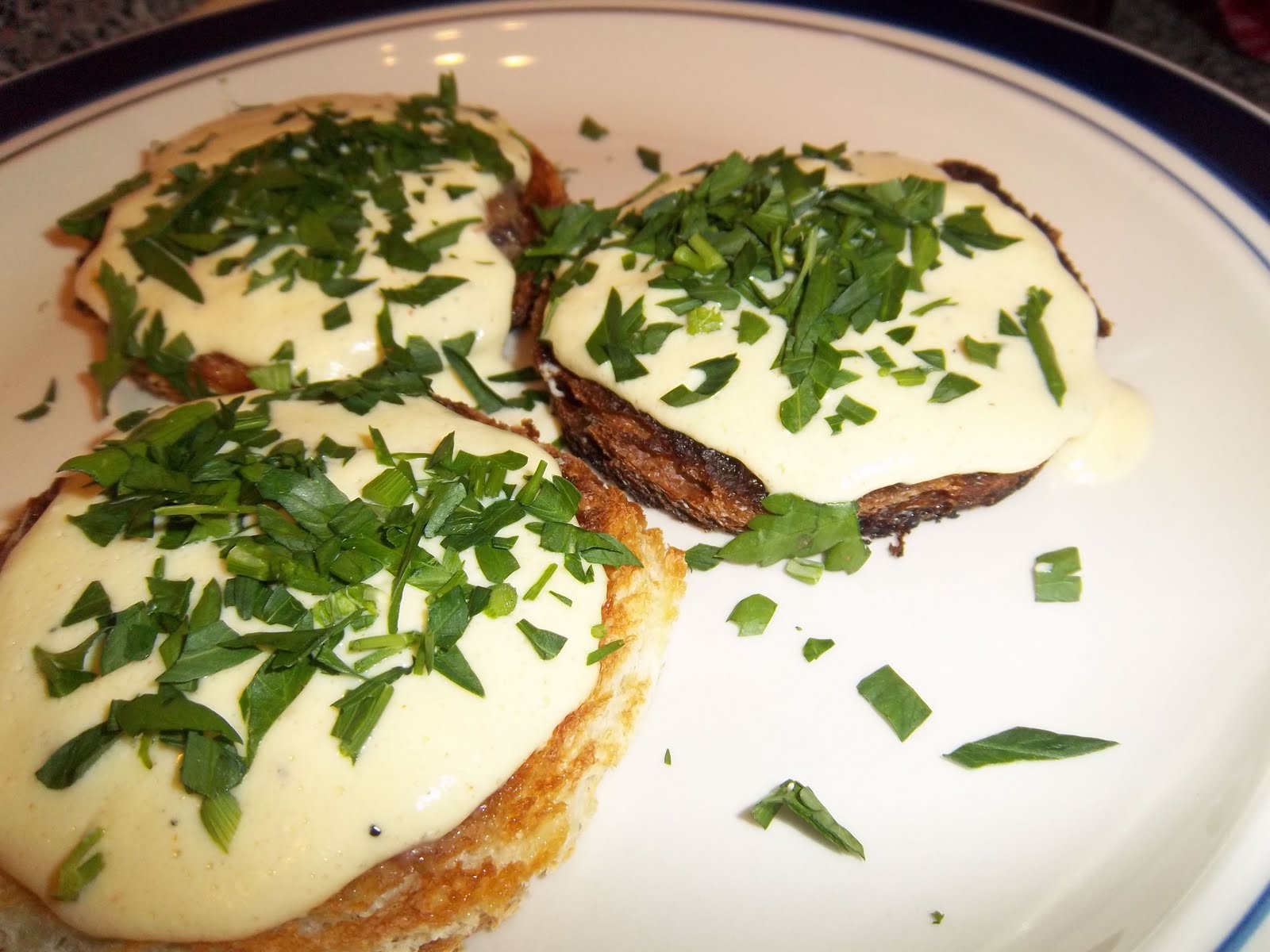
#287 Scotch Woodcock

Here’s a quickie that was a popular savoury in Victorian times in the same vein as Locket’s savoury and Gloucester ale and cheese. None of them are really eaten these days, though most of the time they are very tasty (though also very rich; no wonder everybody had gout). Although such savouries were served at the end of a meal in those days, it is is perfect for a first course or as a light lunch these days, I reckon.
It doesn’t contain any actual woodcock, of course, but is basically anchovies and eggs on toast – the fish and eggs being a substitute for the prized game bird. Just like how Welsh Rabbit is really cheese and bread instead of the delicious meaty mammal.
This recipe makes six woodcocks:
Start by draining a tin of anchovies before mashing them with two ounces of butter. Next, get the toast ready – cut circles out of six slices of bread and toast them on both sides. Spread with butter and then the anchovy mixture. Keep warm whilst you make the eggy sauce. In a saucepan, add two egg yolks to half a pint of whipping or double cream. Beat the yolks and add pepper a little salt and a good pinch of Cayenne. Stir over a moderate heat until the sauce thickens. Spoon over the anchovies, add a flourish of chopped parsley and serve it forth. If you don’t fancy making the thickened cream sauce, make some softly scrambled eggs made with a bit of cream instead.
#287 Scotch Woodcock. Previous anchovy-based recipes in this blog have ranged from the most delicious to the worst and most bizarre. This one however can join the ranks of the delicious. The intense saltiness of the anchovies was balanced very well with the bland creamy sauce. Very, very good. I ended up eating three and it gave me stomach ache. Hey-ho, you’ve to take the rough with the smooth in life aintcha? Tres bon, 8/10.

Thursday, September 2, 2010

#252 Bloater and Potato Salad

This dish gets right away from the high-tea image and shows how delicious bloaters can be at the beginning of a dinner party’ says Griggers. I wasn’t aware they had that image. These days, I suppose, they have no image at all seeing as they are rarely eaten. Indeed, these had to be ordered, like many of the fish in this book, online at The Fish Society. This is a simple dish and actually probably more suitable as a buffet item… With this recipe, I managed to use up all the fish in my freezer before the move to Houston. Indeed, any recipe after this one will have been done in America. I wonder how successful I will be!?

First prepare three bloaters by removing the skin and removing the fillets. Bloaters are already cooked, but if removing them from the bone is a problem, immerse them in boiling water and leave for a few minutes. Flake the fish or cut it up and put in the centre of a serving dish. Cut up a pound of boiled, waxy potatoes and mix in a vinaigrette. Griggers suggests this one: 5 tablespoons olive oil to one of lemon juice, plus salt, pepper, sugar and a heaped tablespoon of chopped chives. Reserve a tablespoon of it to pour over the fish. Now arrange the potatoes around the fish in an artistic manner and serve.


#252 Bloater and Potato Salad. Not the most exciting meal. The bloaters were very nice, as were the lemony potatoes, but it didn’t feel like a complete course. It would have been much nicer with additional dishes too I think. Could do better, Lady Jane: 5/10

Tuesday, August 31, 2010

#250 Oeufs Mollets Christophe

Well I was hoping to do a really special 250th recipe, but due to my busy schedule I didn’t get round to it. Instead what I had to do was try and empty my freezer of as many things as possible before I left for Texas, which meant a lot of fish after my big order from The Fish Society (an excellent website, by the way). So it is quite bizarre that this little landmark recipe has to have the least English name! The ingredients are very English and despite the French name, the dish was created by an Englishman called Christopher Snow. The exciting thing about this recipe, is the inclusion of the smoked cod’s roe – quite a cheap ingredient, but tricky to find, and one I’ve never eaten before. It looked quite scary and alien-esque in its packet and I wasn’t sure about it, but it is part of the fun of this experiment. Plus none of the meat or fish has been bad thus far….

This is a very easy dish to prepare as there is hardly any cooking required at all. The recipe serves four, but it can be easily increased or decreased in ratios for any number:

Start off by boiling four large eggs; Griggers is very precise about this, so listen good. Place the eggs into already boiling water and leave for precisely six minutes (seven if they are extra large eggs). Remove and run under the cold water to cool them down. Meanwhile, cut four slices of wholemeal bread and cut them into circles, removing a smaller circle from the centre and butter them and then place them in the centre of a plate. Now prepare the roe: peel away the skin of a four ounce roe and beat the pink centre with four tablespoons of double cream until thick, this should only take thirty seconds and then season with black pepper. Peel the cool eggs and wrap a piece of smoked salmon around each one and place it in the little brown bread stand you have made. Lastly, spoon the roe sauce over the egg (this is quite tricky as it is quite thick, so I did a quenelle instead, pretty posh, eh?).


#250 Oeufs Mollets Christophe. “Occasionally when one goes out for a meal, some dish appears which is so delicious and simple that one is angry not have thought of it oneself” says the Grigson. Well I wouldn’t go that far, but it was pretty good. The eggs were cooked to perfection using her method – the yolks were still runny and creamy and complemented the smoked salmon very well (a classic combination, of course). The smoked cod’s roe was really delicious too, rich and heady with natural hot smoke, the only problem was that it was so very rich and it needed some lemon juice to cut through it, I think. That or just less of it. I think with a little alteration, this could be really excellent. 7/10.

Monday, July 26, 2010

#247 Anchovy Matchsticks

I had a few friends round for my 33rd birthday last week and thought it would be a good excuse to do some of the finger foods in the book. This is a slightly strange one and the anchovy-based recipes have been pretty hit-and-miss. I couldn’t really see anything that was hit about this recipe: anchovies, boiled eggs and cream. However, I’ve been surprised more times than disappointed doing this blog….

To make your very own anchovy matchsticks, start off by rolling out 8 ounces of puff pastry into two rectangles thinly. Place anchovy fillets in rows, spacing them around 1 ½ inches apart on one piece of pastry. Next, make the egg filling: mash together 2 hard-boiled eggs with a tablespoon of cream and a little salt and pepper. Carefully add a stripe of egg over the fillets, before painting egg wash over the gaps and placing the other piece of pastry over that. Press down and cut into ‘matchsticks’. Glaze with more egg and bake in the oven at 220⁰C for 15-20 minutes. Serve hot.


#247 Anchovy Matchsticks. These were absolutely vile. The combinations of the hot boiled egg and salty fish made my stomach turn. Horrible, horrible, horrible. 1/10

Sunday, April 11, 2010

#240 Smoked Sprats (and #232 Pickled Eggs revisited)

‘An inexpensive luxury’, says Jane Grigson of smoked sprats. That sentence should be now changed to: ‘An expensive luxury’. How times have changed. I’m not sure why smoked sprats aren’t more widely available because fresh sprats certainly are, so it’s not like they are hard to come by. The only place I’ve seen them is The Fish Society’s website. You eat smoked sprats whole, rather like whitebait, the difference of course, is that they are quite a lot bigger than tiny whitebait.

Anyways, my friends Simon and Rachel came over to visit after their super-amazing trip around South America. They blogged it, natch, have a look-see at it here. I thought smoked sprats would make a great starter. Because my friend Stuart – a staunch vegetarian – came along too so I served some pickled eggs, remember them? Have a look here to see they were made.

To cook the sprats, simply grill them and serve them with lemon wedges and brown bread and butter. To eat them, pull off their heads and tails and eat. If that seems a little too much, you can remove the fillets from each side with your thumb.


#240 Smoked Sprats. I really liked these alot. The problem of bones/guts was, in the end, a non-issue. The bones were just the right side of not being too crunchy or sharp. They were quite strongly smoked, but also sweet in flavour and not over-powering like some cured fishes can be. If you see some, be sure to give them a go. 8.5/10

#232 Pickled Eggs. These were also very good - they required a little wait for the viengar to work its pickling magic, but were worth it. If you've had vile pub pickled eggs, don't be put off by these. the white wine vinegar made them very subltly sharp and the chillies in the pickling liquor lent a decent spicy-punch to them. 7/10.

Friday, April 2, 2010

#238 Grilled Bloaters

For all you heathens out there today is Good Friday. Which, of course, means that Jesus got killed or some such other scrape. I am obviously in the heathen camp. Anyway, the point of all this is one should eat fish on Good Friday. I assume this is because we are at the end of the 40-day fast we have all been on and fish was always allowed on fast days. These rules were bent rather a lot in days of yore: ducks, geese and beaver were all added to the list. So as it is Good Friday, here’s a fish recipe with some of the fish I had delivered from The Fish Society.

Bloaters are cured herrings, like kippers, only the cure is much more subtle. They are also gamier because they are cured whole and ungutted, causing them to bloat as they hot cure in the smokehouse. I’ve never had bloaters before, and was looking forward to trying them. This recipe seemed to most appropriate to begin with as I would get to taste pure unadulterated bloater.


The bloater before prep

Start by getting your grill very hot. Whilst you are waiting for it to hot up, gut the bloater by cutting down its belly, this is not a horrible experience as they are quite dry. If there are any roes Griggers says to keep them for another dish. Now cut the head off and make slashes down both flanks of the fish and spread over with softened butter. Now simply grill for three minutes per side so that the skins go all bubbly and crispy. Serve immediately with brown bread and butter and a lemon wedge.


#238 Grilled Bloaters. These were very nice indeed. The cure as expected was much more subtle and less salty than kippers, which meant you could eat more; always a good thing in my book. They are also much less fishy and pungent, so I am surprised that they have gone out of favour somewhat as they are much less of an acquired taste than kippers. Anywho, if you have never tried them (and few have) this is definitely the best place to start. 7/10

Friday, October 16, 2009

#197 Sedgemoor Eel Stew

The first of four eel-based recipes from the book (five if you include the elvers recipe) and hopefully the star turn for my dinner party. I chose this one first because I knew them some people would be squeamish about them and this one seemed the least scary. It’s called a stew, but really it’s poached fish in a parsley sauce; a dish that everyone’s had in some way or form before. It’s a classic Somerset recipe this, where there are eels in abundance (according to Griggers); this is not the case so much these days, certainly for Manchester. However, I did get them. Try your fishmonger and you never know; I got mine from Out of the Blue in Chorlton. Be warned – you do get them live, so be prepared to kill them and prepare them yourself. Read how I went about it here.

This serves six easily.

You need three to four pounds of clean and skinned freshwater eel for this recipe. Begin by cutting the eel(s) into even-sized portions of around two inches in length. Season them lightly. Make a stock from the eel heads and skin as well as the flat part of the tails: Place the trimmings in a pan and cover them with half-water, half-cider (use good dry cider). Bring to a boil and then cover and summer for twenty minutes.

Arrange the eel pieces in a shallow pan and pour over enough hot stock to barely cover the eels. Poach the eels for around fifteen minutes, until the eel meat starts to come away from the bones. Don’t let the stock come to a proper boil though – steady poaching is the key, and it may take longer with thicker eels. When cooked, remove the eel pieces and arrange them on a serving dish, cover them with cling film and keep them warm.

Now make the sauce by boiling down the cooking liquor until it tastes strongly and then add ¼ pint (i.e. a 150 ml pot) of clotted, Jersey or double cream and four tablespoons of chopped parsley. Season again if required. Pour the sauce over the eel and serve. She suggests serving this stew with toast or fried bread. As fried bread had already featured in the last two courses, I went for toast. I also served some broccoli too.

#197 Sedgemoor Eel Stew. This was really good; the sauce was both sharp and creamy due to the cider and fresh with grassy parsley. The flavours were robust, but not too strong to mask the eel itself. It was very delicate in flavour; you could tell that they had come from a very good river as it tasted of fresh springwater. It stayed beautifully moist due to the gelatinous nature of it too. Much superior to salmon or trout, I think. Now that people don’t eat eel, I feel I have found a real hidden gem. I just have to go through the rigmarole of killing and cleaning them! At least I can say that this was the freshest fish I've ever had! 8.5/10

FYI: delicious as eel maybe, beware if someone offers you raw eel, say as sashimi. Eel blood is toxic before it is cooked, so if you get given a bloody bit, it could be a bad man trying to do away with you.

Wednesday, October 14, 2009

#195 Canapes a la Creme

The entrée for the dinner party. It’s one of those recipes that I’ve never got round to because – frankly – it’s never really seemed that interesting and a bit of a rigmarole to produce (there quite a few of these!). Grigson says that they are “[a] fine mixture of hot, rich, piquant and cold.” I don’t really know why this recipe is in English Food, I’m sure that there are other canapés in book Savouries à la Mode by Mrs de Salis she could’ve nabbed. Perhaps she chose this one because the ingredients are quite English. Anyways, here is the method, if you want to try and make some for yourself:

Cut some white bread in centimetre thick slices. Cut out circles and fry them in butter. Grigson doesn’t say how large they should be – I used a highball glass. Next put anchovy fillets on each slice – she says three, but that seemed excessive to me for the size of fried bread I'd cut out, so just added one. Finally add a spoonful of cold clotted cream to each canapé and serve straight away.

The canapes in production


#195 Canapés à la Crème. 3/10. They weren’t vile – all of the ingredients that go to produce this are among my favourite foods – they were just odd and uninspiring. There was not too much fattiness from the fried bread and cream, and the anchovies were too much (it’s a good job I didn’t add three!). I think they could’ve been improved if a cream cheese or crème fraiche mixed with chives as suggested on the night had been used rather than clotted cream. Still, they were easier to make than I thought – particularly when I had my army of sous chefs with me! Cheers guys.

Tuesday, September 29, 2009

#190 Finnan Haddock

A bit of a cop out this one as it it’s not really a recipe, though it is listed as one in the book. It’s actually more a bit of advice on good eating. There’s many like this in the book. Here, Griggers discusses the dos and don’ts of buying Finnan haddock, which is smoked haddock. We call it Finny haddock in Yorkshire. Findon, or Finnan is a small coastal village near Aberdeen in Scotland. It is there where the proper stuff is made. Griggers warns us of buying those ‘golden fillets’ that are that weird shiny orange colour like cheap sweaty spray-on tan, which I suppose it is but with added smoke flavour. Splarf. My mum used to buy them and they are vastly inferior to the proper stuff. There have been a few recipes so far in the book that has used Finnan haddock, and I think that I have mentioned all this before. However, if you want the really good shit, it is Arbroath that you need to travel to. There, Arbroath smokies are made. As I was in the fishmongers buying some prawns (see a later entry for what I wanted those for) there some were, just lying there. So I bought one, as you have to be opportunistic in this game.

So the recipe? “Heat briefly under the grill or in the oven, and eaten with plenty of butter and bread, or used for kedgeree.” So a brief grilling it was for my little smokie.


#190 Finnan Haddock. If you ever see those little Arbroath smokies in the fishmongers you have to buy some. The flesh was so succulent and sweet due to its protection by the now leathery skin, and the smoke flavour was nothing like anything I’ve tasted before: it was as though it had only just been taken out of the smokehouse and slipped onto my plate. The smoke flavour was sweet and acrid, not unlike a good cigar. Excellent. 8/10. If I catch any of you buying a golden fillet, I will come over personally and poke you in the eye with it.

Monday, September 7, 2009

#184 Kedgeree

The thrifty cooking is going well – Charlotte and I having been very shrewd. However, when it comes to Sunday dinnertime, I did want a nice big hearty (and pricey) roast. Instead I went for kedgeree. I don’t recall ever having eaten it before, even though I knew exactly what is required to make it. I had high hopes for it: curry, eggs and Finnan (smoked) haddock. What can’t be good about that!? It used to be a breakfast dish, but these days it’s eaten for dinner or tea.

I have been researching the origins of kedgeree, and there seems to be two differing stories: the Scots reckon that it hails from there, and when the lovely British Empire decided to pop over to Asia and add India to its collection, the Scots brought it over too and the curry element was added. The alternative story is that the dish started in India, but then when colonialists came over, they added the smoked fish. I’m going with the latter story – the best evidence is the etymology of the word: kedgeri is the name of a similar Indian dish containing rice, lentils and eggs.

To make kedgeree, start off by poaching a pound of Finnan haddock in barely simmering water for ten minutes. You can use any good-flavoured cured fish, of course, for example kippers, smoked salmon or bloaters. Meanwhile chop a large onion and fry it in olive oil until it browns. Add a teaspoon of curry paste (I used Madras) and fry for a minute. Remove the fish from the water, remove its skin and flake the flesh, removing any bones. To the pan, stir in six ounces of long grain rice and when translucent add a pint of the poaching water. Cover the pan and let it simmer gently until all the water has been absorbed. Gently stir in the flaked fish along with a large knob of butter. Plate out the kedgeree and decorate with quartered hard-boiled eggs, prawns and chopped parsley. Serve with a lemon wedge and mango chutney.


#184 Kedgeree. This did not disappoint – the food was substantial and well-flavoured, but light. The combination of curry and eggs, and of smoked fish and eggs is great. Plus the extra addition of the lemon, prawns and mango chutney; not something I would normally associate with this dish really makes it special. This is a high-scorer – the only gripe (and it is a minor one) is the use of long grain rice, I am a Basmati man myself; it has a nutty flavour and doesn’t go as stodgy. 8/10.

Thursday, November 15, 2007

#10 To Make a Nice Whet Before Dinner


Yes, you heard! It's from 1769, you know.

Simon came over and I did a 3 courser and this was the starter! Fried bread (in butter!), anchovy fillet, then grilled with a shed-load of Cheshire cheese on the top. That's it. Quite possibly one of the most delicious (and fattening) morsels I've ever had - I know I keep saying these things on the blog...

Simon says:
The starters was as delicious as it was unhealthy. Butter-fried bread with anchovy fillet and Cheshire cheese. So simple, so tasty. We were drinking red wine but this dish would make a fine accompanyment to a good beer. 9/10

I say:

#10 To make a Nice Whet Before Dinner: 10/10. Delicious, simple, what can I say?? I'd eat it every day if my arteries could cope!