Showing posts with label 4: Fish. Show all posts

Monday, January 14, 2019

#435 Shellfish Puffs

Here’s quite an involved recipe from the book that requires several techniques, one of which is the making of choux pastry – the one pastry I can’t seem to get right. However, I was asked to cater for a recent dinner party, and I thought this one could work very well because the theme was ‘An Alternative Christmas Dinner’. Prawn cocktail is often served as a starter at Christmas and I thought this hot shellfish starter would be a good alternative. It was more 1970s than prawn cocktail, sounding like a dish you would see crop up in Fanny Cradock book, not in a Jane Grigson tome!

It’s not for the faint-hearted though, aside from the pastry there’s a complex sauce made from the shells, so that means you need to shell your fish yourself to make this one. If you have never done this before, I recommend choosing prawns. Here goes:
First of all, make your choux pastry. Bring to a boil in a pan ¼ pint of hot water, a shy teaspoon of sugar and 2 ½ ounces of butter. Meanwhile, sieve 4 ounces of plain or strong white flour into a bowl; I went for the latter as you get better expansion, though this is not necessarily a good thing, see below.
When everything is boiling, take the pan off the heat, pop in all the flour in one go and make a dough by mixing the whole lot together using a wooden spoon. Put the pan back on the heat again and beat the dough well with your spoon. The dough will soon become waxy and will come away from the bowl. This can take a few minutes, especially if you’re out of practise when it comes to beating thick doughs, as I was.
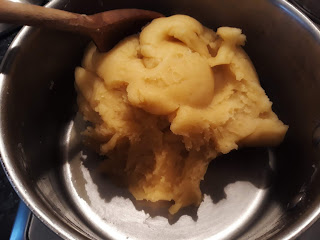

Let the mixture cool for 5 minutes and beat in 4 eggs one by one, waiting for the previous one to become fully incorporated before adding the next one. Use an electric stand mixer for this if you can, otherwise and electric hand whisk. The dough can be used straight away or covered and cooled and used later.
Prepare some baking trays by lining them with greaseproof paper. Now it’s time to pipe the pastry – Jane gives no indication as to how many we need or what size they should be. I scooped the paste into a piping bag fitted with a large round nozzle and made mounds around 1 inch in diameter. It’s important to raise the piping bag as you dispense the dough so your paste is very domed – you get a better and larger puff that way.
If your piped pastry has little spikes, press them down with a wet finger so they don’t burn and carefully drip on the tray (don’t sprinkle water on the pastry itself though).


Jane now says to bake them for 35 minutes at 230°C which is far too long and too hot as I quickly discovered! I found they baked best at 200°C, becoming golden brown at the 20-minute mark.
Once they are good brown colour, remove them from the oven and cut a slit or make a hole in their bottom with a skewer. Tip them on their side, return them to the oven and turn the heat down to 120°C so that the steam that puffed them up can escape to create a nice crisp interior. Cool on a rack.


As always, whenever I make choux buns, they turned out all different sizes, all looking like clouds rather than perfectly domed profiteroles. However, they were hollow so good enough for me.
Choux buns can be stored in an airtight tub for a week, so you can get all of this done way before the time you want to serve the course.
For the filling, you need a pound of prawns in their shell, or a 1 ½ pound lobster, or a 1 ½ to 2 pound crab (or crabs). I went for prawns as I couldn’t get hold of crab or lobster at either of my favourite fishmongers! In retrospect it was a good thing, as prawns are much easier to shell than lobsters and crabs. My prawns were raw, so I steamed them in a saucepan containing just a few tablespoons of water. This method yielded a delicious, sweet tasting bright-pink liquid. I kept it and added it to the sauce later.

The delicious pink prawn stock

Remove the meat from whatever shellfish you are using and refrigerate it. If using large prawns, as I did, don’t forget to de-vein the blighters. If using crab or lobster don’t forget the precious brown meat and roe (if any).

Now make a sauce with the shells by adding them to around ¾ pint of thin béchamel sauce – Jane doesn’t tell us how to make one, but I heated ¾ pint of milk containing a couple of bay leaves, a blade of mace, some old ends of nutmegs and some crushed black peppercorns. I then made a roux with ½ ounce each of butter and plain flour.
Add the shells to the sauce and allow the sauce to simmer away for 15 minutes. Loads of flavour comes out of the shells, and the sauce turns a beautiful salmon pink colour. Sieve ‘energetically’, says Jane, so I strained the whole thing through a conical sieve, pushing down hard with the underside of a sturdy ladle.

As the sauce simmers, fry 4 ounces of chopped mushrooms with a chopped clove of garlic in 3 ounces of butter.
Add to the sauce: the shellfish meat, the cooked mushrooms, 2 heaped tablespoons each of grated Lancashire cheese and double cream and two egg yolks. Heat the sauce, but don’t let it boil. Season to taste with salt and pepper.
Cut the choux buns in half crosswise and spoon some of the mixture into the bottom half. Deftly replace the lids and serve straight away.
#435 Shellfish Puffs. There were quite a few techniques required in this recipe, but I must say that it was absolutely delicious! The sauce was creamy, sweet and packed-full of umami flavours. Not too sure about the choux buns though, but the kitsch 1970s brief was definitely filled. Jane also suggests filling vol-au-vents with the mixture – I think this would work better than choux pastry, being more sturdy, but equally as old-fashioned. Nevertheless, that filling was great, whatever it was served in, so it gets a 8.5/10 from me.

Monday, August 22, 2016

#421 Scallops with Cheese Sauce

This is a Manx recipe, and Manx recipes have not gone down too well in the past (#390 Isle of Man Herring Pie) stands out as particularly bad, but this one sounded pretty promising. Fish and cheese don’t always work well together, but there are those outstanding exceptions such as cod or lobster with mornay sauce, so there’s hope.
This recipe comes from Suzanne Woolley’s book My Grandmother’s Cookery Book, 50 Manx Recipes, and according to her, scallops are called tanrogen, which actually was ‘the name given to the scallop shell when it was filled with cod oil to provide a lamp for the fishermen. A rush which quickly soaked up the oil, was used for the wick’. I absolutely love happening upon these little forgotten glimpses of past lives. I might even give this it a go, though I might use a different oil…
In Ms Woolley’s grandmother’s day scallops were obviously ten a penny as this recipe requires 18 scallops for six people. As I couldn’t get a remortgage, I just bought enough scallops for a couple of people and adjusted the amounts accordingly.
A smiling scallop with its many tiny black eyes (from divernet.com)

When you go to the fishmonger to collect your eighteen scallops, first check that have been sustainably caught (if they have not, go to another fishmongers), then buy six scallop shells. Make sure you get the concave sides to the shells and not the flat sides.

Trim away any untidy parts to the scallops and remove the corals, setting them to one side. Slice each scallop in half so that there are 36 discs in all.
Next, add to a wide pan a quarter of a pint of fish stock, a quartered onion, a bay leaf and some salt and pepper. Bring to a simmer, add the scallops and allow to tick away very gently for five minutes, then add the corals and simmer for a further five minutes.
Towards the end of the cooking time, make a sauce by melting an ounce of butter in a saucepan and stirring in an ounce of flour to make a roux. Cook for a couple of minutes stirring occasionally. Strain away the scallop cooking liquor and beat it into the roux. Keep the scallops warm. Make the sauce a little less thick by adding a little milk. Simmer for ten minutes and then add an ounce of grated Cheddar cheese and a couple of tablespoons of double cream. Check the seasoning, adding more cream if you like.
Arrange six halves of scallop into each scallop shell along with three corals and pour the sauce over each one. Sprinkle each with a little more grated Cheddar and brown very well under the grill.
Jane suggests piping the edges of the shells with mashed potato or lining the shells with pastry and baking them beforehand. I did neither and simply ate mine with crusty bread.
#421 Scallops with Cheese Sauce. At last, a Manx recipe I liked! It had to happen at some point, I suppose. It worked just as well as I thought it would; lovely tender-sweet scallops in a sharp and creamy sauce. The only thing I could think of to improve it would be to add some breadcrumbs fried in butter to the cheese before grilling to add some texture. I made the sauce a little too thin, but that's easily remedied 8/10.

Tuesday, April 28, 2015

#406 Soused Herrings


The herring and mackerel recipes in the Saltwater Fish section of the Fish chapter have been pretty hit and miss; from the sublime #386 Herrings in Oatmeal to the ridiculously rank #390 Isle of Man Herring Pie, so I was rather pleased that this is the final one of the book. That said, this one did not strike too much fear into me; rollmops are okay and this recipe was not a million miles away from them.

Pickled herrings are not really considered as an English food these days, more Scandinavian, yet they were enjoyed frequently, after all how else were those inlanders going to get to eat them prior o e invention of the train? Pickled fish were an essential part of a #334 Salmagundi as we discovered in (quite unexpectedly) the Poultry section.

When it comes to eating soused herrings, Jane suggests eating them the Scandinavian way: ‘serving them with a bowl of cream, beaten with lemon juice, salt and pepper, and flavoured with chives…[and] with wholemeal or rye bread and butter’.

This recipe is for 6 people, but as you’ll see, it is very adaptable to any number for folk.

First, select 6 good-looking, plump, red-cheeked herring and ask the fishmonger to bone them, removing their heads. Once home, season the herrings with salt and pepper, roll them up tightly, and spear with cocktail sticks to secure them. Arrange the fillets in an appropriate ovenproof dish, masking sure they fit closely.

Next, pour over a quarter of a pint each of good malt vinegar and water. Halve 3 bay leaves and thinly slice 3 shallots (or a medium onion) and tuck between the fish. Add to that a deseeded and thinly-sliced red chili and level tablespoon of pickling spice.


Cover the dish with foil and bake at 160⁰C for 45 minutes and allow them to cool.

If you don’t want to serve the herring in their baking dish, move them to a more suitable serving dish and sieve over the pickling liquor.

#406 Soused Herrings. Well this was a middling recipe really, not inedible but not very exciting either. The well-flavoured pickling liquor was much better than the liquor used for rollmops. However, rollmops they were, which are never going to have me doing cartwheels. 4.5/10.


Sunday, July 6, 2014

#395 Red Herrings


Here’s a recipe – or, rather an entry with advice – from English Food that I thought I would never get to cook for two reasons. The first was that I suspected that Jane was having a little joke at our expense and that her entry on red herrings was actually a red herring in itself! Having only ever used the expression and never laying eyes on the food, the penny did not drop for a good while that the saying must have come from somewhere. So, after looking in a few other books I decided red herrings were, in fact, real.

The Red Herring Freehouse, Great Yarmouth
According to Jane’s entry, they are made in Great Yarmouth, and although they have fallen out of favour her in the UK, they are shipped over to the Caribbean in their droves where they are still a very popular food, indeed, a staple food:
Once they were slave food, now they are a food for the poor, a cheap, storable, provider of protein.
So if they are made in abundance on the south coast of England, a few must escape the net and show up in England itself, right? First I looked online, then in Afro-Caribbean shops in Manchester. Not a whiff. Then, when I lived in America, I detected a scent; apparently they are widely available in Afro-Caribbean stores. Well, not in any of the ones I looked in!
I was ready to give up hope, but then, when I returned to Manchester after my two-year hiatus, I eventually found somewhere that sold them, and that place was an online store called the Smelly Alley Fish Company, Reading. Hooray!
I ordered four and eagerly awaited their arrival. In the meantime I had to work out what to do with them.


Before I tackle any recipes, I’d better tell you what a red herring actually is.
A red herring is a heavily brined and smoked whole herring, rather like a bloater, except it is brined for at least a week, dried, and then cold smoked for at least four weeks. It is this extreme curing that gives both its red coloration and its unbelievably long shelf life so that it can easily survive long journeys and the humidity of the Caribbean.
The red herring cure originated in Scotland, but the herring fished in the North Sea were fatty; making them delicious, but decreasing their shelf life. However, the herring caught off the south coast of England at Great Yarmouth had little fat, and therefore were perfect for trade, eventually outcompeting Scotland.
Red herrings were a staple food for poor people living inland during the Middle Ages, especially during Lenten days, and predated the kipper, which is a relatively new invention.
I love Dorothy Hartley’s description of them from her 1954 classic Food in England:
Red Herrings are a form of super-salted bloater, very popular on the western seaboard, specially [sic] in Ireland. They produce a terrible thirst – all artists seem to like them: I cannot account for this. Rudyard Kipling makes his “Hal o’ the Draft” cook salt herrings in the Cathedral, but he provides the only corroborative authority that I can produce for this notable dietetic discovery.
Note: At Hogmanay, if the [sic] Glasgow friend wishes you well, he slips a red herring down his sleeve into the palm of his hand as he grasps it.
Next New Year’s Eve, I shall try that trick.
Now we know what a red herring is, why is it used in the famous idiom? Red herrings were used as a method of training hunting hounds. A false trail using the pungent red herring would be laid so that the training hound or hounds could be taught to ignore the obvious strong scent and pick up the faint and subtle scent of their hare or fox quarry. Hence, when someone is falsely distracted from their path or purpose, they have been given a red herring. Every day’s school day.
So what do you do with your red herring, once you have found it? Well, here are Jane Grigson’s instructions, which as per the rules of the game, I must follow:
If you ever manage to buy some, soak them well in water or milk. Then grill them or toast them in front of the fire, basting them with butter or olive oil. Serve them with scrambled eggs or potatoes mashed with plenty of butter. Or think of them as anchovies, to be used as a relish rather than a main food.
All good so far, but they are so dry, I wasn’t sure how long to soak them for. Hours? Days? I needed more instruction.
In Good Things in England (1932), Florence White gives us an 1823 Great Yarmouth recipe:
  1. Choose those that are large and moist.
  2. Cut them open, and pour over them some boiling small beer.
  3. Let them soak half an hour, then drain and dry them.
  4. Make them just hot through before the fire, and rub them over with cold butter.
  5. Serve with egg sauce or buttered eggs; mashed potatoes should also be sent up with them.
All well and good, but mine were not moist, but as dry and hard as if mummified.
Here’s a recipe from a lady called Meg Dodd’s, via The Scots Kitchen: Its Lore & Recipes (1929) by F Marian McNeill:
Skin, open, and trim red herring. If old and dry, pour some hot small beer or water over them and let them steep a half-hour, or longer if hard. Broil them over a clear fire at a considerable distance, or before the fire; rub them with good oil or fresh butter while broiling, and rub on a little more when they are served. Serve them very hot with cold butter, or with melted butter and mustard, and mashed potatoes or parsnips.
And finally, from the Smelly Alley Fish Company’s own website:
To cook them, soak for 48 hours, then fry with tomatoes - a great breakfast! They are great as they are (they don't need to be cooked), and as they are very salty, you might need a pint of beer to drink with them.

I took Jane’s instruction and soaked them in milk, in the end, overnight. The next morning, the house awoke to the pungent smell of soaked red herrings. I fished them out of their now rufous milky marinade and grilled them smeared in butter, serving them with eggs for breakfast.
They were still pretty dry after all that soaking, though the roes found inside were nice and soft, and quite possibly the saltiest things I have ever eaten in my life. Trying to eat the flesh of the herring was tricky as it could not be parted easily from the bones. I had, as warned, a huge thirst, and the smell of red herring had still permeated my little terrace a week later.
#395 Red Herrings. What to say of red herrings!? Well they did taste good, but they were so unbelievably strong in flavour, and so difficult to eat (think fish jerky) I barely ate half of one. I think I need to revisit them following advice from those other recipes. A slow simmer in some hot milk might be a good idea, to help rehydrate the fish, or give a two-day cold soaking, but I think that it might be best cut with plenty of butter as potted red herrings or something like that. I have two left, so shall keep you posted on that one. Score? 7/10 I think, because the flavour was great, given even its pungency, it just needs taming!

Sunday, April 27, 2014

#392 Scallops Stewed with Orange Sauce


This is a recipe that comes from the 18th Century that unusually combines shellfish with orange – in particular the Seville orange and this is the final recipe in the book that uses them. It’s been interesting to see the diverse recipes for these bitter oranges that I used to think were used solely for making marmalade. Now that I appreciate such things, I was looking forward to this one.

If you are not a fan of shellfish, Jane says that white fish such as sole and whiting can be substituted quite easily.

This recipe serves 6 people, but it can be easily scaled up or down.

Although it's not mentioned, use the corals in this recipe too. 
Waste not, want not!

To start, simmer together ¼ pint each of water and dry white wine along with a tablespoon of white wine vinegar, ½ teaspoon of ground mace and 2 cloves in a saucepan for 5 to 10 minutes or so. You have essentially made a very simple court bouillon. Season the water with salt and pepper, and then prepare your scallops. Cut 18 scallops in half lengthways and pop them into the water. The scallops need poached only briefly in just simmering water. I left mine in for 2 minutes only, though I reckon 90 seconds might have been better.

Quickly, fish out your scallops with a slotted spoon and keep them warm and covered. Strain the stock and reduce it to a volume of around 8 fluid ounces. Whilst you wait for that to happen, make a beurre manié by mashing together ½ ounce of softened butter with a tablespoon of flour.

When the stock has reduced, turn down the heat to a simmer and whisk in small knobs of the butter-flour mash to thicken the sauce. Let the sauce simmer without boiling for a few minutes to cook out the flour and then add the juice of a Seville orange (failing that the juice of a regular orange and the juice of half a lemon). Check the sauce for seasoning and add more salt and pepper if needed. If you want a richer, more luxuriant, sauce beat in an egg yolk and 3 tablespoons of cream. For some reason I added some parsley to the dish, though it doesn't say so in the recipe.

Place scallops in a bowl, pour over the sauce and serve straight away. Jane suggests serving the scallops with #176 Samphire or with #382 Laverbread as a Sauce.

#392 Stewed Scallops with Orange Sauce. Intriguing though the recipe was, it didn’t quite live up to my expectations. I didn’t think the flavour of the oranges and scallops married that well, perhaps because the sauce was rather sharp. I think with some tweaks, however, this could be made a lot better or even reimagined as a scallop and orange salad or something like that. Just below mediocre, 4.5/10.

Thursday, February 13, 2014

#391 Soft Roe Paste


The last of three recipes that use mackerel or herring roes.

There are two types of roe: hard and soft. The former comes from female fish and contains the egg, and the latter, sometimes called melts, are from the male fish and contain the sperm. This recipe, just like the other two, use soft roes. Eating the sperm sac of a fish might appear to be more of an ordeal than a pleasure, but they are tasty and can be picked up very cheaply at the fishmongers. Alternatively, when buying mackerel or herring, you can ask the fishmonger to keep behind any roes that might be present as he scales and guts them. At home, simply sequester them in a freezer bag until you have for a recipe. They are an acquired taste because they are very slightly bitter and so they lend themselves to creamy and buttery ingredients (for example see #159 Creamed Roe Loaves).
Jane makes a point for this recipe to try and buy nice neat matching pairs of roes, rather than just the cast offs that ‘have been flung on to a separate tray’. I would have thought that this recipe would be perfect for the roes that are so carelessly thrown onto the roe tray. Not that this happens anymore – because they are not so popular these days, you almost always have to buy frozen packs.

This recipe just shows how the British just loved to pot things: meat, fish, cheese. It can all be potted and preserved for a later date. In this case the roe paste will only last maybe 4 or 5 days in the fridge, but that’s a lot longer than raw roes would last.

To make your roe paste, first fry 7 ounces of soft herring or mackerel roes in an ounce of butter, then, Jane says, to pass them through a sieve.
 This was a tricky task, which was made much easier by the utilisation of my mouli-legumes. Beat the warm roes into 6 ounces of softened butter. Jane recommends using slightly salted butter, but I have to say, I prefer normal, salted, butter; after all you’ll only add more salt when it comes to seasoning later!
Next, mix in a tablespoon of double cream, then season with salt, Cayenne pepper and lemon juice. Finally add a little chopped parsley.

‘Serve chilled, but not chilled to hardness, with thin toast or baked sliced of bread.’

#391 Soft Roe Paste. I liked this paste, the bitter flavour of the roes was cut with the lemon, cream and parsley whilst still maintaining the roe flavour. However, it didn’t exactly make me do backflips. Good, but not great, and nowhere near the dizzy height of previous fishy pastes like #378 Elizabeth David’s Potted Crab. 5.5/10.

Friday, February 7, 2014

#390 Isle of Man Herring Pie


I’ve been putting this one off for ages because it starts with the sentence: “A very similar recipe to the [#133] Welsh Supper Herrings”. These were not good; pappy fishy cat food mush and raw potatoes. However, that was 5 years ago (5 YEARS!) and I like to think of myself as a better cook now than in those naïve days.
This recipe comes from a Mrs Suzanne Woolley who ran a restaurant called Mheillea (‘Harvest Man’) on the Isle of Man. Normally herrings would have been cooked with potatoes as in Wales, but she decided to make a pie of them. Aside from that, it’s pretty much the same as the Welsh Supper Herrings. This did not bode well.
Mrs Woolley's book - still avaialable!

First of all you need to make or buy some shortcrust pastry, large enough to line and lid a baking dish large enough to hold the ingredients of the pie. A small lasagne-style dish would be appropriate. Line the dish and keep it in the fridge. Reserve the pastry for the lid in the fridge too.
Next, prepare 6 herrings. You need to scale, gut and bone them. Or ask your fishmonger to do it. Boning herring is actually a pretty straight-forward job, as you need no filleting skills whatsoever. I can’t put it better than Jane herself:
Cut off heads, fins and tails and bone them: to do this, put the herring on a board, backbone up, spreading out the slit sides of the belly. Press gently along the backbone from neck to tail, until you feel the bone giving. Turn the herring over, and you will find you can pick out the backbone complete with most of the whiskery bones still attached (separate bones can be pulled out).
It’s worth mentioning that you need really fresh firm herrings for this. If they’re just a few days’ old, they will have started to go mushy, and the procedure described by Jane above will be most unsuccessful.
Next, season them on both sides with salt, black pepper and ground mace (about ½ a teaspoon should do it). Spread some softened butter over the base of the pie and arrange the herrings on top. Peel, core and slice 3 good-sized cooking apples and thinly slice 2 medium onions. Put the apple on next to forma layer, then the onions. Place dots of butter over the top, season again with salt and pepper, then sprinkle over 4 tablespoons of water
 Roll out the remainder of the pastry, sealing the pie with some beaten egg or cream. Make a hole in the middle of the pie so that steam can escape and brush the lid with your egg or cream.
Bake at 180-190⁰C for 40 minutes or so. “Check after 30 minutes”, says Grigson, “by pushing a larding needle or skewer through the central hole of the lid, so that it pierces the herring; you should be able to feel whether the herrings are cooked by the way the needle or skewer goes in.”
And there you have it. I assume the pie was supposed to be a self-contained meal, maybe a suitable salad could be served alongside it.
#390 Isle of Man Herring Pie. Well I have to say I’ve not had a really terrible recipe from English Food in quite a while, so I was well overdue. The herring just did not go with the apples at all; it would at least have ben palatable as an apple and onion pie. I cannot see how this recipe made it into any cookbook! Really bad. Went straight in the bin. 1/10.

Wednesday, January 15, 2014

#389 Salmon Stewed in Seaweed with Dulse Hollandaise


Seaweed is not so popular in this country and this recipe requires two different kinds. The first is dulse and I have used it before to make #307 Mashed Potato with Dulse. There’s some information about dulse on that post, should you want it. 
However, the other seaweed – the one the fish is stewed in – is not so familiar. It is called fingerware, and according to the recipe, comes in ½ ounce (or 15g these days) packets. I could find no mention of fingerware in any of my books, or in shops. I did manage to find its Latin name in A Dictionary of Food and Nutrition by David A Bender, but that was all I found though. Here’s the full entry:
                fingerware Edible seaweed, Laminaria digitalia
This name sounded familiar (being an ecologist one picks up the Latin names to some organisms), and it turned out to be good-old kelp. Now I had something to try and order. Unsurprisingly, I was able to find it on Amazon, but only in massive triple packs. Hey-ho. It just had better be bloody nice!
Fingerware, Laminara digitalia, in situ
Now I had my two seaweeds I could cook the recipe, which, by the way, is one that Jane modified from a book from Karin Perry's Fish Book. Originally, halibut was used, but you could also use any round sea fish like sea bass, cod, or grey mullet.
 Fingerware how I received it.

Begin by preparing your whole salmon. According to Jane, it should weigh somewhere around 2 ½ pounds, mine was a little larger because the only salmon available to me was farmed, and they grow much larger than wild salmon. Anyway, give the salmon a rinse and pat it dry. Leave out in the kitchen for it to warm to room temperature for 30 minutes or so.
Next prepare the fingerware, you’ll need ½ ounce of it. I could only get it in huge sheets, so I cut out a piece and cut that into broad strips. Pour boiling water over it and leave it to rehydrate for 30 minutes.
While you wait, get the fish kettle ready: place two upturned ramekins inside end-to-end to act as a stage for the rack; the idea here is that the fish cooks in the steam rather than in the water. Lay the fingerware over the rack and then brush the upper side of the fish with some melted butter. Season it with salt and pepper, and then lay the fish butter-side-down on the rack. Brush the other side of the fish with more melted butter and season. Don’t forget to season inside the fish too. Lay the rest of the fingerware over the fish.
Next, get some hot water on ready to pour into the kettle. Cut a piece of kitchen foil large enough to cover the fish in its kettle; the lid cannot be used because of the ramekins. Pour in the hot water, then place the rack and fish inside the kettle. Cover with foil, put over two burners and steam for 15 minutes.

When the time is up, have a little look and see if the fish is done. You could use a knife to have a little inspection, or pull a fin; if ready the fin should pull out in a satisfying way. If not ready, leave another 5 minutes.
When done, take the kettle from the heat, but keep the foil over it for another 15 minutes. While you wait, prepare the hollandaise sauce.
Take 2 tablespoons of crumbled, dry dulse in a bowl and pour over it boiling water. Leave for 2 minutes, strain it in a sieve and refresh with cold water. Pat dry with kitchen paper.
Start by cutting 7 ounces of softened unsalted butter into small cubes. Place 3 egg yolks in a bowl along with a tablespoon of water. Whisk well and then place the bowl over a pan of simmering water. Then, whisking all the time, add one or two cubes of butter and when incorporated add a couple more cubes until all the cubes are used up. Season with salt, pepper and lemon juice and stir in the dulse.
Transfer the salmon to a serving dish and pour the sauce into a jug.
When portioning out the fish, Jane suggests, giving each person a small piece of the fingerware. She also suggests to accompany it with boiled new potatoes and samphire or blanched cucumber or mange tout.
 #389 Salmon Stewed in Seaweed with Dulse Hollandaise. Hmmm. A tricky one to judge, this one. I thought the salmon was cooked very nicely and one cannot ever complain about hollandaise sauce. The problem was the seaweed didn’t seem to add anything at all to the dish. I think if I had used partially-dried dulse like you can get in Ireland, fried it to make it crispy and used that in the sauce, it would have made a world of difference. For that, it loses points, so let’s say 6/10.

Friday, November 15, 2013

#386 Herrings in Oatmeal


Herrings and oatmeal used to be staple foods in the North of England and Scotland, where the ‘silver darlings’ were plentiful and oats were pretty much the only cereal crop that could be grown in those inhospitable climes of The North. They were particularly enjoyed at breakfast. We don’t seem to eat fish at breakfasttime anymore, except for the rare kipper or a bit of smoked salmon stirred through scrambled egg, if we’re feeling posh.
Also, you don’t see recipes for this dish in older cookbooks, I assume it is because it’s so straightforward and was so commonplace that writing it down was simply not required. I cannot even find the phrase “herrings in oatmeal” before the 20th Century! More modern books include them of course, even if it just to remind us of the foods our forefathers ate.
Herring in general are quite ignored, I think, though their relative the mackerel is increasing in popularity. It’s strange that in the middle of the last century they were over-fished. It’s a shame they’ve fallen out of favour, as they are very nutritious and very cheap.
It is herring spawning season right now – they are bright-eyed, plump and have massive creamy roes in them, so if you want to try them, now is the right time
I confess, I have never eaten herrings in oatmeal, but I love herrings and I love oatmeal, so they couldn’t be bad.
This recipe is for six, but it is easy to see how it can be scaled up or down:

First of all, you need six fine herring. Ask the fishmonger to open the herring from the back as though they were kippers. Ask him to save the roes (they’re not required for the recipe but they should always be saved).
At home, season the fish and them press them into some medium or fine oatmeal that has been scattered over a plate; about 3 ounces should do it. Fry the herrings in butter until they are lovely and golden-brown. Do them in batches if need be, keeping the cooked ones warm in the oven on a bed of kitchen paper to keep them crisp. Serve with lemon wedges.

Jane tells us the best way to serve these is with simple boiled potatoes and bacon. I had the spuds, but swapped the bacon for a salad! Traditionally fatty bacon would be crisped and fried, and the herring would then be cooked in the bacon fat; next time (and there will be a next time) I’ll do the bacon thing.
#386 Herrings in Oatmeal. Well I have said it many times, but I’m going to say it again, the simple ones are the best. These were delicious, forgotten gems. The chewy oatmeal really complimented the mild herring perfectly. This sort of food has fallen so out of our collective consciousness that you just do not see it anywhere. I might be my new favourite thing. When my little restaurant opens, herrings in oatmeal will certainly be on the menu. 9/10.


Tuesday, July 30, 2013

#380 Gooseberry Sauce for Mackerel


After the rather wet start to the summer, I was beginning to think that this year’s gooseberries were never going to arrive. Then we had that glorious stint of hot weather. Now we have so many gooseberries and other soft fruit, we barely know what to do with them. Well here's one thing, just as mackerel is in season. I like Jane’s introduction to this recipe:
On May 26th, 1796, Parson Woodforde [we have met him in the blog before, see here] and his neice, Nancy, had for their dinner ‘a couple of maccerel boiled and stewed gooseberries and a leg of mutton roasted’. In other years, they were not so lucky; the gooseberries did not always ripen for the arrival of the first spring mackerel.
Ms Grigson’s recipe is a very simple one indeed:
Begin by topping and tailing 8 ounces of gooseberries and then melt an ounce of butter in a pan. Add the gooseberries, cover with a lid and cook until soft. I love how they go from vivid green to an almost straw-yellow when heated.
Use your wooden spoon to crush the berries on the side of the pan to form a rough purée, you could, if you are so inclined, pass them through a sieve to produce a smooth sauce. I don’t see the point in these things normally; it’s not like gooseberry seeds are particularly offensive.
The tart flavour of the gooseberries is cut with either ¼ pint of double cream or béchamel sauce. I went for the latter for health’s and money’s sake. Taste the sauce and add a little sugar, if needed, don’t make it sweet like an apple sauce for pork.
That’s it! Very simple and not just for mackerel either, but other oily fish, roast duck, pork, lamb, veal and – no surprises – goose.
#380 Gooseberry Sauce for Mackerel. A triumph of good, simple cooking. The creaminess of the béchamel did a great job of wrapping its way around those tart gooseberries, so much so that only a pinch of sugar was required. I could eat it all on its no problem! 8.5/10

Sunday, June 30, 2013

#378 Elizabeth David's Potted Crab


This recipe I tried a couple of months ago and thought it so good, it should make an appearance as the fish course in my pop-up restaurant earlier in the month. The recipe has been lifted from a pamphlet by Elizabeth David called English Potted Meats and Fish Pastes. You can find the pamphlet in her anthology An Omelette and a Glass of Wine (a book any interested cook worth their salt should own). Ms David honourably adapted old recipes and updated them for the contemporary population. They still hold up today, I take some pride in taking up her baton – via Jane Grigson – albeit on a small scale, in showing that these dishes need to be brought back and celebrated. They are so different from the nasty little pots found on our supermarket shelves.

For this recipe you need to start with a large 2 pound crab – ask your fishmonger in advance to bagsy you a large, hefty-clawed male for you. If such a thing is not available, buy 2 smaller hen crabs. At home, dip into your toolbox for a hammer and root out your lobster tools (or alternatively a nutcracker and skewer) and get to work picking and scooping the meat from the crab, keeping the brown meat in separate pots from the white. It’s worth mentioning that you can buy the tubs of pre-picked crabmeat, but the result will not be anywhere near as delicious.

 
How do you pick a crab of its meat? This excellent walk-through guide from Channel 4 is very good. One day I’ll write my own, if I ever get round to it!

Season the crab meats with salt, black pepper, mace, nutmeg and Cayenne pepper, as well as a good squeeze of lemon juice. Now layer up the two meats in a single mould such a stoneware pot, or several smaller ones. Start with half of the white meat, then the brown and then the remainder of the white. Pack it down firmly and pour over melted slightly-salted butter; you will need around half a pound of butter altogether. Griggers here recommends Lurpak, which eats much better in this sort of dish.

 
Bake in a ban Marie at 150⁰C for 25-30 minutes. Remove and pour over some clarified butter. Allow to cool and store in the fridge covered with foil or clingfilm. If you put a good thick layer of butter over the crab, it will keep for several days. Don’t forget to take it out of the fridge a few hours before you want to eat it.

I served the potted crab simply with spelt bread and a lemon wedge.

#378 Elizabeth David’s Potted Crab. Absolutely delicious, the rich butter and creamy crab meat are suitably sharpened by the warming spices and lemon juice. This must be the best of the potted meat and fish dishes in the book and I cannot sing its praises high enough. 10/10