Showing posts with label lamb. Show all posts

Thursday, November 5, 2015

#416 Cumbrian Tatie Pot

I recently made to visit to my friends in their 18th century house in Mallerstang, Cumbria and have been meaning to bring the ingredients up with me to make this dish. It’s one of those lamb, onion and potato based meals you find in the North of England such as Lancashire Hot Pot and Lobscouse, or indeed Irish stew and Scotch broth. It mysteriously appears in the Meat Pies & Puddings section of the Meat, Poultry & Game Chapter.

Mallerstang is a beautiful, slightly bleak, hamlet close to Kirkby Stephen. It sits at the foot of Wild Boar Fell, and there are the remains of a mediaeval castle which is flanked by the sparkling River Eden. It’s an amazing place that is seemingly trapped in time; I recommend a visit.

Cumbrian Tatie Pot is one of those rare dishes in England that mixes its meats, something more common on Continental Europe. “The recipe in slightly different form appears in various books of Lakeland cookery”, says Jane, “and often the beef is described as ‘optional’ – which it most definitely is not. It makes the character of the dish. So resist the national tendency to leave it out.” You have been told.  I found several recipes on the Internet, and none of themhad beef on their ingredient lists.

“Tatie Pot”, she goes on to say, “is very much a dish of communal eating, at village get-togethers, or at society beanos…There is always a certain rivalry to see whose version is the best.” Well I was driving up for a get-together and it was Cumbrian and it looked like the perfect dish to cook in a kitchen equipped with an Aga. What could possibly go wrong?

The first thing you need to do is get hold of the meat; you’ll need 2 pounds of either scrag end (often called round of lamb/mutton these days) or best end of neck off the bone and 2 pounds of shin of beef. Make sure you ask for the bones as well as some extra ones, if the butcher has some. Whilst you’re in the butcher’s shop get yourself a nice black pudding.

When you get home, use the bones and some stock vegetables and herbs, plus a little wine if you have it, to make a good stock. As I was cooking on an Aga, I could get it simmering on the hot plate before popping it in the cool oven overnight. Here’s a post from the other blog on stock-making, if you’re not used to making them.


Cut the meats into good-sized pieces and coat them in some well-seasoned flour and arrange the pieces in a wide roasting pan. Scatter over the meat six level tablespoons of mixed, dried pulses (e.g. split peas, pearl barley, red lentils). In the original recipe, Jane says to soak them overnight, but with today’s dried pulses there is no need for this step. Chop two large onions and slice the black pudding into half-inch slices and disperse these evenly, tucking the black pudding between pieces of meat. Season.

Next, peel around three pounds of potatoes and quarter them lengthways. Arrange them on top with their rounded sides pointing upwards. Season well.

Skim the stock of fat and warm it up then pour it over so that it comes halfway up the spuds. Bake at 200⁰C for four hours, topping up the stock with more stock or water, so that the potatoes get a good, dark, crunchy top. As I was cooking on an Aga, I put the tatie pot in the hot oven for two hours and then in the cool oven until everything was nicely cooked and unctuous. The hot oven was rather hotter than expected and the potatoes were perhaps a little darker and crunchier than expected, but never mind, this is country cooking.

#416 Cumbrian Tatie Pot. Even though those potatoes were a little on the burnt side, they did not detract from the fact this was an absolutely delicious dish. The long and slow cooked meat was as soft as butter, the pulses gave body and nuttiness and it was a delight to discover a piece of melting black pudding every now and again. This is definitely going to appear on a future menu; simple and excellent food that sticks to your ribs: 9.5/10

Friday, February 6, 2015

#404 Lamb (or Mutton) to Eat as Venison


All the way back in November, I was asked to cater for a dinner party; a very special one because it had the most interesting brief. A seven-course dinner was required where each course represented a different time in history.

For the Georgian course, I went straight to my favourite book from that time period The Experienced Housekeeper by Elizabeth Raffald (1769). Flicking through the pages, I happened upon a recipe To dress a Leg of Mutton to eat like Venison. It required you to ‘[g]et the largest and fattest leg of mutton you can get cut out like a haunch of venison as soon as it is killed, whilst it is still warm.’ It then goes on to tell you to ‘remove the bloody vein’ and then marinade the thing in wine, dry it, and to roast it in pastry. I was intrigued, but it was obviously unachievable. Looking in other books, I found many versions of it, sometimes roasted, sometimes braised, but always marinated in red wine (and often in the blood of the beast too!). I knew the recipe looked familiar, and it finally dawned on me that a recipe for it appeared in good old English Food by good old Jane Grigson.

There’s a 4 day marinating time for this recipe, so plan ahead if you fancy making it – and I really suggest you do; see my review of the recipe below.

Start off by making the marinade: dice up 5 ounces each of onion, carrot and celery, chop 3 cloves of garlic and brown them in a couple of tablespoons of oil, such as sunflower or rapeseed. Take your time over this and get them good and brown; the veg won’t be in the final dish, but its flavour will be. Let it cool.


Now mix the cooled, browned vegetables with the following:
1 bay leaf
2 good sprigs of thyme
4 sprigs of parsley
2 sprigs of rosemary
8 crushed juniper berries
8 crushed coriander seeds
10 crushed black peppercorns
3 tsp salt
1 (UK) pint red or dry white wine, or dry cider
¼ (UK) pint of red or white wine vinegar (and, though not on the ingredients list, cider vinegar, if going down the cider route)


Now tackle the meat. Use a full leg of lamb or mutton, I went for the latter. It was huge, so I increased all the above values by a half. All you need to do it score the fat into a diamond pattern, like you would do for a ham. Find a large, deep dish or pot and place the lamb inside and pour over the marinade. Make sure the whole leg gets the marinade on it, so turn it over a few times. Keep the leg somewhere cool – a fridge, or a nice cool cellar or pantry – and cover it with foil. Turn it twice a day for four days.

When the four days is up, get a new set of vegetables ready. Slice 2 onions, 2 carrots, 2 leeks and chop 2 sticks of celery. Also chop up 8 ounces of unsmoked (‘green’) streaky bacon. Brown all of these in a couple of ounces of butter


Spread the vegetables over the base of a deep roasting tin, place the leg on top and strain the marinade over it. Top up the marinade liquid with veal stock so that it comes up two-thirds of the way up the tin. You don’t actually need to use veal stock; chicken stock or water would do, I am sure. However, if you want to make your own, look here for my recipe for it from the other blog). Cover with more foil.


You have two choices now: either bring the whole thing slowly to boil and simmer gently for 2 hours on the hob, or bring to simmer and pop it in a cool oven instead, 150⁰C will do it. If you are using mutton, you need to cook the leg for another hour or even 90 minutes. Turn the joint over after one hour and in the final thirty minutes, ladle out 2 pints of the cooking liquid and boil it down hard to make a concentrated, richly flavoured stock.

When the cooking time is up, remove the leg and put it into another roasting tin and turn the oven up to 220⁰C. Roast for a good 20 minutes and baste well with the concentrated stock to achieve a nice glaze.


Jane suggests serving with gravy made with the pan juices and reduce stock and the usual lamb/mutton accoutrements. See here for a post all about that. I actually served it with a 'Lenten Pie', from Raffald's book. At some point I will blog each course on the other blog.

Jane points out that you do this recipe with a leg or pork and magically transform it into wild boar.

#404 Lamb (or Mutton) to Eat as Venison. Oh my goodness, this may simply be the single most delicious thing I have ever cooked! First of all, it tasted exactly like venison; beautifully gamey, but with the moist succulence you would expect from lamb or mutton. It was transformed! There must be some kind of witchcraft afoot. I was amazed, and luckily so were my diners! I cannot recommend this more highly, absolutely bloody brilliant. 10/10.

Sunday, January 18, 2015

#403 Raised Mutton Pies


Just a quickie from the Meat Pies &Puddings part of the Meat, Poultry & Game Chapter:
This is the last of the raised pie recipes in English Food. It’s a little different in that you don’t need to make a jellied stock like the others, but a gravy made from mutton bones.

If you can’t get hold of mutton, then lamb will do just as well.

To make the pie, you will need to make a batch of hot water pastry – have a look at the post #282 Raised Pies. It also goes through the process of making the pies themselves. In this case, the pies are to be made small. To do this you can use wooden pie dollies or jam jars and raise the pastry around them. Alternatively, and much easier, is to use muffin tins and roll pastry to fit.

For the filling, you need a whole best end of neck of mutton, or a pound of fillet meat. Make sure the butcher give you the bones of the sheep. Chop the meat finely, including some fat. Finely chop 3 shallots or 4 ounces of onion along with 4 ounces of mushrooms and a tablespoon of parsley. Mix all of these together with the meat and a teaspoon of dried thyme and salt and pepper. Place in a pan with ¼  pint of water, bring to a simmer and let it tick over for 5 minutes. Cool.

Fill your pastry cases, however you have constructed them, with the mixture and bake for 25-45 minutes at 200⁰C, depending on size.


Once whipped out of the oven, pour in gravy made from the bones. There is no instruction from Jane as to how to make this, but it’s pretty easy. Make a stock from bones, trimmings and some stock veg. Reduce it and mix into a roux of butter and flour to thicken it up.


#403 Raised Mutton Pies. These were great – I must admit I was a little dubious of the watery filling, but it really was delicious, the vegetables and herbs made the water into a delicious stock, which reduced during baking. They were so good, I added them to one of pop-up restaurant menus. 8/10.


Thursday, January 1, 2015

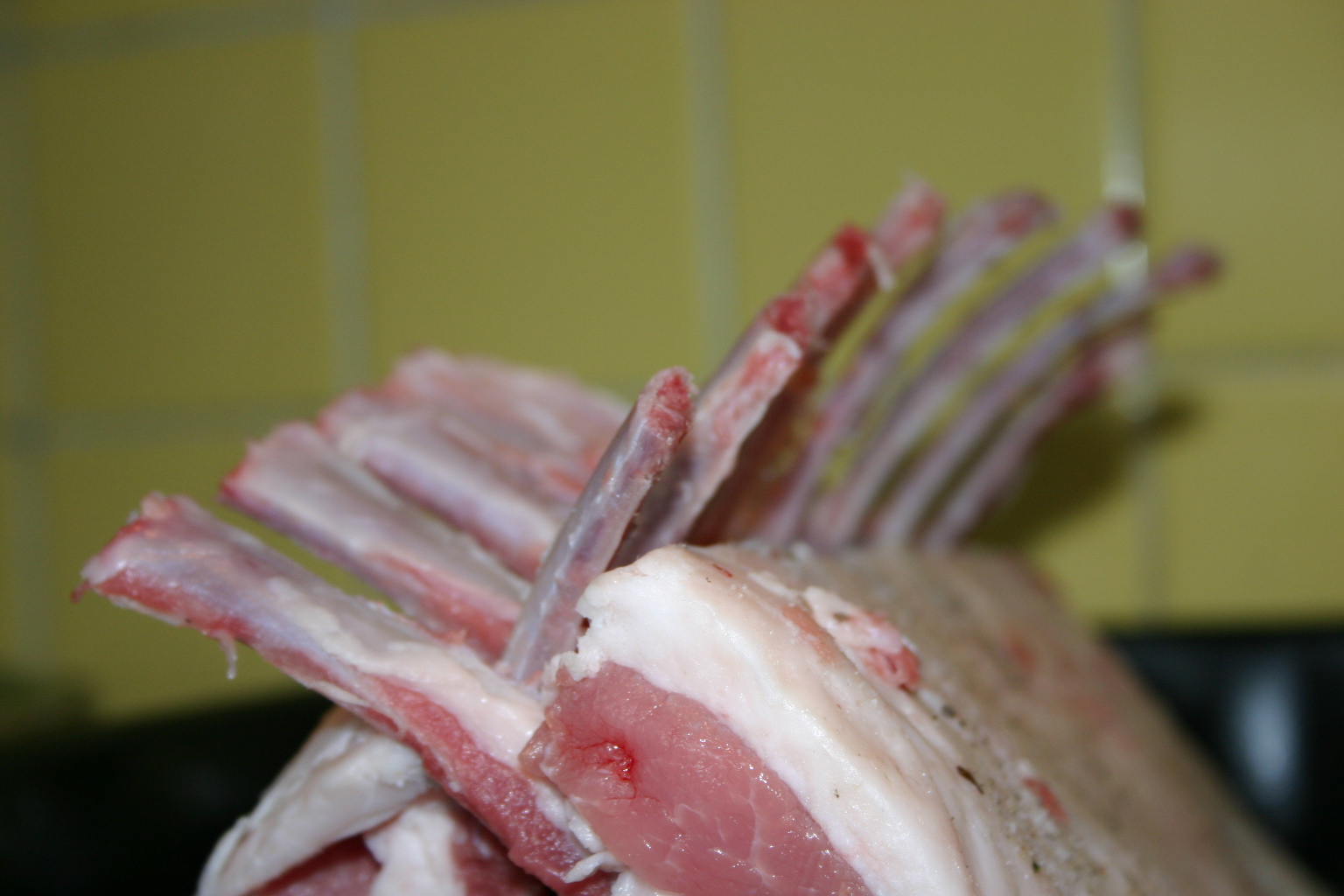
#400 Crown Roast of Lamb


Well, well, well. Here we are at #400! Who would have thought I’d get this far?

I’ve chosen this classic piece of meat sculpture for this milestone as it is such a special thing, and hardly seen these days. Plus, doing it Jane’s way means you don’t simply pop to the butcher’s shop and ask for the roast assembled and oven-ready. No, Jane’s way means constructing it yourself; something I really could not have done at the beginning of this project. This saves you a lot of money, and earns you plenty of kudos with your friends.

I did a quick look through some old books and it is odd that this classic and ancient and slightly macabre dish does not seem to appear before the 20th Century. I must be wrong here – can anyone shed any light on it?

To make your own rack of lamb, you will need three things: your lamb, stuffing and a trussing needle & thread.

First, the stuffing: go for any of the stuffing recipes in the Stuffings section of the last chapter, or go with the stuffing recipe from #175 Shoulder of Lamb with Rice and Apricot Stuffing. I chose the latter.

Ok, now the tricky bit. Go to your butcher and ask for a whole best end of neck; it is from this that you will get your two, perfectly symmetrical, racks. You should get 7-8 cutlets from each rack. Here’s what you ask the butcher to do (in Jane’s own words):

  1. to divide in two down backbone so you have two symmetrical pieces,
  2. to chine it [this means to remove the backbone],
  3. to make small cuts between the cutlet bones [this is quite simple to do yourself].

The butcher will desperately try to chop off the long bones and you must insist he does not! At home, you can get the racks prepped by French trimming the thin ends; scraping away the fat from the ribs, just like #305 Guard of Honour. It’s quite laborious at first, but you’ll soon get the knack.

Sit the two racks back-to-back with the fatty sides touching. Take your trussing needle and sew the ends together with two stiches, making sure the thread is tied good and tight.

Stand it up and shape it into a crown using your fist – this is where those little cuts the butcher made are important.  Cover the ends with foil and sit the whole thing on a rack in a foil-lined roasting pan. Season the meat (especially the fat) and fill the centre with your chosen stuffing.

Roast for 75 minutes  at 190⁰C. Remove from the oven, cover with foil and let the meat rest for 20 minutes or so. If you want to be posh remove the foil from the ribs and replace with paper ruffles.

But what to serve with roast lamb? Don’t fear, Grigson has it all covered for us in this post.

#400 Crown Roast of Lamb. What a spectacle this was! I loved the way it looked; not all nice and neat with each rib the same length, but instead the bones were their natural varied lengths, making it look even  more like a real crown. The stuffing was, of course, great and the meat itself wonderfully tender and medium rare. A surprising thing bearing in mind it had been a roasting for what seemed like a long time. The only minor thing is that the stuffing began to char, so I would recommend covering it with some foil for the first half of the roasting. Nevertheless, still marvellous. 10/10.


Thursday, January 2, 2014

#388 Sweet Lamb Pie from Westmorland

Happy New Year Grigsoners!

There are no Christmas recipes in English Food left to cook, but this one is close, being a cross between a savoury lamb pie and a sweet mince pie. It’s a recipe that has no introduction from Jane Grigson, though I feel it should, as it is pretty strange-sounding: a pie with a minced lamb, dried fruit and apple filling. Though it hails from Westmorland (a now defunct northern English county now made up of bits of Cumberland, Lancashire and Yorkshire), it seems to me to be a very typical pie baked during the medieval period, where it was very common to cook meat with lots of dried fruit and spices.
The Westmorland Coat of Arms
Why was this done? After all it seems to be an odd combination. Many people say that it is because heavy use of fruit and spices masked the taste of rancid and rotten meat. This, however, is a total myth; the reason meat was combined with spice, dried fruit and sugar was because all of these ingredients were extremely expensive. It was all showing off. They are – in my past experience – also a good combination: previous recipes like #87 Mrs Beeton’s Traditional Mincemeat and #328 Salmon in Pastry, with a Herb Sauce follow the same principle.
By the time of the Victorian era, none of these ingredients were particularly expensive, and this sort of food fell from favour, the only surviving remnant being the now totally meat-free mince pie.
This pie is known as a ‘plate pie’, which is still commonly made in Northern England. It is simply a pie made, not in a tin, but on a plate. The plates can be of typical (ovenproof!) ceramic or formed from enamel. Whichever you use, make sure it is deepish. My Mum still makes both sweet and savoury plate pies.
To make the pie, start with the filling. Mince together 6 ounces of lean, boned lamb with 3 ounces of lamb fat (you can the butcher for fat trimmings or keep your own and freeze them until you have accrued enough). Mix these together along with 6 ounces of apples, any will do, but I used tart Bramleys, 4 ounces each of currants, raisins and sultanas, 2 ounces of candied peel, the juice of one orange and half a lemon, 2 ounces of blanched, slivered almonds, 4 tablespoons of rum, a good pinch of salt, freshly ground black pepper, half a teaspoon each of mace and cinnamon and a quarter of a teaspoon of freshly grated nutmeg. Phew.
Once well-mixed, give it a little taste and add more seasoning and spices if you wish.
Next, roll out enough shortcrust pastry and line the plate with it. Scatter over the filling and cover with more pastry, sealing the edges with beaten egg or water. Trim the edges and crimp, before glazing with beaten egg in the usual way.  
Bake at 200⁰C for around 30 minutes.
Jane says that any remaining filling can be used to make small mince pies. I think I went one better however, and made sweet lamb Eccles cakes, which were such a success they ended up on my last Pop-Up Restaurant’s menu.
#388 Sweet Lamb Pie from Westmorland. I spotted this pie quite early, thinking it must be awful. Today I feel Jane Grigson has taught me well and I now knew this would be good. When you bite into it, you get the taste and aroma of lamb – so you know it is there – but the fruit and spice compliment it very well. There is no added sugar and the apples are still tart, so it is not sickly like a Christmas mince pie. Is it sweet? Is it savoury? It does not matter; these sorts of recipes are the crowning glory of English Food. Really lovely, go and make one. 8/10.

Monday, September 2, 2013

#382 Laverbread as a Sauce


The third in a laverbread trilogy… the first post #352 Laverbread and Bacon tells you a little more about the mysterious iodine-tanged, deep-green gelatinous goo. Thanks to Jane Grigson it is goo I have grown to enjoy very much, and something I would never have tried had I not undertaken this project. Whenever I visit Wales I always come back with a tub of the stuff. Cheers Griggers!

This is a very quick and easy recipe that cleverly uses the flavour of orange to cut through and temper the very rich seaweed. It goes with roast lamb, ‘especially roast lamb and new potatoes’. It also goes with most fish; in Wales it is often eaten with cockles. Jane says that a hotelier friend of hers served it with lobster and it was ‘a most successful combination’.
Heat up 8 ounces of laverbread with the grated zest and juice of an orange, then season with lemon juice, salt and pepper. That’s it!

#382 Laverbread as a Sauce. This was a delicious sauce that was much lighter and more accessible than the sauce in #353 Roast Rack of Lamb with Laverbread, which was not for the faint-hearted. Lovely and light, I give it 7.5/10.

Tuesday, July 2, 2013

#379 Kidneys in their Fat


Another recipe from English Food that appeared at my pop-up restaurant last month. These kidneys were served alongside fried sweetbreads as an accompaniment to a roast saddle of lamb. The idea here being a way of introducing some offal into the meal, but making it an optional extra so that anyone that was squeamish did not have try it. I must say that they went down very well, with most of the guests opting to ‘excavate’ their own pink kidneys from their crispy fat. A brave lot they indeed were.

This recipe is close to Jane’s heart: ‘[A]lmost the first dish I learnt to cook on arriving in Wiltshire…[it] was a particular favourite of my husband’s.’

This is a very simple recipe. Ask your butcher for kidneys still covered in their suet, when you arrive home trim away any big chunks so that the kidneys are covered with about half an inch of fat. It won’t completely encase them, so when it comes to roasting them, make sure any bare kidney faces downwards, or use the fatty trimmings and cocktail sticks to cover the gaps.
Arrange the kidneys on a wire rack over a roasting tin and bake them in a hot oven - 230⁰C - for 20 to 30 minutes. Check them after 15 though. The perfect kidney will be hot and pink, so if still a little too red and bloody, leave for a few more minutes. For some stupid reason, I forgot to take in picture of the pink kidneys within. Sorry folks!

Serve the kidneys straight away with roast lamb, or as a first course with brown bread and mustard.
#379 Kidneys in their Fat. As an offal fan, I was really looking forward to this one. When done perperly, the kidneys are mild, sweet and juicy, it is only when overcooked that they take on that mealy texture and overly-metallic tang. The trouble is that there is such a tiny window between cooked to perfection to overdone. If you get it on the button, however, they are a simple and delicious treat 8.5/10

Wednesday, September 12, 2012

#353 Roast Rack of Lamb with Laverbread


A second post involving the Welsh speciality laverbread; a deep green gelatinous sauce made from well-stewed seaweed known locally as laver (see the previous post). I still had some left over for this recipe which I made for my friend Charlotte – a veteran of my cooking, poor woman – as it was her birthday and luckily she requested lamb.

This is a recipe that I couldn’t do when I was in America because what you don’t want are nice pre-butchered racks, but a whole best end of neck. This is the upper part of the back and ribs that sequesters the beautifully tender lamb cutlets. If you can, wait until the lamb are a little older; these muscles don’t do much work so they don’t have as much flavour as, say, leg. Older animals have worked a bit longer so there is some make up in the flavour department. Also, they’re much bigger so you get more meat in your best end of neck.

Anyways, ask the butcher for one best end of neck, then ask him (or her) to split it down the centre, removing the backbone. Take the meat home, including the bones that he removed and you paid for!

Now prepare the lamb ready for roasting by cutting away any fat and meat from the ribs, don’t go too far down – maybe and inch and a half at the wider end and an inch at the thin end.


You should end up with two racks that can be propped up against each other with bones interlacing like fingers. Now take a clove of garlic and slice it thinly. Make holes down the fatty sides of the racks with a very sharp pointy knife and slot a sliver of garlic in each one. Season the lamb all over and put it in a roasting tin so that the ribs criss-cross.


Cover the exposed bones with a piece of foil so that they do not burn. Roast the lamb for 45 minutes at 220C (425F) for pink lamb, going up to 60 minutes for well-done (though cooking it well done would be a travesty in my humble opinion).

Next, make the gravy by first making a lamb stock from the bones and trimmings (this bit can be done well in advance). Add them to a saucepan with a carrot and a tomato both roughly chopped, a pint of beef stock and some salt and pepper. Bring to a simmer and let it tick away for a couple of hours or more if you can. Pass through a sieve and cool. Remove the floating fat and return to the pan with a glass of white wine or vermouth. Reduce until you get a well-flavoured stock. Lastly, slake a tablespoon of cornflour with a little cold water and stir into the stock to produce a nice gravy.

When the lamb is ready, take it out of the oven and cover with foil and let it rest whilst you make the laverbread sauce. Melt 3 ounces of butter in a saucepan and add a pound of laverbread. When hot, stir I the juice of 1 lemon and 2 oranges. Season with salt and pepper.

Place the lamb in the centre of a serving dish, pouring any juices in the gravy. Pour the sauce around the edges of the lamb and then decorate with thinly sliced oranges.

#353 Roast Rack of Lamb with Laverbread. Well the meat (which I cooked pink) was absolutely delicious, tender and well-flavoured. I wasn’t sure about the laverbread at first – it not being cut by the bland oatmeal like in the previous recipe – but I soon got used to it. The taste is very strong, but when eaten with the lamb you can see why they are eaten together so often. The gravy too was excellent; mild and not in the slightest bit greasy as lamb gravy can so often be. 9/10


Saturday, May 26, 2012

#340 Veal (or Lamb) Cutlets


Here’s a simple recipe from the Beef & Veal section of the Meat, Poultry & Game chapter. I am trying to get through all of the veal recipes before I move back to England later this year; it’s not because it is cheaper here, it’s just that it is much easier to get hold of.
A cutlet is a chop (rib) from the best end of neck, just above the shoulders. I went for veal, though they were called ‘Tomahawk Chops’ in the shop, I don’t know that’s typical in the US or not. Anyways, it’s a very tender cut of meat that needs very little cooking, what is nicely done here is the meat is breadcrumbed so it is protected from direct heat, keeping it juicy, but with a crunch. Jane says that the thickest the cutlets should be is an inch. You need one cutlet per person (or two, or even three, if doing lamb). Jane also mentions that boned loin can be used, but the slices should be half an inch, maximum. That’s us told.
You need some breadcrumbs first: I use a blender for that job and then scatter them over a baking tray and let them dry out in a cool oven. If the bits are too big, you can always give them a very quick whizz in the blender again. Mind you don’t turn them into dust though. Take the meat out of the fridge so it can warm up to room temperature.
To the breadcrumbs add some grated lemon zest and finely-chopped herbs: parsley, thyme, marjoram and my new favourite herb, winter savory. Coat the cutlets in flour, patting off the excess, then into some beaten egg and then into the herby crumbs.
Heat some clarified butter in a heavy-based frying pan and fry gently on both sides. The amount of time depends on the thickness of the meat and how ‘done’ you want it to be. I did inch-thick cutlets, cooking them around 3 or 4 minutes a side. The crispy crumb protects the meat, so if you do accidentally cook the meat right through, it won’t be dry.
When cooked, take out the cutlets and let them rest while you get on with the job of making a sauce: on a medium heat, stir 2 teaspoons of flour into the pan juices and then whisk in ½ pint of stock – veal, lamb or chicken, it’s up to you – simmer for a little under 10 minutes to cook out the flour. Take it off the heat and then whisk in a good-sized knob of butter. Taste the sauce and add salt, pepper and lemon juice to taste. “The sauce should be well seasoned, and not too copious or thick”, says Jane.

“Lemon quarters, mushrooms, watercress, a few boiled potatoes, are the right kind of setting for a meat cooked in this way”. I did the same, though I swapped watercress for broccoli. I think you always need something on your plate, perhaps that’s why she included watercress.
#340 Veal (or Lamb) Cutlets. These were great; everything was all very subtly-flavoured so the slightly piquant lemon and herbs didn’t mask the wonderfully tender veal. What else can I say? Great stuff. 8/10.

Thursday, February 16, 2012

#333 Lamb's Head and Barley, with Brain Sauce

My-oh-my! Where do I start with this one!? It is quite possible the most infamous recipe in the whole book. I must say it didn’t seem as daunting as it did when I first spotted it after I had decided to cook the whole book.
Lamb’s head was once rather popular – in particular during the nineteenth century. According to Grigson, Queen Victoria’s chef was a fan. Why has it that in the last few decades it has just simply disappeared from our food culture? It did hang on in Northern England and Scotland and it was one of Jane Grigson’s favourite meals and she emphasises that it is not “ungenteel…or even savage food”.
Still Life with Sheep's Head
by Francisco de Goya (c.1808-12)

Mrs Beeton gives a recipe for leek soup that requires a sheep’s head and also describes how to “dress a sheep’s head” with a very similar recipe to Jane’s, though the barley is replaced with oats (as it is in the Scottish fashion). And if lamb’s head with brain sauce makes your stomach turn, I found a recipe in Elizabeth Raffald’s 1769 book The Experienced English Housekeeper for lamb’s head and purtenances, which, to you and I, are the innards. Calf’s head was also very popular; it was the main ingredient in mock turtle soup, for example. So the heads of sheep, calf and, of course, wild boar have been enjoyed for centuries in pretty well-to-do houses, so they can’t be that bad, can they..?

If you are thinking of cooking this receipt, first of all you need to find somewhere that’ll sell you a lamb’s head. I managed to get hold of one opportunistically at Global Foods in St Louis. There they were, just piled up in the freezer aisle. It is very important that you find an organic or halal butcher, then you can be sure that the animal was fed only what lambs should. The prion that causes scrapie is a concern with lamb that comes from the high-intensive farms, or at least it was. You also need to find some guests willing to eat it. Three brave souls - Anna, Vincent and Michelle - came to certainly the most unusual Sunday dinner I've ever had...

“Ask the butcher to clean and split the head…” starts Jane with this one. I wasn’t lucky enough to have a butcher on hand so I had to do this myself with a meat cleaver and a hammer. It took a fair few whacks and cracks before it split, but I got there in the end. I felt a little like Jack Nicholson in The Shining. Carefully remove the brain and keep it one side, whilst you soak the head in salted water for an hour before rinsing it and placing it in a pot.

Pour enough water to cover and bring to the boil slowly, skimming any grey scum that rises as you go. Now add the following: a bouquet garni that includes a good sprig of winter savory (which was the most difficult ingredient to find!); an onion studded with 3 cloves; 2 carrots and a parsnip, both peeled and halved, a small peeled turnip, a trimmed and cleaned leek, 8 ounces of pearl barley and a good seasoning of salt and pepper – at least a tablespoon of salt is required I would say. Let the broth tick away slowly on a bare simmer for 1 ½ hours.

Whilst the broth bubbles, prepare the brain ready for the sauce. Begin by carefully removing the loose membranous net of blood vessels and placing the brain in salted water for 30 minutes. Remove it from its brine onto a square of muslin and tie it up. Place the brain in with the head and let it poach for 10 minutes. The brain will now be cooked and become firm, unwrap it and chop the brain.

It is quite homogenous with no gristly bits, so don’t worry. Now make a simple bĂ©chamel sauce by melting an ounce of butter in a saucepan. When it bubbles, stir in an ounce of flour and cook for two minutes before gradually whisking in ¼ pint of milk. Thin the sauce to an appropriate consistency with some lamb stock from the pot and let it simmer for at least 10 minutes, adding more stock if it gets too thick. Stir in the chopped brain and some parsley if you wish. Season and add a squeeze of lemon juice.

When the head is cooked, remove it from the pot and start having a good rummage around to find the meaty bits. I couldn’t find very much to be honest. There were two cheeks containing some good moist meat and the tongue of course. Apart from that, it was slim pickings. I thought perhaps there might be some edible palate as I knew ox palate was popular in the eighteenth century. The only other place I found some was at the base where head meets neck. Anyway, serve up what meat you can extract on a plate or bowl and surround with some of the barley along with some rolled grilled rashers of bacon and some lemon quarters and pour the sauce into a sauceboat.

The stock makes “a marvellous soup”. If you want to be in the true peasant style, serve it as the starter. Jane recommends saving it for another meal; “[l]amb soup, then lamb’s head, is too much of a good thing.” I have five tubs of it in my freezer…

#333 Lamb’s Head and Barley, with Brain Sauce. Making this is in no way as macabre as you might expect, except for the part with the cleaver and hammer that is. There was very little meat, but what there was tasted delicious and was very tender and the barley broth was hearty. The brain sauce was also good – the brain itself was tender with a certain firmness that was quite appealing and had a very mild kidney or liver flavour. I think it could have done with a touch of Cayenne pepper. So overall, not bad at all, though the amount of meat was disappointing. The soup left over is delicious but needs a touch of sugar, as lamb and mutton broths often do… 6.5/10.

Tuesday, November 29, 2011

#317 Skuets

This is an old recipe made up of sweetbreads, bacon and mushrooms grilled on skewers. Indeed, the work skuet is a corruption of the word skewer. The recipe first pops up in the literature in The Compleat Housewife by E Smith (a Lady) first published in 1729. Here’s her recipe from the 1753 edition:
Take fine, long, and slender skewers; then cut veal sweet-breads into pieces like dice, and some fine bacon into thin square bits; so season them with forc’d-meat, and then spit them on the skewers, a bit of sweet-bread, and a bit of bacon, till all is on; roast them, and lay them round a fricasy of sheep’s-tongues.

Chef to kings: Antoine CarĂŞme

Forced meat is simply meat mixed with other ingredients to ‘force’ it to go further. I made forcemeat balls a while back (click here for the post). The recipe given here is a jazzed-up version from French chef Antoine CarĂŞme’s 1833 book L’art de la cuisine franŇ«aise au dix-neuvième siècle. According to Grigson, he praises it as an excellent English dish. Jane suspects he found out about it when he lived and worked in London as the Prince Regent’s chef. The changes he made were simple: lose the forcemeat, add some nice mushrooms and serve with bread sauce (see here for recipe) as well as some crunchy browned breadcrumbs.

Sweetbreads are not the easiest of cuts to get hold of these days: I remember speaking to a butcher in Houston who said he came by them sometimes, but if I wanted some, I would have to buy a whole ten pound tray. I was tempted but declined. What if I didn’t like them? Well I am glad I didn’t because I spotted a pack of frozen calves’ sweetbreads in Whole Foods whilst buying some other bits and bobs. I do love that shop.

For those that are not aware, sweetbreads are a type of offal and come from the thyroid gland, situated around the throat, of either calves or lambs. The thyroid, or thymus, gland produces the hormone thyroxin which is involved in the proper regulation of metabolism. Hyperthyroidism is a common disease where the sufferer produces too much, causing very high metabolism and, as a consequence, is rather skinny. I had a cat with it once. Other glandular organs are also sold as sweetbreads such as the pancreas, the sublingual glands of the tongue, the parotid gland of the cheek and also the testicles, though ‘throat’ sweetbreads are by far the commonest. Why are they called sweetbreads? Well, they are sweet because they taste richer and sweeter compared to meat, and they are bread because the old English word for flesh is bræd. I assume the bread that we get in loaves carries the name it does because Jesus said bread was his flesh during the Last Supper (I’m surprised he didn’t put anyone off).

Diagram showing the position of the thyroid, or thymus, glands


Sweetbreads were once very, very popular, but have now died a death. Though, like many of the old forgotten cuts of meat, there is a slight resurgence. I had never eaten them, but certainly wasn’t nervous about eating a big gland; I just always worry that the reason people don’t choose to eat them anymore is because they taste bad.

This recipe makes enough for four people:

Begin by preparing a pound of veal or lamb sweetbreads. To do this, dissolve a tablespoon of salt in some water and soak them for around an hour. Rinse them, place in a saucepan and cover with chicken or veal stock and mix in a couple of teaspoons of either lemon juice or wine vinegar. Bring to a boil and allow them to simmer until they go from pale pink to a whitish opaqueness.


In the case of veal sweetbreads, this took about 15 minutes. Remove the sweetbreads and allow to cool a little before removing any membranes or gristly bits. You must be careful here – Jane makes a point of mentioning this and she was right – don’t let too much of the sweetbread come away with the membranes. If using lamb sweetbreads, be extra careful, as you’ll end up with nothing! Press the sweetbreads by pressing a plate on them until they cool.

Turn the grill on to a medium heat. Whilst it warms up you can construct your skuets: cut the sweetbreads into chunks – 12 good sized cubes is best – cut around 8 rashers of streaky bacon to square shapes and brush any dirt from 16 medium-sized mushrooms. Take a skewer and add a mushroom, some bacon, a piece of sweetbread, a bit of bacon, a mushroom etc. I used four mushrooms and three pieces of sweetbread per skewer each separated with some bacon. Make four skuets in all.

Brush them with melted butter and grill them, turning occasionally for about 15 minutes. Whilst they are cooking, fry some breadcrumbs in butter until brown and crisp.


Serve with some of the browned crumbs and bread sauce as well as some nice vegetables.

#317 Skuets. What a revelation these turned out to be. A really good meal and the sweetbreads were by no means gross. They were very tender and sweet, and tasted faintly of oysters. I put this down to the fact there must be a lot of iodine in sweetbreads as it is required for them to function properly. The salty bacon and the juicy grilled mushrooms complemented it very well. The crumbs lent a nice bit of crunch and bread sauce is always welcome in my book. All-in-all a very good meal. 8.5/10