Showing posts with label seafood. Show all posts

Sunday, April 27, 2014

#392 Scallops Stewed with Orange Sauce


This is a recipe that comes from the 18th Century that unusually combines shellfish with orange – in particular the Seville orange and this is the final recipe in the book that uses them. It’s been interesting to see the diverse recipes for these bitter oranges that I used to think were used solely for making marmalade. Now that I appreciate such things, I was looking forward to this one.

If you are not a fan of shellfish, Jane says that white fish such as sole and whiting can be substituted quite easily.

This recipe serves 6 people, but it can be easily scaled up or down.

Although it's not mentioned, use the corals in this recipe too. 
Waste not, want not!

To start, simmer together ¼ pint each of water and dry white wine along with a tablespoon of white wine vinegar, ½ teaspoon of ground mace and 2 cloves in a saucepan for 5 to 10 minutes or so. You have essentially made a very simple court bouillon. Season the water with salt and pepper, and then prepare your scallops. Cut 18 scallops in half lengthways and pop them into the water. The scallops need poached only briefly in just simmering water. I left mine in for 2 minutes only, though I reckon 90 seconds might have been better.

Quickly, fish out your scallops with a slotted spoon and keep them warm and covered. Strain the stock and reduce it to a volume of around 8 fluid ounces. Whilst you wait for that to happen, make a beurre manié by mashing together ½ ounce of softened butter with a tablespoon of flour.

When the stock has reduced, turn down the heat to a simmer and whisk in small knobs of the butter-flour mash to thicken the sauce. Let the sauce simmer without boiling for a few minutes to cook out the flour and then add the juice of a Seville orange (failing that the juice of a regular orange and the juice of half a lemon). Check the sauce for seasoning and add more salt and pepper if needed. If you want a richer, more luxuriant, sauce beat in an egg yolk and 3 tablespoons of cream. For some reason I added some parsley to the dish, though it doesn't say so in the recipe.

Place scallops in a bowl, pour over the sauce and serve straight away. Jane suggests serving the scallops with #176 Samphire or with #382 Laverbread as a Sauce.

#392 Stewed Scallops with Orange Sauce. Intriguing though the recipe was, it didn’t quite live up to my expectations. I didn’t think the flavour of the oranges and scallops married that well, perhaps because the sauce was rather sharp. I think with some tweaks, however, this could be made a lot better or even reimagined as a scallop and orange salad or something like that. Just below mediocre, 4.5/10.

Friday, February 7, 2014

#390 Isle of Man Herring Pie


I’ve been putting this one off for ages because it starts with the sentence: “A very similar recipe to the [#133] Welsh Supper Herrings”. These were not good; pappy fishy cat food mush and raw potatoes. However, that was 5 years ago (5 YEARS!) and I like to think of myself as a better cook now than in those naïve days.
This recipe comes from a Mrs Suzanne Woolley who ran a restaurant called Mheillea (‘Harvest Man’) on the Isle of Man. Normally herrings would have been cooked with potatoes as in Wales, but she decided to make a pie of them. Aside from that, it’s pretty much the same as the Welsh Supper Herrings. This did not bode well.
Mrs Woolley's book - still avaialable!

First of all you need to make or buy some shortcrust pastry, large enough to line and lid a baking dish large enough to hold the ingredients of the pie. A small lasagne-style dish would be appropriate. Line the dish and keep it in the fridge. Reserve the pastry for the lid in the fridge too.
Next, prepare 6 herrings. You need to scale, gut and bone them. Or ask your fishmonger to do it. Boning herring is actually a pretty straight-forward job, as you need no filleting skills whatsoever. I can’t put it better than Jane herself:
Cut off heads, fins and tails and bone them: to do this, put the herring on a board, backbone up, spreading out the slit sides of the belly. Press gently along the backbone from neck to tail, until you feel the bone giving. Turn the herring over, and you will find you can pick out the backbone complete with most of the whiskery bones still attached (separate bones can be pulled out).
It’s worth mentioning that you need really fresh firm herrings for this. If they’re just a few days’ old, they will have started to go mushy, and the procedure described by Jane above will be most unsuccessful.
Next, season them on both sides with salt, black pepper and ground mace (about ½ a teaspoon should do it). Spread some softened butter over the base of the pie and arrange the herrings on top. Peel, core and slice 3 good-sized cooking apples and thinly slice 2 medium onions. Put the apple on next to forma layer, then the onions. Place dots of butter over the top, season again with salt and pepper, then sprinkle over 4 tablespoons of water
 Roll out the remainder of the pastry, sealing the pie with some beaten egg or cream. Make a hole in the middle of the pie so that steam can escape and brush the lid with your egg or cream.
Bake at 180-190⁰C for 40 minutes or so. “Check after 30 minutes”, says Grigson, “by pushing a larding needle or skewer through the central hole of the lid, so that it pierces the herring; you should be able to feel whether the herrings are cooked by the way the needle or skewer goes in.”
And there you have it. I assume the pie was supposed to be a self-contained meal, maybe a suitable salad could be served alongside it.
#390 Isle of Man Herring Pie. Well I have to say I’ve not had a really terrible recipe from English Food in quite a while, so I was well overdue. The herring just did not go with the apples at all; it would at least have ben palatable as an apple and onion pie. I cannot see how this recipe made it into any cookbook! Really bad. Went straight in the bin. 1/10.

Monday, September 2, 2013

#382 Laverbread as a Sauce


The third in a laverbread trilogy… the first post #352 Laverbread and Bacon tells you a little more about the mysterious iodine-tanged, deep-green gelatinous goo. Thanks to Jane Grigson it is goo I have grown to enjoy very much, and something I would never have tried had I not undertaken this project. Whenever I visit Wales I always come back with a tub of the stuff. Cheers Griggers!

This is a very quick and easy recipe that cleverly uses the flavour of orange to cut through and temper the very rich seaweed. It goes with roast lamb, ‘especially roast lamb and new potatoes’. It also goes with most fish; in Wales it is often eaten with cockles. Jane says that a hotelier friend of hers served it with lobster and it was ‘a most successful combination’.
Heat up 8 ounces of laverbread with the grated zest and juice of an orange, then season with lemon juice, salt and pepper. That’s it!

#382 Laverbread as a Sauce. This was a delicious sauce that was much lighter and more accessible than the sauce in #353 Roast Rack of Lamb with Laverbread, which was not for the faint-hearted. Lovely and light, I give it 7.5/10.

Tuesday, July 30, 2013

#380 Gooseberry Sauce for Mackerel


After the rather wet start to the summer, I was beginning to think that this year’s gooseberries were never going to arrive. Then we had that glorious stint of hot weather. Now we have so many gooseberries and other soft fruit, we barely know what to do with them. Well here's one thing, just as mackerel is in season. I like Jane’s introduction to this recipe:
On May 26th, 1796, Parson Woodforde [we have met him in the blog before, see here] and his neice, Nancy, had for their dinner ‘a couple of maccerel boiled and stewed gooseberries and a leg of mutton roasted’. In other years, they were not so lucky; the gooseberries did not always ripen for the arrival of the first spring mackerel.
Ms Grigson’s recipe is a very simple one indeed:
Begin by topping and tailing 8 ounces of gooseberries and then melt an ounce of butter in a pan. Add the gooseberries, cover with a lid and cook until soft. I love how they go from vivid green to an almost straw-yellow when heated.
Use your wooden spoon to crush the berries on the side of the pan to form a rough purée, you could, if you are so inclined, pass them through a sieve to produce a smooth sauce. I don’t see the point in these things normally; it’s not like gooseberry seeds are particularly offensive.
The tart flavour of the gooseberries is cut with either ¼ pint of double cream or béchamel sauce. I went for the latter for health’s and money’s sake. Taste the sauce and add a little sugar, if needed, don’t make it sweet like an apple sauce for pork.
That’s it! Very simple and not just for mackerel either, but other oily fish, roast duck, pork, lamb, veal and – no surprises – goose.
#380 Gooseberry Sauce for Mackerel. A triumph of good, simple cooking. The creaminess of the béchamel did a great job of wrapping its way around those tart gooseberries, so much so that only a pinch of sugar was required. I could eat it all on its no problem! 8.5/10

Monday, September 24, 2012

#355 Devilled Herring or Mackerel


When I was in America there was one part of English Food I had to almost ignore: the Saltwater Fish section of the Fish chapter. This is because the seas surrounding the USA and the UK contain different species of fish. Mackerel and herring were particularly difficult to get hold of and when they were around they had been imported from Spain!

I thought I would get going with this simple recipe where the herring or mackerel are painted with a spicy mixture (the ‘devil’) and grilled. Devilling was a popular way of livening up almost any kind of food that really caught on during the Victorian and Edwardian eras. If you are not used to cooking fish, this would be a great place to start I think.

This recipe serves six, but it can easily be scaled up or down.

Get yourself 6 fresh herring or mackerel and ask the butcher to clean them reserving any roes should they have them. Roes are usually found around February time so there were none for me!

At home preheat the grill, then rinse the fish inside and out, pat them dry and make several diagonal cuts down the sides of each one then get to work on that devil. Mix together 3 tablespoons of Dijon mustard, 2 teaspoons of sunflower or groundnut oil, ¼ teaspoon of Cayenne pepper and a good pinch or two of salt.
 
Using a brush, paint both sides of the fish with the devil. If you do have roes, paint them too and slip them inside the fishes’ cavities. Roll them in dry breadcrumbs (you’ll need about 3 ½ ounces), then sprinkle with around 3 ½ fluid ounces of melted butter.

Line your grill pan with foil and the fish on it. Grill 6 minutes one side, then 6 minutes on the other, basting every now and again. The skin should blister and begin to blacken. Serve hot with lemon wedges and some sprigs of parsley.

#355 Devilled Herring or Mackerel. This was very good; the fish was perfectly cooked and the skin had gone nice and crispy. However, there was no way near enough of the devil mixture on the fish, in fact I hardly noticed it. If you try the recipe, I would double the amount of mustard and Cayenne pepper at least, or perhaps exchange the Dijon mustard for hot English mustard. Very succulent fish, but there was nothing devilish, and so because of this I am going to give it 5.5/10.

Friday, August 31, 2012

#352 Laverbread and Bacon


A couple of weekends ago, Hugh and I popped down to Swansea for a wedding. It is a very nice city, with a very nice market. Whilst there I was very keen to get hold of some Welsh laverbread; there are a few recipes that use it so I bought a couple of tubs. I am always keen to try new foods and I had never eaten laverbread; always excited to see another species added to my list!
Laverbread does not contain any bread, but is in fact a species of seaweed found on the rocky seashore of Wales and is rarely seen outside of the borders. It is however, available online pretty easily if you’re not in or near Wales.
Plate from an unknown book - laver is number 4
 
According to my Traditional Welsh Recipes teatowel, to make laverbread, you need wash your laver (the algae Porphyra laciniata) and, without any additional water, simmer it until it becomes dark green gelatinous pulp – about 4 hours. Drain the leaves and chop them, adding salt to taste; and there you have it, laverbread, or bara lawr as the Welsh call it. Laverbread is traditionally fried in small balls or patties in bacon fat. It doesn’t take long because the laverbread is already cooked.
 
There are several seaweed based recipes in English Food, I have already covered one using the seaweed dulse, yet no one in England really eats it, and the tradition is slowly dying in the two remaining seaweed-eating nations in the British Isles: Wales and Ireland. In the past everyone used to eat it, but like many foods labelled ‘peasant food’ a stigma was, and still is, attached. It is strange that in most other countries people are so enthusiastic about their peasant foods – they are the comfort foods! – yet most of us turn our noses up at them.
Didn’t mean to get into a lecture there, but whatever falls out of brain ends up on the post. Anyways, as a rookie to the ways of laverbread and how to cook it, it went for this simple recipe that would hopefully be a good introduction.
Take a pound of prepared laverbread and mix in enough fine oatmeal to make soft, coherent dough. Roll into balls and flatten slightly. Fry in bacon fat for a few minutes per side or until nice and golden brown.
 
Serve with bacon in a mixed grill or a fried breakfast. I did something a little healthier and used the bacon I fried to flavour vegetable soup, and used the laverbread patties almost as dumplings.
#352 Laverbread and Bacon. Well I have to say I was impressed with the laverbread. I was subtly flavoured with iodine just as mussels and oysters are, but there was no fishiness to it. If I was living in Wales, laverbread and bacon would definitely be on my Sunday breakfast list. 7/10.
 

Sunday, July 1, 2012

#343 Oyster Stuffing and #344 Oyster Sauce

Oysters are rather expensive in the UK and it can be a rather arduous task shucking them, though in the US, they are much cheaper and often come in tubs preshucked in their own liquor ready for cooking. It is for these reasons that I have been trying to finish all the recipes in English Food that include oysters before I return to England in a little over a month’s time. These two are the final oyster recipes. Not only that, by cooking these recipes I have completed the Stuffings section of the Stuffings, Sauces & Preserves chapter. This might sound impressive, but if you clicked on the link, you’ll have seen that there were only five in the section, and one of those was a sauce!

These are two recipes that were made very popular during the Victorian era that put together shellfish and meat. I have grown to love this combination and so I was looking forward to cooking these. Past recipes on this vein are Chicken with Mussels, Beefsteak Stewed with Oysters as well as the classic Steak, Kidney and Oyster Pudding (and pie!).

I’m not going to blog the two individually because they cannot really be made separately. The first is a light stuffing made with classic stuffing ingredients like breadcrumbs and suet. The second is a simple béchamel sauce flavoured with liquor collected from the oysters used for the stuffing.

The quantities in the recipe are for a large turkey and it requires rather a lot of oysters – 4 to 5 dozen! You can halve the number if you are using the big Atlantic ones; it’s the equivalent to 2 tubs of the preshucked ones you see in supermarkets in the US.

If you do have to shuck your own, I have heard of a method that takes the pain out of it, though I have never tested it myself. Apparently, if you put your cleaned oysters in the freezer flat side facing up, they should magically open their shells after 10 minutes or so. The reason for this is that they go to sleep and relax their strong adductor muscle which you usually have to fight against with the shucking knife when you open them manually.

#343 Oyster Stuffing for Turkey and Other Poultry

Grigson says you can halve the quantities if using a large chicken, which is what I did. Even then, I found I still had plenty left over so I cooked it separately in an ovenproof dish.


First of all shuck 2 or 3 dozen oysters should you need to; do it over a sieve in a bowl so you can save the liquor for the oyster sauce. Chop the oysters, keeping the pieces large. Mix them into the other stuffing ingredients: 10 ounces of white breadcrumbs made from stale bread, 5 ounces of suet, 2 heaped tablespoons of parsley, the grated rind of a lemon, 2 heaped teaspoons of thyme, ¼ teaspoon of both nutmeg and mace, a good pinch of Cayenne pepper, 2 large beaten eggs, salt and pepper. It is important to mix these together rather loosely; there should be no dry breadcrumbs but at the same time it should not be mixed into to big ball of stodge.


Stuff the cavity of your poultry rather loosely - it will expand as it cooks - and truss the legs with some string. Also stuff it into the neck end too, if the flap of neck skin has been left on your bird, securing it with a couple of short skewers (I have noticed that the neck skin is usually removed in America). Any left over can be baked for thirty minutes in an ovenproof dish.


Roast the bird as normal, taking the total weight including stuffing when calculating the roasting time.


#344 Oyster Sauce

Open 2 dozen oysters, saving the liquor. Make a béchamel sauce by melting 2 ounces of butter in a saucepan then stir in two tablespoons of flour. Mix together with a wooden spoon to make a roux and cook on a medium heat for a couple of minutes. This is a white roux, so don’t let it colour. Add ½ pint of milk in 3 or 4 parts, stirring until the milk is absorbed and the roux smooth before adding more, then stir in ¼ pint of double cream and the reserved oyster liquor from the sauce and stuffing. Simmer for 20 minutes, stirring everyone now and again. This part could be done in advance if you need – make sure you cover the pan with a lid because a thick skin will quickly grow. Chop the oysters into good sized pieces and add them to the sauce. Heat through then season with salt, white pepper, grated nutmeg, Cayenne pepper and lemon juice. The sauce should be the ‘consistency of double cream’, says Griggers.


FYI: Mrs Beeton suggests using left-over oyster sauce in a fish pie which I think is a marvellous idea.

#343 Oyster Stuffing for Turkey and Other Poultry. This was amazing – the oysters were tender and the stuffing was light, the flavour being lifted by the fresh herbs and the aromatic lemon zest.

#344 Oyster Sauce. This was a beautiful white and well-flavoured sauce mildly spiced with a wonderful iodine tang from all that oyster liquor. Absolutely delicious.

I can’t score these separately as they would never be made separately; that said this one is a no-brainer: 10/10.

Thursday, June 14, 2012

#342 Halibut with Anchovies

It’s always nice to add an extra species of animal or plant to my list of foods I have eaten. Halibut is reasonably pricey so I have typically avoided them in the fishmonger’s shop. They are also beasts – the largest flatfish to be found in European waters. Check out this one caught off the west coast of Iceland in 2010:


It weighed an impressive 34 stones (that’s 476 pounds, or 220 kilos)!

This recipe is from the Polish novelist Joseph Conrad’s wife. She was and Englishwoman called Jessie George, who obviously had a flair for cookery. She wrote a book called A Handbook of Cookery for a Small House, and I assume (for Grigson doesn’t say) that it is this volume from which the recipe comes.

The recipe includes an unusual ingredient – Patum Peperium, otherwise known as Gentleman’s Relish. It is a highly spiced potted anchovy spread, and was a Victorian invention – click here for a link to the other blog for more information on this delicious savory.

This will serve 3 or 4 people, depending upon the size of your piece of halibut, which should weigh between 1 and 1 ½ pounds. Try and get hold of a steak, if you can only get fillets buy two pieces and sit them on top of each other. Make the spiced butter by mashing together 4 ounces of softened butter and a very generous heaped teaspoon of Patum Peperium and smear it over the halibut, including the underside. Sprinkle over 6 tablespoons of white breadcrumbs and bake in the oven for 30 minutes at 190⁰C (375⁰F) until the breadcrumbs have browned.

In the meantime make the tomato sauce that accompanies the fish. Peel 8 ounces of tomatoes by cutting through the skins in a cross shape on their undersides. Place in a jug and pour over boiling water. After 1 or 2 minutes, remove the tomatoes and the skin should be easy to peel away. Chop the tomatoes and cook them in a saucepan with a good sized knob of butter. Gently cook until the juices are reduced to just 3 or 4 tablespoons. Season with a teaspoon of Worcester sauce and some salt, pepper and sugar.

Remove the fish from the oven and place on a serving dish, pour the buttery juices into the sauce and spoon it around the fish. Finally, add 6 split anchovy fillets and place on top of the fish in a criss-cross pattern.


Jane suggests serving with matchstick potatoes. She does not let us know how to make them, but luckily I knew anyway: peel some potatoes and cut into 2 or 3 millimetre matchsticks – julienne as the French say – use a food processor or Chinese mandolin to do this (if you don’t have one, then don’t even bother and boil some potatoes in their skins instead). Plunge the potatoes into a roomy bowl of water so you can rinse away the start. Then drain them in a sieve.

Heat up some cooking oil such as sunflower or groundnut. When a piece of bread goes nice and brown in about 30 seconds, it is hot enough to add the potatoes in batches. Fry for 2 or 3 minutes until golden brown, around 180⁰C if you have an electric deep fat fryer or cooking thermometer, then drain on kitchen towels. Salt and serve.

#342 Halibut with Anchovies. What a delicious dish! The fish was firm, flaky and moist and the butter was seasoned with just the right amount of the Patum Peperium. The tomato sauce was rich yet fresh; a great meal for a summer’s evening. 8.5/10.

Saturday, April 21, 2012

#338 Beefsteak Stewed with Oysters


This is the third and final recipe that uses the classic combination of beef and oysters. I was so dubious about it at first but now I relish and look forward to recipes like this. This one is a simple stew that is easy to prepare and uses few ingredients. It probably was at its peak of popularity in Victorian times – I have mentioned before a few times how oysters were so cheap they were used as a seasoning. The final product isn’t overly fishy as one might expect.

This will feed between 3 and 5 people depending upon greediness.

Start with your oysters; you need to prepare 18 of the buggers. However, this is only if you are using the small British ones, if you are using the large Pacific or Atlantic ones, you can get away with half or even a third of the amount. Luckily, being in the USA at the moment it is pretty easy to find the little bivalves pre-shucked in tubs in their own liquor. If you can’t get hold of the pre-shucked kind, I hear you can easily open them by putting them flat side up in the freezer and when the oysters fall asleep they open up. I have never tested this so it may all be nonsense. However you get your oysters, make sure you drain them well through a sieve and keep the liquor.

Next, the beefsteak – any kind ‘will do for this recipe, from chuck to rump’ – you need 1 ½ pounds in all. Cut it into large neat pieces and season well with salt and pepper. Melt 2 ounces of butter in a large deep pan with a lid and brown the beef, in batches if necessary. Once that job is done, add around ½ pint of water and the oyster liquor. Cover, bring to a simmer and cook until tender between one hour and 90 minutes depending on the cut of meat.

Whilst it gently bubbles away, mash together ½ ounce of butter with a rounded teaspoon of flour.  When the meat is ready, add 2 ounces of port and stir the butter and flour mixture in small knobs until the sauce thickens. You might not want to add it all. I like a sauce on the thick side so I did. Don’t let the sauce boil hard though. Next add the oysters – if large, cut into two or three pieces – and season with salt and pepper. Heat the oysters through for a couple of minutes – no longer, or they’ll be rubbery.

‘Serve very hot’, says Griggers, with triangles of bread fried in butter ‘tucked around the sides’.

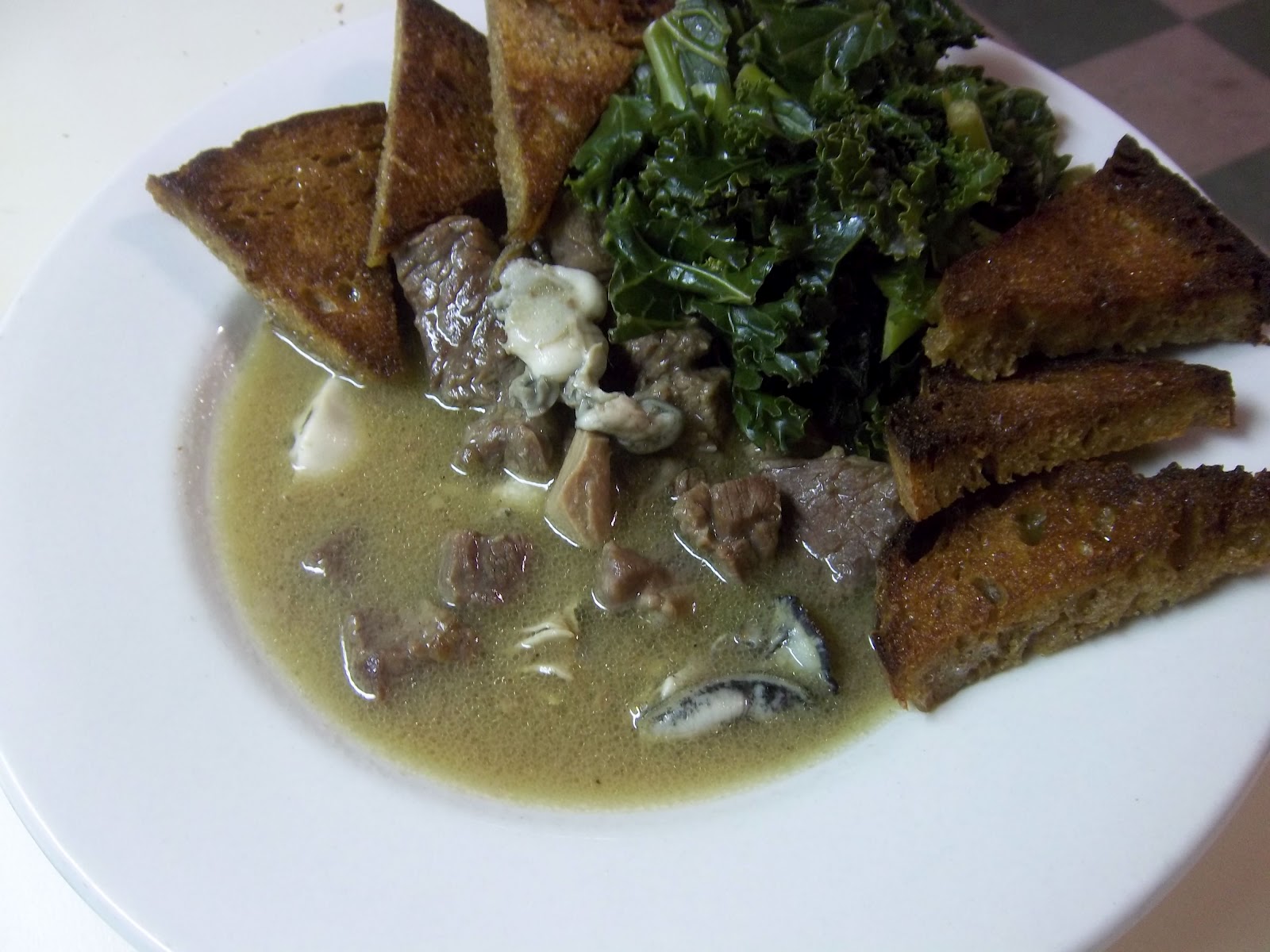
#338 Beefsteak Stewed with Oysters. I love this combination so much! What a shame there are no more recipes left like this. The water had become a rich but not overpowering sauce that goes so well with the iodine-scented oysters. The fried bread was a great contrast in texture and the recipe is so easy and quick compared to a pie or pudding too. It is such a shame that oysters are so expensive. I am wondering if mussels could be used as a substitute. This one is going to remain a staple whilst I am in the USA where oysters are cheap! 10/10.

Friday, December 9, 2011

#320 Steak, Kidney and Oyster Pie

A while ago I made an extremely similar recipe – steak, kidney and oyster pudding. A seminal English dish that I had saved for the landmark 200th recipe. This pie essentially follows the same history (and recipe) as the pudding – the combination of the three main ingredients seems to start with Mrs Beeton. I have found similar recipes going back further like oyster pie, beef-steak and oyster pie, veal and oyster pie and calves’ foot and kidney pie. I could go on, but I shan’t, I think you get the message. The pudding was delicious so there was no way this could be a fail...

+
=

It is worth mentioning my supplier for the beef again - I got it from Missouri Grass Fed Beef, the boss, Jeremy, gave my the kidney for nothing as well! Good man.
This pie uses exactly the same filling as the pudding, so click the link here to find out how to make it; it’s pretty straight-forward stuff. The important thing to note is to check how much and how watery the gravy is before you add the oysters – if there is alot, strain the gravy and boil it down until it darkens and thickens. You need to make it thicker that you would think, because you add oyster liquor to it when it has cooled.
Put the cold filling in a pie dish and get the pastry ready. You can use either puff or shortcrust pastry for the pie. I went for puff. Roll the pastry out and cut strips of pastry about half an inch wide to cover the rim of the pie dish, using water as glue. Griggers says to let the strips hang inwards a little to prevent hot filling from leaking out.

Brush the pastry rim with more water and cover the pie. Crimp down the edges so that the pastry is well-secured. Then Jane says to scallop the edges if you have shortcrust pastry or nick the pastry if puff pastry, after that make a central hole and a leaf design from any trimmings. I hardly had any trimmings left as I didn’t really have enough pastry. Lastly, make a pastry rose with a stem and fit it loosely into the central hole, then give the whole thing an egg glaze.

Bake for around 45 minutes at 220-230⁰C (425-450⁰F).

#320 Steak, Kidney and Oyster Pie – well I already knew this was going to be good seeing as I have essentially made this before, but just to reiterate: absolutely amazing. The combination of rich wine gravy, the metallic kidney and the creamy iodine finish of the oysters is fantastic. Mrs Beeton should be made a saint! 9/10.

Thursday, November 24, 2011

#316 Oyster or Mussel Soup

There is no introduction to this recipe by Grigson in English Food. I am never sure whether Jane did this because she didn’t want to, or whether she thought she didn’t need to. It turns out the recipe goes back quite a bit with a huge amount of similar recipes cropping up during the nineteenth century, including examples from stalwarts such as Eliza Acton (1845), Alexis Soyer (1850) and Elizabeth Raffald (1769). Recipes also crop up in their droves in American cook books of the nineteenth century.

Oysters were hugely popular in British cuisine up until the early nineteenth century, and were at one point considered poor-man’s food, until the seas of Britain became polluted from the Industrial Revolution. These days, they are rather more expensive, though dropping in price now that our seas are much cleaner than they used to be. Farming helps keep the price of the oyster down and there are several successful farms around the UK now. The oyster farm is by no means a recent invention – the Gauls in the 7th century BC farmed them and sold them as far afield as Rome. It went a bit tits-up however when they were completely trounced by the Barbarians.

I chose to use oysters here, but you can use mussels for this recipe instead. There are several pluses to using them: if you are on a budget, they are good and cheap; and also it is easy to get the meat from them. If I were in England, I would probably go for mussels simply for the reason that shucking oysters is one major pain in the arse. However, here in America where seafood is very popular and you can walk into your local supermarket and buy pre-shucked fresh oysters in their own liquor from the fish section. Now that I know this, expect to see a lot more recipes that use oysters in the blog. Mussel farming, like oyster farming, is a main contributor to the reason they are cheap; they can be grown quickly and in great numbers on ‘parks’ made by hanging ropes down into the sea.

Eating seafood such as like oysters and mussels before starting this project would have filled me with dread – our family never ate things like this – but now they fill me with joy. I just love the little beasties.


This recipe is for 6 people (or 4 greedy ones).

Start off with your appropriate seafood: according to the book you’ll need either 2 dozen oysters or 2 pounds of mussels. The number of oysters you need will actually depend on the species of oyster available – 2 dozen if native oysters, or one dozen if the large Pacific or Atlantic species. Shuck the oysters, or alternatively leave them flat-side up in the freezer for a while until they open up for you. Either way, make sure you keep any oyster liquor. If you are using one of the large species, cut each one into two or three pieces.

If the mussel is your bivalve of choice, then give them a good scrub and pull out their beards should they have any. Tap each one: if the shells close, your mussel be alive and well, if it remains open, your mussel be dead, so discard it. Chuck them in a large pan, cover, and place over a high heat. After a few minutes, give them a shake and see if the mussels have opened. If they have they are cooked. Remove the meat from them and place them in sieve over a bowl to collect the juices. Don’t forget to keep any juices from the bottom of the cooking pan too.

Now the shellfish is prepared, you can get on with making the soup. Finely chop 4 shallots and soften them in 2 ounces of butter. Once golden, stir in two tablespoons of flour and let it cook for a minute or two. Find yourself a whisk and mix in the reserved juices and then 1 ¼ pints of light beef stock or veal stock. Season with sea salt, black pepper, Cayenne pepper and nutmeg. Cover, and simmer for 20 minutes or so. When you are ready to serve, add the oysters or mussels plus ¼ pint of double cream and some chopped parsley. Bring it up to a boil, turn off the heat and add a squeeze of lemon juice. Serve immediately.

#316 Oyster or Mussel Soup. This was a fantastic soup! The combination of rich creamy stock and fresh iodine-scented oysters was magic. One of the best soups I’ve done – and really easy too. If you’re doing a dinner party and you want to impress without breaking your back, I would definitely have a go at this. I shall try it again soon but with mussels and see if they are as good as the oysters. 9/10.

Monday, July 11, 2011

#302 Caveach of Sole

I decided that I needed to get back into doing some proper cooking now that I have a new stove in my new apartment. I invited some people around from work and their various spouses and kids. It is pretty hot here in St Louis at the moment so I needed to choose a recipe that was nice and summery and not all hot and stodgy. It needed to be buffet-style as there would be eight of us in all and I can only fit four around my little table. It also needed to be one that is prepared in advance so I wouldn't be rushing around in the 35°C heat on the day. I don't ask for much do I? Oh, and it also couldn't be weird. My options for this kind of food are rather limited in the book now, but I happily found this one that seemed fresh and clean and rather Mediterranean in style.


The sole lies on its side on the sea bed to camouflage itself.
Over time, natural selection has reacted to this by moving one eye
so that they both sit on one side of the head.

The word caveach refers to a method of preserving fish by cooking and then pickling it and comes from the Spanish escabeche. I did a little research on the preservation method and could only find books from the early-to-mid nineteenth century that mention it in any detail; though it seemed popular in both Britain and America at that time. The recipe below is more of a dinner party adaptation where the fish is only left for a few hours to pickle and isn't intended as a preservation method at all. You can caveach any fish you like – the most popular seemed to be mackerel, herring and sardine, presumable because they were the cheapest and most common seafish at that time.

It is also nice to cook a receipt from the Seawater Fish section of the book – options are limited in America because there are different species of fish found commonly in their waters compared to European waters. However there is some common ground and the newly-discovered and very excellent grocery store Straub's has a great selection of fish and meat as well as some other tricky-to-find ingredients, so I'll be using them quite frequently during my time here in Missouri.

First of all prepare your sole fillets – you'll need eight in all. Flatten them a little with a rolling pin, season with salt and pepper and fry them quickly in a little olive oil so that they brown a little. Cut them into thirds and arrange the pieces on a serving dish. Slice a medium red onion thinly and scatter over the fish along with the thinly sliced pared rind of a lemon and a couple of bay leaves cut in two. Next mix together seven fluid ounces of olive oil with three tablespoons of white wine vinegar and pour over the fish. Season again with salt, pepper and some Cayenne pepper too. Cover and refrigerate for at least a few hours, but preferable over night. When it is time to serve, scatter over some chopped herbsparsley, coriander or chervil are suggested by Griggers. I went with coriander. Serve with bread and butter and a salad.


#302 Caveach of Sole. This was everything I had hoped it would be – fresh, clean and slightly piquant. The delicately flavoured sole was not overwhelmed at all by the onions and the mild seasoning. A very good recipe this one – and simple too. I think I am going to try it with other, cheaper fish in the USA like tilapia or catfish. Any fish would work I reckon. A dinner-party stalwart this one will be, I feel. 8/10.

Sunday, June 19, 2011

#299 Leg of Lamb Stuffed with Crab


For the 300th recipe I got a few people round to mine for a little dinner party. Number 300 would hopefully be impressive and I wanted to do something for #299 that would be impressive too and this recipe certainly sounded the part. I also wanted something that dated in the eighteenth or nineteenth centuries, again to match receipt 300.

A recipe for a leg of lamb stuffed with 'a forcemeat containing the meat of a crab or lobster … [with] a little grated lemon peel, and nutmeg', appeared in The London Art of Cookery by John Farley (1811), so it has a decent history, though this kind of food has very much fallen out favour in England. However, one particular chef gave it a breath of new life in the 1970s. A chap called Guy Mouilleron came up with the recipe that appears in English Food and therefore here in the blog, after some French chefs who were working in London were having a right good-old laugh at the English's eating habits. "Fancy" one of them said "they even eat lamb with crab!" Chef Mouilleron thought it sounded like a good idea and conjured up a recipe. It's funny that every British (and Irish!) person I've spoken to about this recipe has thought it just a bizarre as those French chefs.

There's no need to be freaked by this combination though, says Jane, meat was often 'piqued' with fish all the time to give it extra flavour; the idea is not to impart a fishy flavour though, but a mysterious deliciousness. This is true as I already knew after one the great recipes from the blog – steak, kidney and oyster pudding. Meats are also cooked with anchovies a lot too, especially lamb and that cornerstone of English cuisine, the Melton Mowbray pork pie. It seems these things are being lost because of the Englishman's squeamishness of all things fishy in general.

It is strange to me that Americans – or, at least, Houstonians – don't really eat that much lamb and getting hold of a full, large leg of lamb with the bone in isn't really possible in Houston's otherwise comprehensive supermarket meat sections. However, I did manage to get hold of one very easily from the very good Pete's Fine Meats on Richmond Avenue.

Pete's Fine Meats, Houston TX

The recipe also calls for crab meat of course. You can boil your own (see here for instructions) or buy one preboiled. Do not, says Griggers, buy frozen meat as it had lost most of its flavour. However, here in America, where folks like seafood, it is very easy to get hold of freshly picked crab meat in supermarkets, so if you are in the USA, there is no need for you to sit and spend thirty minutes picking the meat from a crab's carapace. God bless America for making the recipe a little easier for yours truly.

If you fancy the idea of this combination, here's how to make it:

Start off by tunnel-boning a large leg of lamb. This is not that difficult to do – I followed the instructions here and it took just five or ten minutes to do. Use the bones to make half a pint of lamb stock (see here for recipe). Season the inside and outside of your leg.


Next, make the stuffing. You need eight to ten ounces of crab meat; either buy it fresh if you can or get hold of a crab weighing around one-and-a-half pounds. To the crab meat, mix in half a teaspoon of curry powder, a tablespoon of fresh mint and three egg yolks. Season with salt and pepper. Stuff the cavity with the crab and sew up the lamb at both ends with a stout needle and some thick thread. All this can be done in advance, of course.


Preheat your oven to 180°C (350°F). Chop equal amounts of onions and carrots, enough to cover the bottom of a roasting tin, as well as a large celery stick. Season well and place the lamb on top. Cover with a double layer of foil (if you have a self-basting tin, you can use that instead) and roast in the oven for two hours. Take the roasting tin out of the oven and place the lamb on another tin and put back in the oven to crisp up.

For the accompanying sauce, put the tin with the vegetables on the hob and bring to a simmer, cooking for five minutes. Now add the lamb stock and half a pint of dry white wine. Make sure you scrape off any of the burnt bits from the surface of the roasting tin. They are the best bits. Strain the sauce into a saucepan, skim away any fat and then stir in a quarter of a pint of double cream and a teaspoon of curry powder.
Place the meat on a large serving dish (don't forget to take out its stitches!) and surround it by buttered noodles and pour the sauce into a sauce boat. Griggers didn't say what vegetables to serve with it, so I served green beans, my own personal favourite lamb accompaniment.


#299 Leg of Lamb Stuffed with Crab. Well I wanted something that looked impressive and it this definitely looked the part. The meat was very good as was the minty and fresh tasting stuffing, though the sauce was a little bland. It wasn't bad or anything, it just didn't pack the punch that I expected it to. If I were to cook it again, I would simmer that sauce right so it became concentrated before adding the cream and curry powder. My expectations were also raised because the lamb section of the book has been so very good thus far. That said, roast lamb can never be bad in my opinion, so I give it a 7/10.

Sunday, February 6, 2011

#272 Melted Butter

As our Jane quite rightly points out in English Food, many old recipe books suggest serving meat, fish and vegetables with good butter or good melted butter. This is not just high quality butter melted on the food, but a butter sauce not unlike hollandaise. The main difference being that flour is used to thicken the sauce instead of egg yolks, which makes the sauce much easier to make. In The Experienced English Housekeeper by Elizabeth Raffald, there are quite a few mentions of it, but no actual receipt. The recipe given here is from The Cook’s Guide by a certain Charles Elmé Francatelli who was briefly the chef at Buckingham Palace during the reign of Queen Victoria. Oh la-dee-da! (He left because he was disgusted with the filthiness of the kitchens.)
Anyways, the sauce seemed to be the perfect accompaniment to the poor old lobster I accidentally dismembered, then boiled. I’ll give the basic recipe and then the variations…
To make the sauce it is best to do the whole thing in a bain-marie or double boiler – i.e. a bowl over simmering water.  Weigh out 9 ounces of unsalted or lightly salted butter – Griggers suggests using a good Danish butter – melt one third of it in the ban-marie with some pepper and nutmeg. Next, stir in an ounce of flour and ¼ pint of cold water, using a whisk to prevent lumpiness. Heat until the sauce is at simmering point, then turn the heat right down and leave for 20 minutes for the sauce to thicken. Now beat in the rest of the butter piece by piece using the whisk. Add any flavorings you want at this point (see below for some suggestions). Season with lemon juice and salt, plus more pepper if required. Lastly, add a tablespoon of double cream for richness.
Flavorings:
Shrimp sauce – add some brown shrimp to the sauce at the end; use fish stock instead of water if you like
Lobster and crab sauces – add the chopped flesh plus some Cayenne pepper. If the lobster was a lady lobster with roe, then pass it through a sieve into the sauce.
Anchovy sauce – add some anchovy essence.
Herb sauce – add plenty of chopped herbs to the sauce near the end of cooking. For larger herbs like sorrel and spinach, steam and chop them before adding them to the sauce.
For the sauce I made, I didn’t want to chop the lobster up, so I stirred in the brown meat (which people think is inedible because of its consistency, but it is delicious) and some chopped parsley and provided it in a jug to be poured over the lobster halves.

Check out the fancy lobster tools!

#272 Melted Butter. I really like this surprisingly light sauce and it complimented the lobster brilliantly. Plus it was much easier than a sauce hollandaise – one didn’t have to stand next it hoping it wouldn’t split. I imagine it would be good to serve with fish, potatoes and asparagus for a Sunday lunch in the summertime. A definite winner this one.

Wednesday, February 2, 2011

#271 How To Boil Crabs, Lobsters, Prawns and Shrimps

A woman should never been seen eating and drinking, unless it be lobster and Champagne, the only true feminine and becoming viands.
Lord Byron 1788-1824
A freshly boiled crab or lobster is the most delicious crab or lobster. Apparently. In England, this is not something that commonly happens in a typical household. Like all our meat and fish, the animals that provide us with all that delicious protein are helpfully done away with by burly men in abattoirs, boats or warehouses.  We have lost touch with our food rather and find the idea of killing an animal for food ourselves distasteful. Pretending this doesn’t happen, in my opinion, is the distasteful act.
That said, I am not actually comfortable myself with killing animals, and as any previous reader of the blog will know, killing three eels was most distressing for me. Now it is the turn of some shellfish. This recipe is one that I never did back in England because I simply never saw live crabs and lobsters, prawns or shrimps in fishmongers. Houston, however, is a very different state-of-affairs. There’s live seafood in pretty much any supermarket you walk into here.
The lobster tank in Central Market, Houston

So if you stumble upon a live crab or lobster in the local fishmonger or supermarket here is what to do. Well, as you’ll find out, it maybe isn’t what you are meant to do….
The main point I wanted to get across is that boiling seafood can be humane (or at least no more or less humane than, say, killing a cow with a stun-gun). In English Food, Jane Grigson says that RSPCA guidelines suggest putting the animal in cold salted water and letting the water heat up – apparently when a certain temperature is reached, the creature expires ‘without suffering’. Guidelines have changed rather and nowadays it’s suggested that the little arthropod is popped into the freezer until it falls into a torpor. When plunged into the water, it’s dead before it has a chance to wake up. (The other method is to stab it in the top of the head using a sharp knife and a mallet.)
So, first things first, my mate Danny (who was helping me out with the cooking) got a lobster from Central Market. On the fishmonger chap fishing out the one we chose, I suddenly felt a pang of guilt, so we hurried to my freezer to get it nice and sleepy. Whilst we waited, the salt water into which it was boiled needed to be prepared. The water needs to be very salty. If you can, use sea water, if not dissolve enough sea salt so that the briny solution will bear an egg (this requires a lot of salt). Bring to the boil.
I was informed that the lobster would take 20 minutes or so to fall asleep. This was total nonsense, because 90 minutes later it was still moving around. Shit. By now we’d had a fair few glasses of wine due to the stress. A little later, the lobster seemed pretty inert, so we decided this was the time. Like, I said before, the idea of this post was to do away with some misconceptions about killing seafood in boiling water. So sure I was of this, I filmed the process, so you get a rare glimpse of me in action! Unfortunately things didn’t quite go to plan, and I may have reinforced those misconceptions. Oh dear.


Next time (if there is a next time) I’ll just throw the thing straight in!
Okay, back to the cooking. The cooking time is 15 minutes simmering for the first pound and then an additional 10 minutes for every extra pound.
For shrimp and prawns: 3 minutes for large prawns and for small shrimps, simply let the water come up to the boil again and they’ll be done.
Serve the shellfish simply, says Griggers, with brown bread, butter and lemon wedges.
#171 How to Boil Crabs, Lobsters, Prawns and Shrimps. Well that was an event! Aside from the auto-dismemberment episode, the cooking itself went very well. I split the lobster lengthways, removed the brown meat and used it to make a butter sauce (see next entry, when I write it!), and grilled the lobster with butter briefly. Delicious. 8.5/10.