Showing posts with label 4.3: Shellfish. Show all posts

Monday, January 14, 2019

#435 Shellfish Puffs

Here’s quite an involved recipe from the book that requires several techniques, one of which is the making of choux pastry – the one pastry I can’t seem to get right. However, I was asked to cater for a recent dinner party, and I thought this one could work very well because the theme was ‘An Alternative Christmas Dinner’. Prawn cocktail is often served as a starter at Christmas and I thought this hot shellfish starter would be a good alternative. It was more 1970s than prawn cocktail, sounding like a dish you would see crop up in Fanny Cradock book, not in a Jane Grigson tome!

It’s not for the faint-hearted though, aside from the pastry there’s a complex sauce made from the shells, so that means you need to shell your fish yourself to make this one. If you have never done this before, I recommend choosing prawns. Here goes:
First of all, make your choux pastry. Bring to a boil in a pan ¼ pint of hot water, a shy teaspoon of sugar and 2 ½ ounces of butter. Meanwhile, sieve 4 ounces of plain or strong white flour into a bowl; I went for the latter as you get better expansion, though this is not necessarily a good thing, see below.
When everything is boiling, take the pan off the heat, pop in all the flour in one go and make a dough by mixing the whole lot together using a wooden spoon. Put the pan back on the heat again and beat the dough well with your spoon. The dough will soon become waxy and will come away from the bowl. This can take a few minutes, especially if you’re out of practise when it comes to beating thick doughs, as I was.
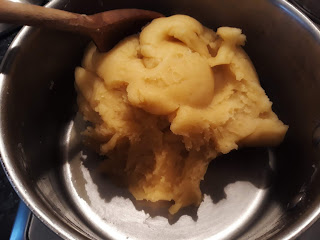

Let the mixture cool for 5 minutes and beat in 4 eggs one by one, waiting for the previous one to become fully incorporated before adding the next one. Use an electric stand mixer for this if you can, otherwise and electric hand whisk. The dough can be used straight away or covered and cooled and used later.
Prepare some baking trays by lining them with greaseproof paper. Now it’s time to pipe the pastry – Jane gives no indication as to how many we need or what size they should be. I scooped the paste into a piping bag fitted with a large round nozzle and made mounds around 1 inch in diameter. It’s important to raise the piping bag as you dispense the dough so your paste is very domed – you get a better and larger puff that way.
If your piped pastry has little spikes, press them down with a wet finger so they don’t burn and carefully drip on the tray (don’t sprinkle water on the pastry itself though).


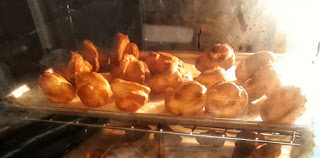
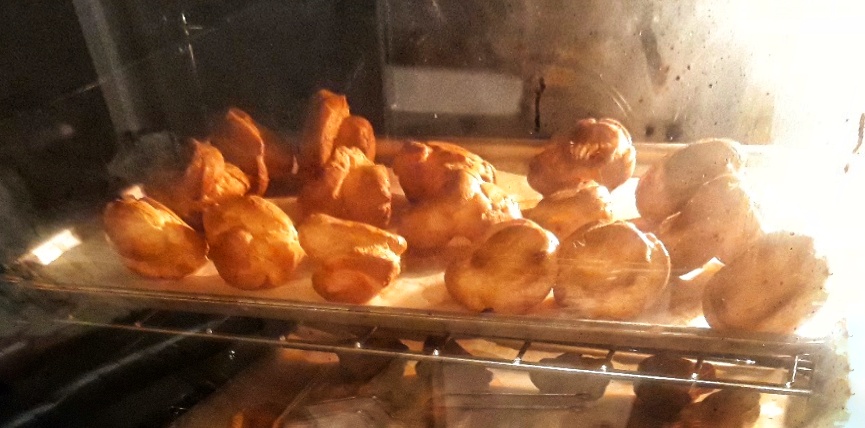
Jane now says to bake them for 35 minutes at 230°C which is far too long and too hot as I quickly discovered! I found they baked best at 200°C, becoming golden brown at the 20-minute mark.
Once they are good brown colour, remove them from the oven and cut a slit or make a hole in their bottom with a skewer. Tip them on their side, return them to the oven and turn the heat down to 120°C so that the steam that puffed them up can escape to create a nice crisp interior. Cool on a rack.


As always, whenever I make choux buns, they turned out all different sizes, all looking like clouds rather than perfectly domed profiteroles. However, they were hollow so good enough for me.
Choux buns can be stored in an airtight tub for a week, so you can get all of this done way before the time you want to serve the course.
For the filling, you need a pound of prawns in their shell, or a 1 ½ pound lobster, or a 1 ½ to 2 pound crab (or crabs). I went for prawns as I couldn’t get hold of crab or lobster at either of my favourite fishmongers! In retrospect it was a good thing, as prawns are much easier to shell than lobsters and crabs. My prawns were raw, so I steamed them in a saucepan containing just a few tablespoons of water. This method yielded a delicious, sweet tasting bright-pink liquid. I kept it and added it to the sauce later.

The delicious pink prawn stock

Remove the meat from whatever shellfish you are using and refrigerate it. If using large prawns, as I did, don’t forget to de-vein the blighters. If using crab or lobster don’t forget the precious brown meat and roe (if any).

Now make a sauce with the shells by adding them to around ¾ pint of thin béchamel sauce – Jane doesn’t tell us how to make one, but I heated ¾ pint of milk containing a couple of bay leaves, a blade of mace, some old ends of nutmegs and some crushed black peppercorns. I then made a roux with ½ ounce each of butter and plain flour.
Add the shells to the sauce and allow the sauce to simmer away for 15 minutes. Loads of flavour comes out of the shells, and the sauce turns a beautiful salmon pink colour. Sieve ‘energetically’, says Jane, so I strained the whole thing through a conical sieve, pushing down hard with the underside of a sturdy ladle.

As the sauce simmers, fry 4 ounces of chopped mushrooms with a chopped clove of garlic in 3 ounces of butter.
Add to the sauce: the shellfish meat, the cooked mushrooms, 2 heaped tablespoons each of grated Lancashire cheese and double cream and two egg yolks. Heat the sauce, but don’t let it boil. Season to taste with salt and pepper.
Cut the choux buns in half crosswise and spoon some of the mixture into the bottom half. Deftly replace the lids and serve straight away.
#435 Shellfish Puffs. There were quite a few techniques required in this recipe, but I must say that it was absolutely delicious! The sauce was creamy, sweet and packed-full of umami flavours. Not too sure about the choux buns though, but the kitsch 1970s brief was definitely filled. Jane also suggests filling vol-au-vents with the mixture – I think this would work better than choux pastry, being more sturdy, but equally as old-fashioned. Nevertheless, that filling was great, whatever it was served in, so it gets a 8.5/10 from me.

Monday, August 22, 2016

#421 Scallops with Cheese Sauce

This is a Manx recipe, and Manx recipes have not gone down too well in the past (#390 Isle of Man Herring Pie) stands out as particularly bad, but this one sounded pretty promising. Fish and cheese don’t always work well together, but there are those outstanding exceptions such as cod or lobster with mornay sauce, so there’s hope.
This recipe comes from Suzanne Woolley’s book My Grandmother’s Cookery Book, 50 Manx Recipes, and according to her, scallops are called tanrogen, which actually was ‘the name given to the scallop shell when it was filled with cod oil to provide a lamp for the fishermen. A rush which quickly soaked up the oil, was used for the wick’. I absolutely love happening upon these little forgotten glimpses of past lives. I might even give this it a go, though I might use a different oil…
In Ms Woolley’s grandmother’s day scallops were obviously ten a penny as this recipe requires 18 scallops for six people. As I couldn’t get a remortgage, I just bought enough scallops for a couple of people and adjusted the amounts accordingly.
A smiling scallop with its many tiny black eyes (from divernet.com)

When you go to the fishmonger to collect your eighteen scallops, first check that have been sustainably caught (if they have not, go to another fishmongers), then buy six scallop shells. Make sure you get the concave sides to the shells and not the flat sides.

Trim away any untidy parts to the scallops and remove the corals, setting them to one side. Slice each scallop in half so that there are 36 discs in all.
Next, add to a wide pan a quarter of a pint of fish stock, a quartered onion, a bay leaf and some salt and pepper. Bring to a simmer, add the scallops and allow to tick away very gently for five minutes, then add the corals and simmer for a further five minutes.
Towards the end of the cooking time, make a sauce by melting an ounce of butter in a saucepan and stirring in an ounce of flour to make a roux. Cook for a couple of minutes stirring occasionally. Strain away the scallop cooking liquor and beat it into the roux. Keep the scallops warm. Make the sauce a little less thick by adding a little milk. Simmer for ten minutes and then add an ounce of grated Cheddar cheese and a couple of tablespoons of double cream. Check the seasoning, adding more cream if you like.
Arrange six halves of scallop into each scallop shell along with three corals and pour the sauce over each one. Sprinkle each with a little more grated Cheddar and brown very well under the grill.
Jane suggests piping the edges of the shells with mashed potato or lining the shells with pastry and baking them beforehand. I did neither and simply ate mine with crusty bread.
#421 Scallops with Cheese Sauce. At last, a Manx recipe I liked! It had to happen at some point, I suppose. It worked just as well as I thought it would; lovely tender-sweet scallops in a sharp and creamy sauce. The only thing I could think of to improve it would be to add some breadcrumbs fried in butter to the cheese before grilling to add some texture. I made the sauce a little too thin, but that's easily remedied 8/10.

Sunday, April 27, 2014

#392 Scallops Stewed with Orange Sauce


This is a recipe that comes from the 18th Century that unusually combines shellfish with orange – in particular the Seville orange and this is the final recipe in the book that uses them. It’s been interesting to see the diverse recipes for these bitter oranges that I used to think were used solely for making marmalade. Now that I appreciate such things, I was looking forward to this one.

If you are not a fan of shellfish, Jane says that white fish such as sole and whiting can be substituted quite easily.

This recipe serves 6 people, but it can be easily scaled up or down.

Although it's not mentioned, use the corals in this recipe too. 
Waste not, want not!

To start, simmer together ¼ pint each of water and dry white wine along with a tablespoon of white wine vinegar, ½ teaspoon of ground mace and 2 cloves in a saucepan for 5 to 10 minutes or so. You have essentially made a very simple court bouillon. Season the water with salt and pepper, and then prepare your scallops. Cut 18 scallops in half lengthways and pop them into the water. The scallops need poached only briefly in just simmering water. I left mine in for 2 minutes only, though I reckon 90 seconds might have been better.

Quickly, fish out your scallops with a slotted spoon and keep them warm and covered. Strain the stock and reduce it to a volume of around 8 fluid ounces. Whilst you wait for that to happen, make a beurre manié by mashing together ½ ounce of softened butter with a tablespoon of flour.

When the stock has reduced, turn down the heat to a simmer and whisk in small knobs of the butter-flour mash to thicken the sauce. Let the sauce simmer without boiling for a few minutes to cook out the flour and then add the juice of a Seville orange (failing that the juice of a regular orange and the juice of half a lemon). Check the sauce for seasoning and add more salt and pepper if needed. If you want a richer, more luxuriant, sauce beat in an egg yolk and 3 tablespoons of cream. For some reason I added some parsley to the dish, though it doesn't say so in the recipe.

Place scallops in a bowl, pour over the sauce and serve straight away. Jane suggests serving the scallops with #176 Samphire or with #382 Laverbread as a Sauce.

#392 Stewed Scallops with Orange Sauce. Intriguing though the recipe was, it didn’t quite live up to my expectations. I didn’t think the flavour of the oranges and scallops married that well, perhaps because the sauce was rather sharp. I think with some tweaks, however, this could be made a lot better or even reimagined as a scallop and orange salad or something like that. Just below mediocre, 4.5/10.

Sunday, June 30, 2013

#378 Elizabeth David's Potted Crab


This recipe I tried a couple of months ago and thought it so good, it should make an appearance as the fish course in my pop-up restaurant earlier in the month. The recipe has been lifted from a pamphlet by Elizabeth David called English Potted Meats and Fish Pastes. You can find the pamphlet in her anthology An Omelette and a Glass of Wine (a book any interested cook worth their salt should own). Ms David honourably adapted old recipes and updated them for the contemporary population. They still hold up today, I take some pride in taking up her baton – via Jane Grigson – albeit on a small scale, in showing that these dishes need to be brought back and celebrated. They are so different from the nasty little pots found on our supermarket shelves.

For this recipe you need to start with a large 2 pound crab – ask your fishmonger in advance to bagsy you a large, hefty-clawed male for you. If such a thing is not available, buy 2 smaller hen crabs. At home, dip into your toolbox for a hammer and root out your lobster tools (or alternatively a nutcracker and skewer) and get to work picking and scooping the meat from the crab, keeping the brown meat in separate pots from the white. It’s worth mentioning that you can buy the tubs of pre-picked crabmeat, but the result will not be anywhere near as delicious.

 
How do you pick a crab of its meat? This excellent walk-through guide from Channel 4 is very good. One day I’ll write my own, if I ever get round to it!

Season the crab meats with salt, black pepper, mace, nutmeg and Cayenne pepper, as well as a good squeeze of lemon juice. Now layer up the two meats in a single mould such a stoneware pot, or several smaller ones. Start with half of the white meat, then the brown and then the remainder of the white. Pack it down firmly and pour over melted slightly-salted butter; you will need around half a pound of butter altogether. Griggers here recommends Lurpak, which eats much better in this sort of dish.

 
Bake in a ban Marie at 150⁰C for 25-30 minutes. Remove and pour over some clarified butter. Allow to cool and store in the fridge covered with foil or clingfilm. If you put a good thick layer of butter over the crab, it will keep for several days. Don’t forget to take it out of the fridge a few hours before you want to eat it.

I served the potted crab simply with spelt bread and a lemon wedge.

#378 Elizabeth David’s Potted Crab. Absolutely delicious, the rich butter and creamy crab meat are suitably sharpened by the warming spices and lemon juice. This must be the best of the potted meat and fish dishes in the book and I cannot sing its praises high enough. 10/10
 

Sunday, March 13, 2011

#281 Scallops with White Wine and Jerusalem Artichokes

If I am going anywhere that is likely to have lots of nice food, I take my copy of now dog-eared English Food along with me in case there is something I don’t expect to see but is required for a recipe. Central Market, the place where I seem to get most of my ingredients from here in Houston, almost always has something unexpected I can use. Today was no exception: I was shopping for some pie ingredients, but also came across some nice Jerusalem artichokes. A quick flick through the book and I found this recipe that combines them with one of my favorite items of seafood, scallops. I was in the mood for treating myself, so I thought this would be a great late lunch dish prefect for these warm days in Houston.
This recipe isn’t one of Jane Grigson’s herself, but from one of her contemporaries and friends Joyce Molyneux, who owned a restaurant called The Carved Angel in Dartmouth. Ms Molyneux adapted the recipe from a recipe she saw for scallop and Jerusalem soup in a book called Four Seasons Cookery Book by a certain Margaret Costa. It’s funny how recipes get changed and passed around, constantly evolving into different dishes.
To make a lunch for four you will need eight large scallops. Remove the corals (should they still be on) and reserve them and cut each scallop into five or six discs. Now trim about twelve ounces of Jerusalem artichokes and cut them into thin matchsticks (keeping trimmings for soup, Griggers says). Fry them gently in two ounces of butter and when nearly tender – about ten minutes – add the scallop discs and four tablespoons of dry white wine. Season with a little salt and pepper. After a minute, add the corals and cook for another two minutes. Don’t overcook – they will become like rubber. Arrange the scallops and artichokes on a warm plate and concentrate any remaining juices, seasoning with more salt and pepper if you like plus some lemon juice. Finally, stir in some chopped parsley and pour over the scallops. I served them with some nice buttered sourdough bread, thinly sliced.
#281 Scallops with White Wine and Jerusalem Artichokes. I loved this. One of the best recipes I’ve done in a while. The earthy artichokes worked so well with the sweet scallops, plus the wine, lemon and parsley really made the whole thing wonderfully fresh tasting. Mopping up the sauce with the bread was the perfect finish. Excellent. 9.5/10.

Wednesday, February 2, 2011

#271 How To Boil Crabs, Lobsters, Prawns and Shrimps

A woman should never been seen eating and drinking, unless it be lobster and Champagne, the only true feminine and becoming viands.
Lord Byron 1788-1824
A freshly boiled crab or lobster is the most delicious crab or lobster. Apparently. In England, this is not something that commonly happens in a typical household. Like all our meat and fish, the animals that provide us with all that delicious protein are helpfully done away with by burly men in abattoirs, boats or warehouses.  We have lost touch with our food rather and find the idea of killing an animal for food ourselves distasteful. Pretending this doesn’t happen, in my opinion, is the distasteful act.
That said, I am not actually comfortable myself with killing animals, and as any previous reader of the blog will know, killing three eels was most distressing for me. Now it is the turn of some shellfish. This recipe is one that I never did back in England because I simply never saw live crabs and lobsters, prawns or shrimps in fishmongers. Houston, however, is a very different state-of-affairs. There’s live seafood in pretty much any supermarket you walk into here.
The lobster tank in Central Market, Houston

So if you stumble upon a live crab or lobster in the local fishmonger or supermarket here is what to do. Well, as you’ll find out, it maybe isn’t what you are meant to do….
The main point I wanted to get across is that boiling seafood can be humane (or at least no more or less humane than, say, killing a cow with a stun-gun). In English Food, Jane Grigson says that RSPCA guidelines suggest putting the animal in cold salted water and letting the water heat up – apparently when a certain temperature is reached, the creature expires ‘without suffering’. Guidelines have changed rather and nowadays it’s suggested that the little arthropod is popped into the freezer until it falls into a torpor. When plunged into the water, it’s dead before it has a chance to wake up. (The other method is to stab it in the top of the head using a sharp knife and a mallet.)
So, first things first, my mate Danny (who was helping me out with the cooking) got a lobster from Central Market. On the fishmonger chap fishing out the one we chose, I suddenly felt a pang of guilt, so we hurried to my freezer to get it nice and sleepy. Whilst we waited, the salt water into which it was boiled needed to be prepared. The water needs to be very salty. If you can, use sea water, if not dissolve enough sea salt so that the briny solution will bear an egg (this requires a lot of salt). Bring to the boil.
I was informed that the lobster would take 20 minutes or so to fall asleep. This was total nonsense, because 90 minutes later it was still moving around. Shit. By now we’d had a fair few glasses of wine due to the stress. A little later, the lobster seemed pretty inert, so we decided this was the time. Like, I said before, the idea of this post was to do away with some misconceptions about killing seafood in boiling water. So sure I was of this, I filmed the process, so you get a rare glimpse of me in action! Unfortunately things didn’t quite go to plan, and I may have reinforced those misconceptions. Oh dear.


Next time (if there is a next time) I’ll just throw the thing straight in!
Okay, back to the cooking. The cooking time is 15 minutes simmering for the first pound and then an additional 10 minutes for every extra pound.
For shrimp and prawns: 3 minutes for large prawns and for small shrimps, simply let the water come up to the boil again and they’ll be done.
Serve the shellfish simply, says Griggers, with brown bread, butter and lemon wedges.
#171 How to Boil Crabs, Lobsters, Prawns and Shrimps. Well that was an event! Aside from the auto-dismemberment episode, the cooking itself went very well. I split the lobster lengthways, removed the brown meat and used it to make a butter sauce (see next entry, when I write it!), and grilled the lobster with butter briefly. Delicious. 8.5/10.

Wednesday, January 19, 2011

#268 Potted Shrimps

Hugh and I invited our mates Maartin and Ninja around for some food so I thought it would be the perfect excuse to do a couple of Grigsons. Poor things. For a starter Hugh made some mackerel pate (I should get the recipe from him and put it on here) and I did these potted shrimps. I wanted to cook a recipe that I couldn’t do in America and this is one. I so far haven’t found anywhere in Texas that sells brown shrimp.
For those of you that don’t know, potted shrimps are a Lancastrian delicacy – they are going out of favour as many traditional foods are these days and, as far as I know, the only place that makes them is a small fishery in Morcambe Bay. They used to be very popular across the whole of the country after Young’s opened a shop selling them in London. The shrimps are fished and boiled on the boat before being dunked in the sea to cool off quickly. As the boat returned to land with its catch, the women and children of the town would be waiting to pot the shrimps.  If you happen upon some brown shrimps, try making them yourself because they are pretty easy to do.
For every pint of shelled shrimps you will need to melt 4 ounces of melted Danish butter along with ¼ teaspoon of powdered mace, a pinch of Cayenne pepper and a grating of nutmeg. Once melted, mix in the shrimps and let them heat through. Pack into pots and cover with clarified butter and then some foil or cling film. Allow to set. Serve spread on brown bread or toast. Piece of piss.
#268 Potted Shrimps. I loved these. The shrimps are sweet and well-flavored and the traditional spices such as mace really complimented them. It’s a shame that mace isn’t used more often these days as it goes so well with fish. 7.5/10.

Thursday, October 1, 2009

#192 Elizabeth David's Prawn Paste

In days of yore, we English loved potted meats and fish. You don’t seem to see many potted foodstuffs around these days: though potted beef is still popular in Yorkshire. Pate does not count. This one at first sight seems a bit weird, and perhaps foul, but there are some interesting ingredients in there. One of the great things that Elizabeth David did in the sixties and seventies was introducing us to Mediterranean flavours, and she managed to sneak a few in here: olive oil instead of butter, basil instead of parsley, lime rather than lemon. She transformed our eating habits; along with Grigson, Floyd, et al. of course. It may seem odd these days – all those continental ingredients mashed up in a now-defunct method of preparing meat and fish – but there you go.

Place eight ounces of cooked, peeled prawns in a blender along with the juice of a lime and around six tablespoons of olive oil – use extra virgin if you have it since as it’s not going to be cooked. Blend until smooth and add half a teaspoon of dried basil and a heaped saltspoon (!) of crushed coriander seeds. Season with a little salt and some Cayenne pepper. Divide between some small ramekins, cover and refrigerate. Serve with hot, thin toast.

By the way, I don’t know the capacity of a saltspoon as I don’t own one, so don’t ask me. Actually, I’d not even heard of one. I guessed and added a quarter of a teaspoon. Also, don’t buy dried basil, as it has no flavour; dry your own in a cool oven for about 20 minutes until crumbly: much better.


#192 Elizabeth David’s Prawn Paste. It may have sounded like horrible soggy fish pap, but this was delicious. The prawns were sweet, the olive oil was fruity and the basil and coriander seeds combined with the lime juice provided a morish tang. Really good – go and make some. 7.5/10.

Tuesday, September 22, 2009

#189 Mussel and Leek Rolypoly

“People sometimes shudder at the mention of roly-poly puddings” says the Grigson; er, no dear, just the idea of THIS one! Why on Earth is there no jam roly-poly pudding, please!? I’ve been putting off the more weird ones – like this – but they are building up now. I wasn’t looking forward to it, but Griggers really does big this one up. It is cheap though, at least when mussels are in season.

I have only recently been able to pluck up the courage to eat mussels; I’ve always been a bit squeamish with bivalves for some reason. However, I do love mussels now. The Romans loved them too, and they’ve been cultured in France since the late thirteenth century, ever since a shipwrecked Irishman called Patrick Walton was washed up on a French beach and noticed some mussels growing on the fishermen’s nets. I doubt he wrapped them in suet pasty though.

To begin you need to cook your mussels – 48 in all, says Grigson. Scrub them and remove their beards and any parasites. Place them in a hot, wide shallow pan and cover. As soon as the mussels open, take them off the heat. Don’t use any mussels that have not opened. Shell them, reserving any juices, and let them cool. Pass the juices through some muslin into a small pan.

Now make the rest of the stuffing: In a bowl, mix together 3 ounces of finely chopped onion, 2 trimmed and finely chopped leeks, 2 chopped rashers of streaky bacon, 3 tablespoons of chopped parsley and a little salt plus plenty of ground black pepper.

Suet pastry is the easiest pastry to make. Sieve 10 ounces of self-raising flour in a large bowl and mix in a pinch of salt and 5 ounces of shredded suet. Using a knife or your hands, mix in some cold water until a firm and light dough is formed.

You are now ready to construct the rolypoly pudding. Roll the dough into a rectangle and sprinkle over the leek mixture leaving a centimetre border around three sides, and then evenly sprinkle over the mussels. Brush the edges with water and roll up the pastry starting at the borderless end, lastly press down the sides to prevent any leakage from the sides. Wrap it in a tightly-sealed but baggy foil parcel and steam for two hours on a rack in a self-basting roaster. If you don’t have one – use a normal roaster and make a foil lid as I did. When ready, place in an ovenproof serving dish and crisp it up in the oven for 10 to 15 minutes - careful now, it might collapse (see pic!). Whilst that is happening, make the butter sauce. Boil down the reserved mussel liquor, take it off the heat, and whisk in 4 ounces of chilled, cubed butter, bit by bit. Season well, add some chopped parsley, and it is ready.


#189 Mussel and Leek Rolypoly 4.5/10. I though I liked this in the end, but then I wasn’t sure; it certainly wasn’t awful. I even had seconds. The mussels were soft and sweet, the leeks were cooked nicely and the pastry was crisp. The sauce was good too. I think it was too rich, and I ate too much. An unusual one, but I’m not sure I would recommend it.

Saturday, May 2, 2009

#140 Crab Tart

I’ve mentioned before that a much ignored chapter in English Food is the Fish chapter (I must tell you what the chapters actually are, so you know where the seemingly random recipes fit). The fish that are in season during May and are in the book are salmon and crab. A quick phone call to Butters to help me decide which fish/crustacean to try first was required – I’ve never cooked with crab other than tinned, and salmon isn’t my favourite. We went for the crab. There’s a few crab recipes but this one seemed relatively straight-forward.

It seems the oceans were a much more plentiful place in the 1970s compared to now (though we knew that already!). The original recipe asks for a boiled crab weighing 2 pounds or one kilogram. Fat chance of that says the fishmonger, however I asked for the biggest one and it wasn’t too far off. It only cost a fiver! I was well happy there – a tiny tin of it cost about 3 quid. Bargin. In fact I noticed the fishmonger was stocked with loads of nice things at the minute...


Butters gets a crab infestation. Again


To make a crab tart, start off by making (or buying) some shortcrust pastry and lining an 8 to 9 inch flan or tart tin with it. Bake the pastry blind in a hot oven - 220°C – for 10-15 minutes. Do this by lining it with greaseproof paper or foil and pouring in some baking beans. For the final couple of minutes remove the beans so that the base can crisp and dry out a little.

Now you have to pay the boiled crab some considerable attention. It’s quite an arduous task but quite satisfyingly so. I won’t go through how to remove the meat here, but I’ll instead send you to this link to Deliaonline, which I followed and it did the job. In fact go to that website if there’s any techniques you want to reference. Once you’ve extracted as much meat as your patience will allow mix the white and brown meats together and season well with sea salt, black or white pepper and Cayenne pepper. Stir in one whole egg and two egg yolks (keep the whites) and 8 fluid ounces of whipping cream. Now add a tablespoon each of Cheddar and Parmesan cheese and stir in. Whisk the two egg whites until firm of peak and fold it into the crab mixture. Pour the whole thing into the case and bake at 220°C for 5 minutes and then turn the heat down to 190°C and bake for a further 25-40 minutes. The tart is ready when it has set and lost its eggy wobbliness.

Not the most photogenic of tarts, I know, but tasted lovely.


Griggers says to serve straight away with brown bread and butter, but to be extra-seasonal, I made a quick salad from rocket, sliced radishes, olive oil, lemon juice and salt and pepper. It went very well.

#140 Crab Tart 7/10. I really enjoyed cooking with and then eating crab. The brown meat dissolved into the cream and eggs making it deliciously sweet and moist and the white meat gave the whole thing good texture. The genius of the dish was the whisked egg whites, which lifted to so well. A definite success that really made me feel Spring is finally here! Great stuff.

Thursday, April 2, 2009

#132 Oyster loaves

One of the least-explored chapters in English Food is the Fish chapter. The main reason for this is that I have the least experience of the foods therein. Being English (I won’t say British as Wales, N. Ireland and Scotland may be different) means, generally, the only fish you get to eat is white fish – cod and haddock. Though I love the fish I’ve tried, one thing we have never eaten as a family growing up in Yorkshire is shellfish. The only exception is prawns because my Mum likes them. Because I’ve never really tried the bivalves – cockles etc., I find them tricky to get my head around them – they look like something from a biological specimen jar and do not resemble anything else that might turn up on the dinner table. I felt an inauguration coming on, and “why not” I thought, start at the top, with the king – oysters.

I popped on down to the Arndale Market in Manchester, got some rock oysters for 70p each and an oyster knife for a fiver from the cooks stall. Hopefully I’ll get to use it more than once…

I thought I’d better not go straight in at the deep end with a raw squirming oyster, but instead get there by degrees. First step – oyster cooked and smothered in some kind of sauce with lots of other flavours. Second step – oyster cooked but by itself. Final step – raw oyster. Griggers was there to help, natch, with this recipe straight out of the 1970s:

This recipe is per person, so multiply up depending on how many you’re cooking for:

Begin by heating your oven to 220°C whilst waiting for it to heat up, open 4 oysters with an oyster knife. This can be tricky if using large rock oysters with big gnarly shells, but with a bit of patience it’s quite easy to get the knack for opening them. Give them a rinse and a scrub under the cold tap first and make sure you hold the flat side of the oyster uppermost and with your grasping hand wrapped in a tea towel. Use the knife to prize the hinged back part of the oyster open. Do this over a bowl so you can keep any liquor that escapes – very important for later. I found that placing a sieve lined with some kitchen paper filtered away any sand or cracked bits of shell.

Now hollow out 2 bread rolls by first slicing the top off and then scooping out the centre, making sure you don’t make any holes in the side. Brush the lid and roll inside and out with melted butter – about ½ an ounce – and bake for 10 minutes until crisp and golden.

Meanwhile, melt another ½ ounce of butter in a pan and cook the oysters for around a minute and a half until they are opaque and firm. Remove them and cut them up into two or three pieces. Pour the oyster liquor into the pan along with 2 tablespoons each of double and soured cream, and season with salt, pepper and 3 or 4 drops of Tabasco sauce. Reduce it down to a thick sauce, stirring all the time, and warm the oysters through in the sauce. Check for seasoning. Lastly, divide the mixture between the hollowed bread rolls and serve immediately.


"Feed me, Seymore"


#132 Oyster Loaves – 7.5/10. I really enjoyed this. I’ve heard people say that oysters taste of ‘the sea’, or ‘ozone’ or iodine’; I’ve never been sure what they meant by that, but now I do! The oysters were sweet, rich and very soft and the piquant, yet creamy sauce really worked well. The idea of putting them in a hollowed bread roll might seem a bit naff now, but you could serve on a circle of bread fried gently in butter to make look more with the times. One would make a really good first course. I am very impressed with my first oyster adventure and would definitely encourage anyone who is squeamish about them to give this recipe a try – it simple and not expensive.


FYI: In days of yore, oysters were considered food for the poor and were largely ignored by the posh. They were used as a substitute for mushrooms (hence steak, kidney and oyster pie) in many dishes as they were very rare due to the fact no-one had worked out how to cultivate them. It wasn't until they became scarce due to loss of habitat and pollution that they were thought to be a delicacy.

Wednesday, November 12, 2008

#91 Spicy Prawns

What makes these English, I do not know; other than a sort of nod to Maharajah days maybe. Anyways, I bought a huge bag of tiger prawns from W H Lung, the Oriental Cash and Carry near where I work for when I made Phat Thai for me and Butters at the weekend. I had loads left over, so I looked through the book and saw Spicy Prawns. I had all the ingredients in and it takes very little time to make. If you have spices at home, it’s a good one to do.

BTW: if you don’t, buy some spices in – they’re cheap as long as you don’t buy Schwartz spices; they are ridiculously overpriced. Go to an Asian supermarket. If you live in Manchester, Unicorn sells good value, organic spices. Also, buy your spices whole and grind them as you need them – the flavour is much better. Use a pestle and mortar, or as I do, a coffee grinder.

For two:
Peel (if you need to) and devein 8 ounces of raw tiger prawns. To devein, cut down the back of the prawn and remove the black vein running along its length. (FYI: it isn’t a vein, but the digestive tract and the black is the mud and God-knows-what else they’ve scoffed). Make a spice mix of ½ teaspoon of paprika, ½ a teaspoon of ground cumin, a ¼ teaspoon of ground ginger and a pinch of cayenne pepper, plus some salt. Heat a couple of tablespoons of olive oil in a pan and fry two chopped cloves of garlic. When they start to turn golden add the spice mix and fry for a minute. This is very important when cooking any spice – you need to fry them in oil at the start, otherwise they taste bland and raw. Add the prawns and fry for another two minutes, stirring them around so they get evenly cooked. Lastly, throw in a good few tablespoons of coriander leaves and cook for one more minute. Serve immediately.

Grigson says to serve with crusty bread or with saffron rice garnished with toasted pine kernels and fried onion slices. I went for the latter as you can see. To make saffron rice, you need to sprinkle in ¼ teaspoon of saffron strands to the rice when it is cooking. Use Basmati rice, fry it in oil for a minute before adding boiling water and some salt. The ratio by volume of rice:water is 1:2. Add the water, stir once, cover, and leave it on the lowest possible flame until all the water has been absorbed. Let it stand for a few minutes and fluff up with a fork. Perfect rice, every time!

FYI: I usually don't eat prawns, but have fallen off the wagon recently. If you eat alot of them, try and cut down. Those that are fished are trawled up with huge trawlers that kill everything in their path. For every tonne of prawns fished, ten tonnes of sea life dies. If you buy farmed, it is not much better; most farms are built on mangrove swamps - a habitat we are already losing at a rate of knots. When I'm done cooking the Grigson recipes with prawns, I'm going only have prawns at special treats.

#91 Spicy Prawns – 7/10. Very tasty and quick to do. Brilliant if you can’t be bothered cooking but want something proper. The prawns were ready in the time it took to cook the rice. The oily spices were just right – very intense, but didn’t mask the subtle flavour of the prawns. The saffron rice helped this thing along with it’s slightly musky-sweet flavour. Of course, this is even easier if you just have it with bread. Great stuff!