Showing posts with label roast lamb. Show all posts

Thursday, January 1, 2015

#400 Crown Roast of Lamb


Well, well, well. Here we are at #400! Who would have thought I’d get this far?

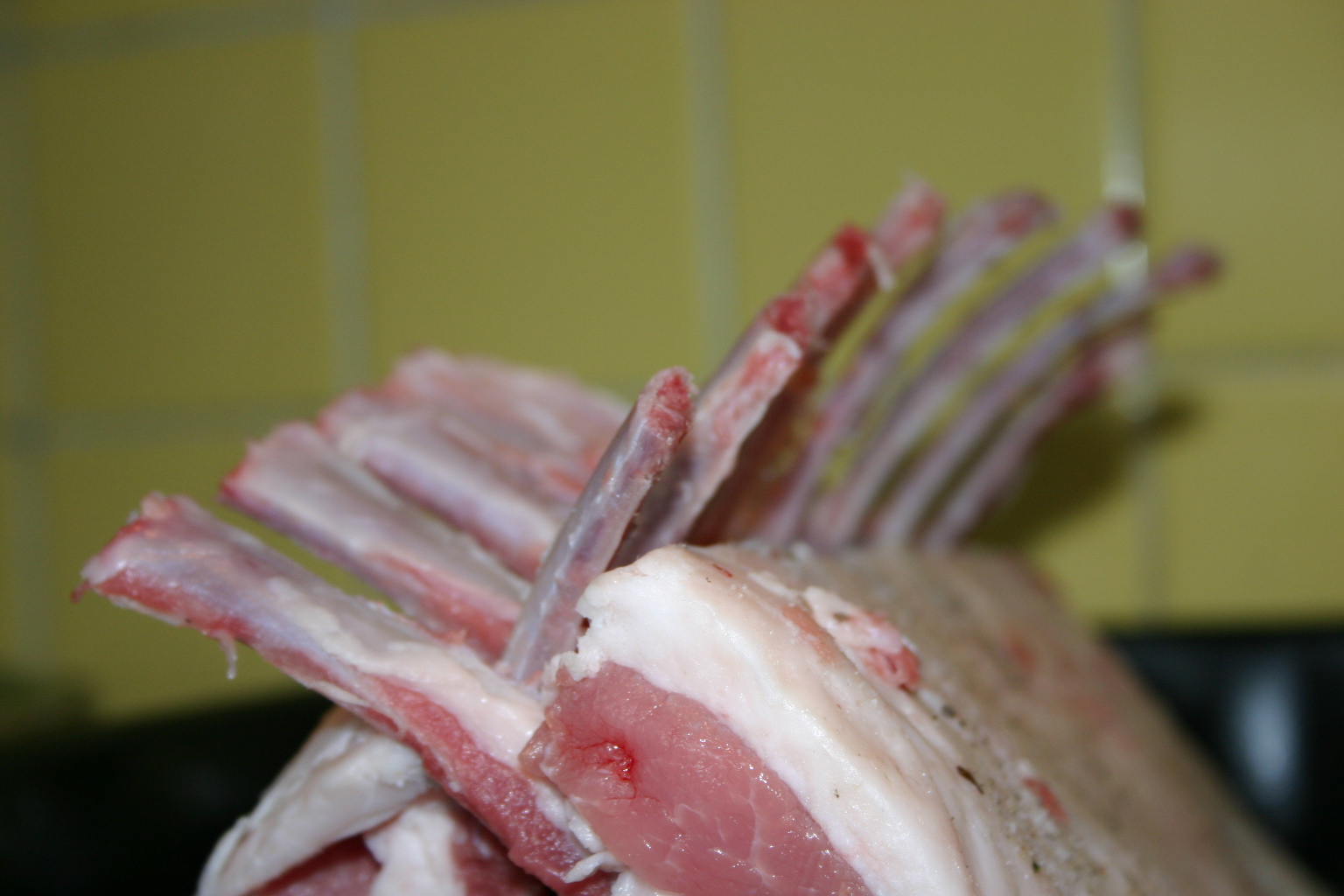
I’ve chosen this classic piece of meat sculpture for this milestone as it is such a special thing, and hardly seen these days. Plus, doing it Jane’s way means you don’t simply pop to the butcher’s shop and ask for the roast assembled and oven-ready. No, Jane’s way means constructing it yourself; something I really could not have done at the beginning of this project. This saves you a lot of money, and earns you plenty of kudos with your friends.

I did a quick look through some old books and it is odd that this classic and ancient and slightly macabre dish does not seem to appear before the 20th Century. I must be wrong here – can anyone shed any light on it?

To make your own rack of lamb, you will need three things: your lamb, stuffing and a trussing needle & thread.

First, the stuffing: go for any of the stuffing recipes in the Stuffings section of the last chapter, or go with the stuffing recipe from #175 Shoulder of Lamb with Rice and Apricot Stuffing. I chose the latter.

Ok, now the tricky bit. Go to your butcher and ask for a whole best end of neck; it is from this that you will get your two, perfectly symmetrical, racks. You should get 7-8 cutlets from each rack. Here’s what you ask the butcher to do (in Jane’s own words):

  1. to divide in two down backbone so you have two symmetrical pieces,
  2. to chine it [this means to remove the backbone],
  3. to make small cuts between the cutlet bones [this is quite simple to do yourself].

The butcher will desperately try to chop off the long bones and you must insist he does not! At home, you can get the racks prepped by French trimming the thin ends; scraping away the fat from the ribs, just like #305 Guard of Honour. It’s quite laborious at first, but you’ll soon get the knack.

Sit the two racks back-to-back with the fatty sides touching. Take your trussing needle and sew the ends together with two stiches, making sure the thread is tied good and tight.

Stand it up and shape it into a crown using your fist – this is where those little cuts the butcher made are important.  Cover the ends with foil and sit the whole thing on a rack in a foil-lined roasting pan. Season the meat (especially the fat) and fill the centre with your chosen stuffing.

Roast for 75 minutes  at 190⁰C. Remove from the oven, cover with foil and let the meat rest for 20 minutes or so. If you want to be posh remove the foil from the ribs and replace with paper ruffles.

But what to serve with roast lamb? Don’t fear, Grigson has it all covered for us in this post.

#400 Crown Roast of Lamb. What a spectacle this was! I loved the way it looked; not all nice and neat with each rib the same length, but instead the bones were their natural varied lengths, making it look even  more like a real crown. The stuffing was, of course, great and the meat itself wonderfully tender and medium rare. A surprising thing bearing in mind it had been a roasting for what seemed like a long time. The only minor thing is that the stuffing began to char, so I would recommend covering it with some foil for the first half of the roasting. Nevertheless, still marvellous. 10/10.


Wednesday, September 12, 2012

#353 Roast Rack of Lamb with Laverbread


A second post involving the Welsh speciality laverbread; a deep green gelatinous sauce made from well-stewed seaweed known locally as laver (see the previous post). I still had some left over for this recipe which I made for my friend Charlotte – a veteran of my cooking, poor woman – as it was her birthday and luckily she requested lamb.

This is a recipe that I couldn’t do when I was in America because what you don’t want are nice pre-butchered racks, but a whole best end of neck. This is the upper part of the back and ribs that sequesters the beautifully tender lamb cutlets. If you can, wait until the lamb are a little older; these muscles don’t do much work so they don’t have as much flavour as, say, leg. Older animals have worked a bit longer so there is some make up in the flavour department. Also, they’re much bigger so you get more meat in your best end of neck.

Anyways, ask the butcher for one best end of neck, then ask him (or her) to split it down the centre, removing the backbone. Take the meat home, including the bones that he removed and you paid for!

Now prepare the lamb ready for roasting by cutting away any fat and meat from the ribs, don’t go too far down – maybe and inch and a half at the wider end and an inch at the thin end.


You should end up with two racks that can be propped up against each other with bones interlacing like fingers. Now take a clove of garlic and slice it thinly. Make holes down the fatty sides of the racks with a very sharp pointy knife and slot a sliver of garlic in each one. Season the lamb all over and put it in a roasting tin so that the ribs criss-cross.


Cover the exposed bones with a piece of foil so that they do not burn. Roast the lamb for 45 minutes at 220C (425F) for pink lamb, going up to 60 minutes for well-done (though cooking it well done would be a travesty in my humble opinion).

Next, make the gravy by first making a lamb stock from the bones and trimmings (this bit can be done well in advance). Add them to a saucepan with a carrot and a tomato both roughly chopped, a pint of beef stock and some salt and pepper. Bring to a simmer and let it tick away for a couple of hours or more if you can. Pass through a sieve and cool. Remove the floating fat and return to the pan with a glass of white wine or vermouth. Reduce until you get a well-flavoured stock. Lastly, slake a tablespoon of cornflour with a little cold water and stir into the stock to produce a nice gravy.

When the lamb is ready, take it out of the oven and cover with foil and let it rest whilst you make the laverbread sauce. Melt 3 ounces of butter in a saucepan and add a pound of laverbread. When hot, stir I the juice of 1 lemon and 2 oranges. Season with salt and pepper.

Place the lamb in the centre of a serving dish, pouring any juices in the gravy. Pour the sauce around the edges of the lamb and then decorate with thinly sliced oranges.

#353 Roast Rack of Lamb with Laverbread. Well the meat (which I cooked pink) was absolutely delicious, tender and well-flavoured. I wasn’t sure about the laverbread at first – it not being cut by the bland oatmeal like in the previous recipe – but I soon got used to it. The taste is very strong, but when eaten with the lamb you can see why they are eaten together so often. The gravy too was excellent; mild and not in the slightest bit greasy as lamb gravy can so often be. 9/10


Wednesday, August 10, 2011

#305 Guard of Honour

For the meaty part of the dinner party I mentioned a couple of posts ago, I thought I would attempt a Guard of Honour. For those of you not in the know, a Guard of Honour is an attractive way of presenting roast rack of lamb by taking two racks and sitting them upon a roasting tray so the rib bones ‘bristle like a military row of crossed stakes’. The Guard can then be stuffed if you like. Jane likes, as this recipe includes the herb stuffing that I have made a few times now.

I did a little research on this dish, assuming it would be a very old one, but was surprised to find that I could only find relatively contemporary recipes, with none cropping up even in the nineteenth century. Odd.

Griggers recommends buying a whole best end of neck of lamb and to ask the butcher to split it in two down the backbone and to get it chined between each rib so that you can carve the joint easily later. To chine is to cut the backbone. If this wasn’t done, you’d have some thick bits of bone to wrestle with. Ask him to leave on the long bones of the ribs. This part is a rather difficult thing to achieve in America for a couple of reasons. First, the joint called a best end of neck means nothing and second, lamb is generally imported from New Zealand and pre-butchered, at least in part. It’s quite easy though to get hold of a couple of matching racks and to simply not have the extra-long bones.

To make a Guard of Honour, take your two racks of lamb and scrape the skin and fat from the very thin part of the chops to expose the bones, then score the fat on the chops and rub in salt, pepper and rosemary or thyme into it (I went with thyme). Stand the joints up and allow the ribs to cross over each other. Fix them in place with skewers. The cavity within can then be filled with herb stuffing. I found the easiest way to do this was to turn the joint upside down, opening it up, so that the most stuffing possible could be added. (Thanks for taking the photos, Joan!)


Turn it the right way up and press the sides together gently, scraping away any escaped bit of stuffing. Check the security of your skewers and place on a roasting tin.


Roast in a preheated oven for 1 ½ hours at 190°C (375°F). Note that this means that the meat will be well-done.


The meat can be carved, after a period of resting, nice and neatly, giving two chops per person.


Serve your roast lamb with any of the trimmings Jane suggests here. She does mention that the stuffed tomatoes recipe goes very well with Guard of Honour, but I wanted to do other things...


#305 Guard of Honour. I really liked this. I did make it because I was in the mood for lamb. Usually I like my lamb pink, but the delicious herb stuffing helped to keep the well-done meat moist and flavourful. I must admit it wasn’t quite as impressive as it should have been because I couldn’t give the precise instructions to the butcher in the preparation of the joint. I think I shall do some of the more tricky lamb recipes back in Blighty. This is only a little complaint of course and the recipe was very good indeed. 8.5/10

Tuesday, August 2, 2011

Griggers advises us on what to eat with roast lamb....

The next recipe from English Food will be roast lamb. Not as popular as it was as a roast meat these days, but easy to come by. Jane Grigson in her wisdom gives us a list: 'Things to go with Roast Lamb'. I thought I'd give the list in full. Hopefully as I cook through the Lamb & Mutton section of the Meat, Poultry & Game chapter, I'll try them all. Some I'll have to as they are also offical recipes, others I have inadvertantly tried as parts of other dishes and such. Anyways, here's the list:

Mint sauce (summer)
Redcurrant or medlar jelly (winter)
Laverbread, heated with orange and lemon juice
Young peas and young potatoes cooked with mint
Asparagus
French beans
Spinach
Cauliflower
Purple sprouting broccoli
Chestnuts and Brussels sprouts
Chestnut puree
Onion sauce (2 recipes for that thus far)
Roast potatoes


Mutton and lamb in oil-on-canvas form