Showing posts with label apples. Show all posts

Friday, August 1, 2014

#397 Herb Jellies

Here’s a quickie from the Preserves part of the last chapter of English Food.
Herb jellies are apple jellies flavoured with a herb and a little vinegar for piquancy. They can be served with roast meats, cold cuts, cheese, even fish or vegetables such as peas.


You can use any herb you like. On my allotment there are vast amounts of mint, lemon thyme, chives, sage and oregano.
Here are some suggestions to give you some ideas:
Mint; lamb, duck, mushy peas, garden peas, new potatoes
Thyme; chicken and other poultry, pork, rabbit
Lemon thyme; chicken, fish
Sage; Pork
Marjoram/Oregano; pork, chicken, cheese
Chervil; game
I shan’t go on – I’m sure you get the idea!
My patch of mint needed taming so I put both the leaves and stems to good use.
It is pretty straight-forward.
First weigh, then roughly chop, some Bramley or windfall apples and place, skin core and all, in a large pan. Add 3 ½ fluid ounces of white wine vinegar to every 2 pounds of apples. Add enough water to only just cover the fruit. Amongst the apple pieces, tuck in 2 or 3 big springs of your chosen herb. Bring to a simmer and cook until the apples have become all mushy, around 20-25 minutes.


Pass the juice through a jelly bag and allow to drip overnight.
Next day, pour the juice into a preserving pan and to every pint add a pound of granulated sugar. Put on a medium heat and stir until the sugar is dissolved. Turn up the heat and bring to a boil. Keep it on a good rolling boil until setting point is reached.
To test for setting point, bring the juice to a temperature of 104⁰C. To do this, the best thing to do is invest in a sugar thermometer, failing that place a drop or two on a freezing-cold plate and push it with your finger when the jelly is cool. If it wrinkles, it is set. I actually use both methods – the thermometer so that I know I’m there, and the wrinkle test to make doubly sure.
Pour into sterilised jars.

#397 Herb Jellies. This is a great recipe, though I found it too sweet. I adapted it by adding 50% more vinegar, and some of the herb itself, finely chopped, added once the sugar dissolved. Orginal recipe gets a 6.5/0, but it was pretty easy to make it an 8/10.

Friday, February 7, 2014

#390 Isle of Man Herring Pie


I’ve been putting this one off for ages because it starts with the sentence: “A very similar recipe to the [#133] Welsh Supper Herrings”. These were not good; pappy fishy cat food mush and raw potatoes. However, that was 5 years ago (5 YEARS!) and I like to think of myself as a better cook now than in those naïve days.
This recipe comes from a Mrs Suzanne Woolley who ran a restaurant called Mheillea (‘Harvest Man’) on the Isle of Man. Normally herrings would have been cooked with potatoes as in Wales, but she decided to make a pie of them. Aside from that, it’s pretty much the same as the Welsh Supper Herrings. This did not bode well.
Mrs Woolley's book - still avaialable!

First of all you need to make or buy some shortcrust pastry, large enough to line and lid a baking dish large enough to hold the ingredients of the pie. A small lasagne-style dish would be appropriate. Line the dish and keep it in the fridge. Reserve the pastry for the lid in the fridge too.
Next, prepare 6 herrings. You need to scale, gut and bone them. Or ask your fishmonger to do it. Boning herring is actually a pretty straight-forward job, as you need no filleting skills whatsoever. I can’t put it better than Jane herself:
Cut off heads, fins and tails and bone them: to do this, put the herring on a board, backbone up, spreading out the slit sides of the belly. Press gently along the backbone from neck to tail, until you feel the bone giving. Turn the herring over, and you will find you can pick out the backbone complete with most of the whiskery bones still attached (separate bones can be pulled out).
It’s worth mentioning that you need really fresh firm herrings for this. If they’re just a few days’ old, they will have started to go mushy, and the procedure described by Jane above will be most unsuccessful.
Next, season them on both sides with salt, black pepper and ground mace (about ½ a teaspoon should do it). Spread some softened butter over the base of the pie and arrange the herrings on top. Peel, core and slice 3 good-sized cooking apples and thinly slice 2 medium onions. Put the apple on next to forma layer, then the onions. Place dots of butter over the top, season again with salt and pepper, then sprinkle over 4 tablespoons of water
 Roll out the remainder of the pastry, sealing the pie with some beaten egg or cream. Make a hole in the middle of the pie so that steam can escape and brush the lid with your egg or cream.
Bake at 180-190⁰C for 40 minutes or so. “Check after 30 minutes”, says Grigson, “by pushing a larding needle or skewer through the central hole of the lid, so that it pierces the herring; you should be able to feel whether the herrings are cooked by the way the needle or skewer goes in.”
And there you have it. I assume the pie was supposed to be a self-contained meal, maybe a suitable salad could be served alongside it.
#390 Isle of Man Herring Pie. Well I have to say I’ve not had a really terrible recipe from English Food in quite a while, so I was well overdue. The herring just did not go with the apples at all; it would at least have ben palatable as an apple and onion pie. I cannot see how this recipe made it into any cookbook! Really bad. Went straight in the bin. 1/10.

Sunday, December 30, 2012

#364 Spiced Apple Sauce


Did you all have a lovely Christmas? I did – certainly when it came to the food. This one is just a quickie, the next post will be more exciting...
On the big day my family decided to go for a roast goose and #180 Roast Beef. Can you believe there is no recipe for roast goose in English Food? There is, however, a recipe for an apple sauce to go with it…
This apple recipe is the final one of four for apple sauce in English Food (for all four, click here), the others have been a little hit and miss; would it be the best? I had high hopes there’s robust spices, brown sugar and sharp Bramley apples and wine vinegar.
Aside from goose, this sauce goes well with salt pork and duck.
Start off by peeling, coring and roughly chopping a pound of Bramley apples. Melt an ounce of butter in a saucepan then add two tablespoons each of water and white wine vinegar before tipping in the apples. Next add your spices; a quarter of a teaspoon each of grated nutmeg, cinnamon and black pepper. Simmer until the apples form a purée. Add more water if need be. Lastly, sweeten the sauce with about an ounce of soft dark brown sugar. Add more spices if you like (I found the amount suggested perfect).
 
#364 Spiced Apple Sauce. This was, by far, the best of all the apple sauces. The sauce was a great mix of tart and sweet and there was such an interesting mix of spices that were warming yet totally savoury. The dash of vinegar enhanced the flavours and gave it a moreish tang that really complemented the rich goose. This will be the only recipe for apple sauce I will use from now on. 9.5/10.

Wednesday, November 7, 2012

#360 Apple Sauce I


This is the third of four different apple sauces in English Food. I have had to wait to cook this one as it requires a quince.

Quince are an ancient fruit, related to apples and pears, that is not seen around too much these days as they have fallen out of favour somewhat and also have a very short season. They have also suffered because of the terrible wet weather we’ve had this year.

Apple sauce should not be reserved just for roast pork, by the way, use it with sausages, black pudding, chicken, turkey, goose or game. It is a surprisingly versatile condiment.

Chop up 8 ounces of Bramley’s seedling apples (those in North America, use Mackintosh apples) and slice one ‘small or moderate quince’. You don’t need to peel or core the fruit, but I would scrub off the naturally-occurring fluff from the skin of the quince, should it have some. Place in a pan along with ¼ pint of water, a heaped tablespoon of sugar (omit if using Mackintosh apples) and a pared strip of lemon peel. Cover and simmer until a puply, then pass through a sieve or mouli-legumes to remove peel &c.

Put back on the heat and stir until it thickens up; you don’t want it ‘sloppy and wet’ as Griggers says. Stir in one ounce of butter and give the finished sauce a healthy seasoning of black pepper.

#360 Apple Sauce I. I liked this one very much and ate it with some rabbit which it complemented very well. The quince mellowed the Bramley’s, making them much less tart. Tres bon. 7.5/10.
 

Saturday, May 7, 2011

#290 Roast Pork with Crackling and Baked Apples


Man's relationship with pigs goes back several thousand years. Acorn-eating wild boar were slowly tamed in European forests to become the slightly tamer proto-pig utilized by the Spanish, French and Greece. Swineherds had the unlucky job of attempting manage the unruly pigs. Modern pigs are not quite as wild as their forbearers, but do apparently revert to their feral behaviour quite readily. So beware.

Galen, the medical pioneer of the Roman era, enjoyed a bit of pork like his fellow Romans. What is odd is that he thought it tasted of human flesh. Whether this was a hunch or whether it was knowledge from experience, I do not know. He is correct though, the cannibals of the South Sea Islands, called the various explorers and pioneers they caught and ate longpigs due to their flavour.

The pig is famed for it versatility and pretty much all the animal can be used, and it is the pig that is the focal animal in Fergus Henderson's wonderful nose-to-tail restaurant, St John in London (check out the blog here). I've never managed to get there unfortunately, but one day I shall! For any nose-to-tail fans out there, the ultimate delicacy must be Pliny's personal favourite, the vulva of a sow who had aborted her first litter, according to Maguelonne Toussaint-Samat in her amazing book A History of Food.

This dish was cooked on my recent trip to England, where Hugh somehow managed to buy a massive shoulder of pork for £1.50. Absolute bargain. He's a good bargain-hunter; in fact, he's known for it! I pounced upon the opportunity to roast it the Grigson way which includes baked apples as well as a glaze to go over the crackling. I imagine a sweet glaze would go down well with Texans going by this sign I spotted at the rodeo:


It's worth mentioning that it is best to buy the largest joint you can afford, the meat will be much more moist and tender in a large joint than a small one. This particularly applies to pork that benefits from a good blast of heat and then a slower roast on a lower hear than say, beef.

As mentioned I used shoulder here, but you can use leg or loin. If the meat has a bone in it, ask the butcher to remove it but ask to keep it. Also ask him to score the rind, every centimetre or so. You can do it yourself with a razor-blade. Make sure that the rind is nice and dry and season the joint all over. You can, leave it overnight in the brine tub, but if you do this, you won't get the crackling. Seeing that the crackling is the best bit, I wouldn't recommend it. If you have bones, pop them in a saucepan with a chopped carrot, a peeled onion studded with three cloves and a bouquet garni. Cover with water and allow it to simmer for three or four hours. Strain and reduce to ¾ of a pint. If there was no bone, use some pork or vegetable stock and simmer for just an hour.

Heat the oven to 220°C (425°F) and rub the skin of the joint with some oil and sprinkle with some salt. Cook for 35 minutes to the pound (1 ¼ hours to the kilo). Place in the oven and turn the temperature down after 20 minutes to 160°C (325°F). An hour before the end of the cooking time, prepare the apples. You need one per person, and use Cox's Orange Pippins if in season. If not, use Braeburn or Mackintosh. Score a circle close to the tops of the apples, to prevent the skins bursting and nestle them around the joint. If you don't want baked apples make an apple sauce.

Next prepare the glaze. Melt a tablespoon of redcurrant jelly in a pan and mix in a tablespoon of French mustard as well as half a tablespoon each of cream and soft brown sugar. Paint the glaze all over the crackling in the final half hour of cooking.

When ready, remove the joint from the oven and let it rest for at least 20 minutes. While you are waiting, make the gravy. Melt an ounce of butter in a pan and when it goes a nutty brown colour, stir in a tablespoon of flour. Whisk in the stock and add any meat juices from the roasting pan.


Voila!

#290 Roast Pork with Crackling and Baked Apples. I have eaten roast pork many times, but never actually cooked, but I can honestly say that this was the best roast pork I've ever had from a domestic oven. It was so tender, it took no effort to slice and the glazed crackling was half crispy, half chewy and almost toffee-like. The baked apples were a revelation. An absolutely fantastic roast dinner! 9/10.

Tuesday, March 8, 2011

#279 Apple Sauce II

I still had sausages left over from Harrison Hog Farm – I ate half of them with Crempog Las and wanted to the give the rest the Grigson treatment. I could have gone with toad-in-the-hole or something, but I’d done that already. Luckily I spotted this apple sauce recipe which can be served with sausages (as well as pork, salt pork, duck and goose). What made me want to do this recipe is that allows one use sausage as the meat in a Sunday dinner rather than a roast meat which can be a pain to do if there is a lot going on in the day. So it’s good old sausage and mash for dinner.
The recipe asks for Cox’s Orange Pippins, Laxtons or James Grieve apples. These are not available in America (as far as I know), and so for any Northern Americans amongst us (and I know there are several), go for Mackintosh apples instead – they have the tart mealiness of a Cox’s Pippin.
There are several apple sauce recipes in English Food and I have now hit a bit of a brick wall – the remaining recipes all use Bramley’s seedlings which can’t be found in the USA, and I haven’t been able to find an appropriate alternative. If anyone has any suggestions, let me know!
Roughly chop 12 ounces of apples – no need to peel or core them. Add them to a saucepan along with a strip of lemon peel and 3 ounces of water (by weight!). Cover and simmer until soft. Pass them through a sieve into a bowl, forcing the apple flesh through to produce a smooth puree. Return to the saucepan and simmer quite briskly until the puree thickens and starts to spit and bubble a little. Stir in an ounce of butter and season with pepper and a little salt, but only if the butter was unsalted.

#279 Apple Sauce II. A slightly strange sauce this. I liked the fact it was unsweetened – bought apple sauces are far too sweet I think and they don’t always do a good job of cutting through the rich, greasy meat it’s usually served with. The butter enriched it but didn't make the whole thing sickly like I expected. A good sauce, but nothing to write home home about! 5.5/10.

Wednesday, February 9, 2011

#273 Fifteenth-Century Apple Fritters (Fretoure owt of Lente)

I do so love the old, old recipes within English Food. I do so also love anything deep-fried, so I knew I’d like this one. A tricky thing about doing some of the apple receipts in this book is that most of them ask for Cox’s Orange Pippins which are not freely available here in Texas. However, I have found an excellent replacement for those sour and slightly soft little darlings; the Macintosh apple. So from now on any American Grigsoners can do the recipes almost as Jane intended. In fact they are so similar that I think they might have been selectively bred from Cox’s.
Although just a simple recipe to us now, this must have been a pretty expensive dessert to make because of the addition of black pepper and saffron. However, these old recipes don’t exactly reflect what commoners ate in the fifteenth century – the only recipes that were written down were those chefs that could read, and that meant chefs to the King and the like. Commoners couldn’t read or write and so those sorts of recipes are much more difficult to get hold of!
I imagine Richard III probably tucked into these the day before the Battle of Bosworth Field, well actually, Henry Tudor, since he was the one that won the thing…
Peel and core six Orange Pippins and slice them thickly. Place in a bowl with a liqueur glass of brandy and a good sprinkling of sugar. Let them steep for a few hours, making sure they all get turned in the sweet brandy. Meanwhile, make the batter. Start by pouring three tablespoons of nearly-boiling water over a pinch of saffron and let it steep. Measure out four ounces of flour and mix in one whole egg and the yolk of another (save the white for later on) along with a tablespoon of oil or clarified butter. Measure out half a pint of milk and mix around half of that in too. Strain the saffron liquid into the batter and add more milk if it’s too thick along with a three gratings from the black pepper mill. Lastly, whisk the egg whites and fold that into the batter. Dip the apples in the batter and fry in oil until nice and golden brown. Serve it forth with some sugar sprinkled over it. I plopped on some lightly whipped double cream too.

#273 Fifteenth-Century Apple Fritters (Fretoure owt of Lente). These were a great end to the lobster that Danny and I cooked. The dessert was very easy too –good if people are round; you don’t want anything complex. The batter was really nice and light due to the egg white, though I couldn’t really taste the spices. No matter, because it was still a great pud! 7/10.

Monday, March 15, 2010

#233 Devonshire Squab Pie

Here’s a slightly odd recipe, as a many from Devonshire appear to be. This squab pie contains no squabs (i.e. baby pigeons), but lamb instead. It is a mystery how it got its name – Griggers suggests that the meat has changed over the years, but the name has stuck. That’ll do for me. This is a simple enough pie to make, though the ingredients are odd: lamb, apples, prunes, spices all topped off with a dollop of clotted cream. Hmmm.

This is easy to make; a simple case of layering up ingredients in a deep pie dish. Start off by removing the meat from a whole best end of neck of lamb. If this seems too much of a chore, just buy about 1 ½ pounds of neck fillet from the butcher instead. Now peel, core and slice two pounds of dessert apples – Cox’s pippins are Jane’s suggestion, but russets and braeburns to well in these sorts of things too – slice two medium onions thinly and chop around 16 prunes. Next, mix a level teaspoon of ground allspice and cinnamon along with half a grated nutmeg in a ramekin or small cup. Layer up the meat, onions, apples and prunes, seasoning the layers with the spices and salt and black pepper as you go. Now pour over a quarter of a pint of lamb stock (use the bones from the best end of neck to make it, otherwise a stock cube!). Cover with a nice thick layer of shortcrust pastry, brush with egg and bake for 30 minutes at 200⁰C, and then turn down the oven to 160⁰C and bake for a further 45 minutes. Serve with clotted cream.


#233 Devonshire Squab Pie. This pie did not turn out to be as weird as expected. You could identify each ingredient in it, and they all stood out whilst complimenting each other very well. However, I think the pie would have been much improved had the lamb been coated in flour and browned a little first so that the flavour was more intense and a thick gravy produced. Several of these pies seem to have very runny sauces. Obviously tastes have changed. The big surprise was that the clotted cream went very well. Although it did make me feel like I was eating my main and pudding all at the same time. A good recipe that could be very easily improved. 6/10.

Tuesday, October 27, 2009

#199 Apple Sauce III

Eagle-eyed followers of the blog will notice that there has been no Apple Sauce I or II. In English Food there four recipes for apple sauce, so I thought it best to get the ball rolling. I’ve made this one first because it is not a sauce for pork, but for chicken. I had a very nice-looking free range chicken that I bought from the poulterer Peter D Willacy at Houghton Farmers Market, you see. He has no website, but you can call him in 01253 883470. The best thing about their chickens is that they come with giblets; not something you see these days, not even in good butchers. I’m hoping to buy a capon from them soon. This sauce can also be served with veal.

Anyways, if you are roasting a chicken this weekend, try this very easy creamy and usual hot apple sauce:

Core, dice and peel a pound of Cox’s pippin apples (or a good equivalent) and fry them in some clarified butter. (If you don’t clarify your butter first, it may burn. Melt it slowly in a pan, blot away any solids on the surface with some kitchen paper, then decant the liquid butter away, leaving behind any other solids that sank to the bottom.) When they have softened and turned a little golden, remove the apple pieces with a slotted spoon, leaving behind the buttery juices. Add six tablespoons of white wine (or cider) to the juices to deglaze and reduce it all well. Lastly, stir through six tablespoons of double cream and sharpen with a squeeze of lemon juice. Serve hot.


#199 Apple Sauce III. A strange one this one because the sauce is essentially stewed apples and cream, which in my book is a pudding. That said, it did go surprisingly well with the chicken as there are no strong flavours to drown out the subtle chicken. 5.5/10.

Thursday, September 3, 2009

#182 Apple Soup

I wanted to hit the ground running with the Griggers project this September after being away in Turin (work, not play) for the latter part of August, but alas, I have been hindered. There are two main problems here: I am skint and I have become a right old fat knacker all of a sudden. These factors combined can be a hindrance with the recipes in English Food. However, Charmolian and I are being rather more mindful of budgets by planning stuff out properly and sharing cooking duties. To begin with, I tried this soup – cheap and easy, but an unusual one. It is apparently, a very old recipe going right back to the fifteenth century. It is very cheap to make and therefore I assume it was a peasant dish: (windfall) apples and beef broth, basically.

So thrifty folks, here’s how to make your own taste of Medieval England:

Start off by simmering some pearl barley and/or rice in some beef stock until cooked. Next bring 2 ½ pints of beef stock in a saucepan. Meanwhile, roughly chop roughly around 12 ounces of either cooking apples or Cox’s apples ; no need to peel or core. Add the apples to the beef stock and simmer until soft. Strain and push the apples through the sieve, and then add half a teaspoon of ground ginger and a quarter teaspoon of ground black pepper before stirring in the rice or barley. Serve very hot.


#182 Apple Soup. A strange one, this one. It’s not the most exciting – it is what it is, apples and beef, and I’m hardly about to do cartwheels over it, but I did grow to enjoy it after a few spoonfuls. The texture was quite appealing, the high pectin content of the apples makes it slightly viscous and gloopy, and combined with the thickening barley and rice made it seem more substantial than it was, which is good as it’s almost totally calorie-free. Would I make it again? Only when I’m very poor. It’s interesting to eat some food that has some history though. 5/10.

Monday, June 8, 2009

#156 Cheshire Pork and Apple Pie

I bought a nice new pie dish last week, so I thought I’d Christen it with a nice big pie for Sunday dinner. I decided upon this Cheshire Pork and Apple Pie because it needed to be pretty quick to do (no cooking of the filling beforehand) as I had to be in the lab in the morning. Plus there was a load of Cox’s Pippins in Unicorn in Chorlton – apparently the last of the stored apples from the previous autumn.

This is a very traditional pie – essentially meat stewed in liquid (in this case cider) under a pastry crust, and comes from Hannah Glasse. It is a little odd in that it has a double crust; I’d have no problems with it if it was cooked in a thick sauce. Surely the pastry lining the pie dish will just turn into a soggy mess? To pre-empt this, I used a previous trick of The Grigson – to place a baking sheet in the oven as it heats, so that when the dish is placed on it, the underside quickly cooks.

First of all make some shortcrust pastry using 10 ounces of plain flour and use two-thirds of it to line a 2 ½ pint capacity pie dish.

To make the filling you need to prepare your pork – you need 2 pounds of boned pork loin. Cut off the rind and trim away the fat with a sharp knife, then slice the loin and chop into chunks. Next peel, core and slice around 12 ounces of Cox’s orange pippins. Then mix 8 ounces of chopped onion together with 4 chopped rashers of cured, unsmoked bacon. Now layer the ingredients in the pie dish: half of the pork, then half of the apples, scatter them with some brown sugar and then sprinkle over half of the onion-bacon mixture. Season each layer with salt and pepper plus some grated nutmeg. Repeat with the remainder in the same fashion. Dot the top with around 2 ounces of butter and then pour on ¼ pint of dry cider. Cover with the remaining pastry sealing and glazing it with beaten egg. Make some fancy pastry decorations if you fancy. Bake for 20 minutes at 220°C, and then turn the oven down to 160°C for a further 45 minutes. Jane doesn’t indicate what to serve with it, but I went with mustard mash and some asparagus.


Check out the arts & crafts spectacular atop the pie!


Oink!


#156 Cheshire Pork and Apple Pie – after much deliberation on this one, I give it 5/10. I think it was pretty average – I wasn’t sure about the amount of liquid in the pie, which after my efforts to prevent it, still made the pastry soggy. I think, it could be easily improved, however by making a roux with the butter and some extra flour and using the cider to make a sauce. I think it would have made this okay effort into a very hearty one that would stick to your ribs, as we say in Yorkshire!

Friday, April 3, 2009

#133 Welsh Supper Herrings

After the creamy and rich oyster loaves last night, I thought I’d go for something a little bit more fresh-tasting and the Welsh Supper Herrings seemed to fit the bill. I chose herring because, like oysters, I’d never knowingly tried them except, of course, in the form of kippers. Herring are quite cheap as are most of the other ingredients so it didn’t break the bank. The odd ingredient here is the Bramley apple, but apparently it’s a traditional thing, herring and apple. First I’d heard.

Gut, clean, descale, behead and fillet a pound of herring – ask your fishmonger to do this, I tried to fillet them myself and was reasonably successful but was a bit of a ballache. Now mix an ounce of softened butter with a tablespoon of mustard made up from mustard powder (Why? Because Griggers says so, that’s why). Spread the butter over the cut side of the fish fillets and roll them up.

Next get to work on peeling and then finely slicing a pound and a half of firm potatoes – Jane recommends using a mandolin for this. Please, please, please be very careful here – I managed to slice a piece of my thumb off doing this last night so watch out. You have been warned. Don’t go suing me if you open a vein… Plunge the potatoes into boiling salted water for a minute she says – though I would do them for 2 or maybe even three (see below). Then slice a large onion and two Bramley (or other cooking) apples that have been peeled and cored. No need for the mandolin for those. Use a little more softened butter to grease a pie dish and make a layer using half the potatoes, then half the apples and half the onions, seasoning as you go with salt and pepper. Next, the rolled up herring fillets and sprinkle them with half a teaspoon of dried sage (Why not fresh? Because Griggers says so, that’s why). Then add the remaining apple, onion and potato, adding a brief painting on of melted butter to the last layer of spuds. Pour boiling water so it comes around half way up the dish. Bake for around half an hour until the potatoes are cooked.


#133 Welsh Supper Herrings – 3.5/10. Not sure if this was a bad dish or a bad recipe for a good dish. The potatoes, apples and onions were very nice – the apples especially lifted it, but the potatoes were not cooked after half an hour even though I blanched them in the boiling water. They were done after an hour, but unfortunately this meant that the herrings had cooked down into a mush not unlike cat food. So pretty disappointing seeing as I almost sacrificed a digit for it. Hey-ho, such is the nature of this undertaking…

Thursday, February 12, 2009

#116 Apple and Raisin Pie

A good honest hotpot deserved a good honest pudding. I wanted a desert-version of a hotpot and went for this apple and raisin pie. This, people, is no ordinary apple pie – it is a buttered apple pie, very popular in the Seventeenth Century. It’s very easy to do, especially if you use bought puff pastry.

Peel, core and quarter 3 ½ pounds of Cox’s Orange Pippin apples and quarters the quarters into six and place in a bowl. Sprinkle over 4 ounces of caster sugar and the grated zest of half a lemon and mix. Melt 4 ounces of unsalted butter in a pan and pour over the apples and lastly 4 ounces of raisins. Mix again and place the apples and buttery juices into a large pie dish. Roll out some puff pastry and cut out a shape large enough to cover the dish. With the trimmings, roll out a thin length of pastry and glue it to the rim with egg white. Then using more egg white glue on the pastry lid and glaze with more egg white. Sprinkle the top with a little sugar and make a slit in the pastry so the steam can escape. Bake in a hot oven – around 220ºC – for 15-20 minutes, and then turn down to 160-180ºC and bake for a further 30-45 minutes until the apples are tender. Serve with lightly whipped cream.


#116 Apple and Raisin Pie – 9.5/10. This is the best apple pie I’ve ever made. The apples were still tart but swimming in a lovely sweet, rich buttery liquor that was the perfect balance. The raisins were very juicy and plump and the pastry crisp. Total genius. Go and make this pie right now, people!

Monday, February 9, 2009

#114 Quince, Medlar, Sorb or Crab Apple Jelly

The quinces I bought the other day were beginning to look a bit sad and I needed to use them up with something. I really like quince, so quince jelly was the obvious choice – making a few jars of this would mean I would still be eating them way beyond their season had ended.

By the way, this recipe can be followed as is but with medlars, sorbs or crab apples, so if you are lucky enough to know where their might be some growing near you try this jelly.

Begin by scrubbing clean your quinces and chop them roughly along with the same weight in Bramley apples. Do not peel or core them – that is where the pectin resides that will set the jelly. Place the fruit in a pan and barely cover them with water. Simmer the fruit until they have become a pulp (I used a potato masher to help the quinces along).


Place the pulp in a jelly bag suspended over a bowl – if you don’t have one, use a muslin-lined sieve instead. Leave the pulp to drip dry – this takes a while, a few hours at least, overnight if you’ve done loads. Measure the volume of liquid and pour into a heavy-based pan and add a pound of sugar for every pint of liquid. Boil this mixture until this has reached setting point (read the recipe for marmalade for more info on this) and pour into sterilised jars.

Quince jelly can be used like any fruit jelly, but is typically an accompaniment to cheeses, game and turkey.

#114 Quince Jelly - 6.5/10. A nice conserve, but I perhaps more apple than I should have, as the quince flavour is not super strong and is sweeter than I’m used to. That said, I used as jam and I think it’ll be a lot better with some game or cheese. Also, the recipe’s very good as I got four jars of jelly from just two quince!

Wednesday, January 21, 2009

#107 Chestnut and Apple Soup

I’m a chestnut fan, but I’ve not ever cooked with them, except for roasting. In fact I’ve only ever eaten them roasted or in a pork stuffing. I spotted some in the greengrocers and thought I’d have a go at this soup. The soups in English Food have been great (with the exception of the Mulligatawny Soup); and what I really like about them all so far is the simplicity – absolutely no faffing about. This one is no different. Give it a go if you see some chestnuts.

This makes enough for 6:

This soup requires a pound of chestnuts, and the first job is to pierce either end of each and every one with a sharp knife. Plunge them into boiling water for 10 minutes. Use a tea towel to grasp onto them with one hand and a sharp knife to remove their softened shells with the other and discard any bad ones; don’t worry if they are not whole. Keep them in the hot water as you peel them to keep the shells soft. Simmer the chestnuts along with one stick of celery in 3 ½ pints of light beef stock for 20 minutes. In the mean time, peel, core and slice two Cox’s Pippin apples. Simmer the apples in 2 ounces of butter until they soften, seasoning well with black pepper. Add the apple and juices to the stock and liquidise the whole thing until smooth. Return it to the pan, check for seasoning, and stir through 4 fluid ounces of single cream. Don’t let the soup boil if you are retuning it to the heat. Serve the soup with croutons fried in butter.

FYI: if you are lucky enough to know where there is a sweet chestnut tree, you can make shampoo from cooking up the leaves and peel.

#107 Chestnut and Apple Soup – 6.5/10. A very nice creamy-pale soup. Rich, yet light at the same time. I would certainly recommend this one; it would make a very good first course. Two apples didn’t really make it taste that much of apples, so it loses some marks for that – I would do three.

Sunday, December 7, 2008

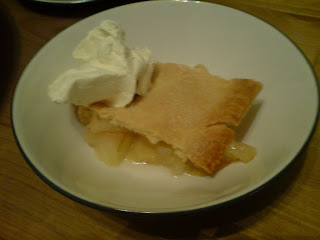
#96 Apple Pie

Oh I have been a bit slack with adding entries of late. I do apologise; I still have written about the food I made last weekend! The dessert that finished off the hare was a nice apple pie. Charlotte brought round some windfall apples so it was the obvious choice really. This is very simple to make – the apples aren’t stewed beforehand or anything and you could even buy your own pastry if you wanted. It’s an English pie, which means there’s only pastry on the top so you don’t have to faff about with blind-baking a pastry base either. It’s all good.


Start off by peeling, coring and slicing a pound of cooking apples and 8 ounces of Cox Orange Pippins. Arrange these in a pie dish, mounding it up in the centre, sprinkling sugar as you go. Try the apples before you add the sugar; you don’t want it too sweet. Roll out 8 ounces of shortcrust pastry. Cut a strip off pastry and glue it to around the edge of the dish with water. Brush this pastry with more water and press the rest of the rolled-out pastry onto it. Brush the lid with water, sprinkle with sugar and make a couple of slits in theb centre so that the steam can escape. Bake at 220ºC for 15 minutes, then lower the temperature to 190ºC for another 30 minutes. Check with a knife that the apples are soft before you take it out though. Serve with double cream.

#96 Apple Pie 7/10. I love pie! This one is super-quick and easy. I’ve had better in the past, but they also require a lot more work. This is deffo the best way if you want to make one quickly.

Thursday, October 23, 2008

#85 Caramelised Cox's Orange Pippins

I wanted to do a quick and easy dessert for when Paddy came round and didn’t really have time for baking or anything requiring too much time or effort, being the busy bee that I am. (#85) Caramelised Cox’s Orange Pippins fit the bill perfectly; a hot dessert that can be made in 5 minutes. That’s what we like.

I love Cox’s Orange Pippins; they’re my second favourite apple after the russet. You can’t beat an English apple in autumn. I don’t really buy them the rest of the year when they’re not in season and all you can buy are shipped over from France or whatever. I think they’ve had a resurgence over the last couple of years as I’ve spotted both varieties in supermarkets. If you can’t get hold of Cox’s Orange Pippins, I suppose you could use any eating apple, but these are the best eaters for cooking with.


Peel and core one apple per person top and tail them and cut into three thickish rounds. Fry the apples on a low to medium heat in butter until they start picking up a faint golden colour. Whilst that’s happening make some cinnamon sugar; one tablespoon of sugar to one teaspoon of cinnamon. I found that this was enough for two apples, but you put on whatever amount you like. When the apples are ready, sprinkle over the sugar. Keep the apples turning over every 30 seconds or so and you should magically end up with a nice sweet glaze covering them. It’s important not to have the heat too high, so be careful. Serve them immediately with a dollop of clotted cream. Piece of piss!

#85 Caramelised Cox’s Orange Pippins: 8/10. Sweet, sticky, fattening and delicious. Also, it’s one of your five fresh fruit and veg portions for the day. It’s a no-lose situation. Bravo Griggers; you’ve done it again, lady!